
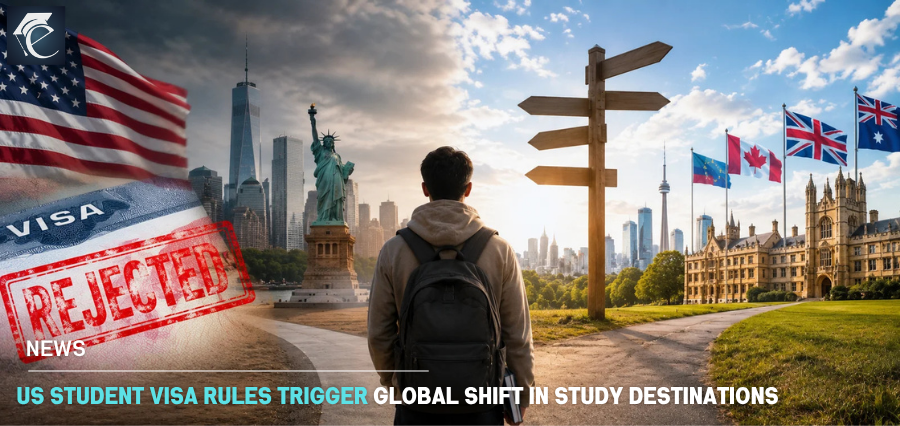
The United States has long been regarded as the world’s leading destination for international students. However, growing uncertainty surrounding immigration policies and recent visa restrictions are prompting many prospective students to reconsider their plans. According to higher education experts, the latest US student visa rules are reshaping perceptions of American universities and encouraging students to explore alternatives in countries such as Canada, Australia, Germany, and the United Kingdom.
The trend has raised concerns across the higher education sector, where international students contribute billions of dollars annually to universities and local economies
Growing Concerns Over New Visa Regulations
Changes to the student visa policy introduced by the Department of Homeland Security in the U.S. are among the most important changes made in this field recently. In accordance with the newly introduced regulations, many international students will no longer be able to use the traditional “duration of status” regime, as they will have to apply for fixed admission periods.
According to the opponents of the changes, the newly established US student visa policy is not favorable for those who plan to study for a long time or continue working after completing their education. It has been reported that universities are worried about the growing complexity of the process for talented students.
International Students Reconsider Their Options
Consultants in higher education say that many future students have widened their scope outside the US due to their interest in countries that offer better immigration laws and post-study work visas.
For years, it was not only academic prowess that made people interested in American colleges. They could find opportunities for conducting research, innovative ideas, and professional development and have access to the global labor market. Nevertheless, due to the changed laws of student visas in America, there is one more point to consider with certainty.
According to education experts, when students have concerns about visas and immigration, they prefer countries offering clear future perspectives.
Impact on Universities and Research Institutions
International students have played an essential role in the higher education environment in the United States, especially in STEM-related areas. Universities are counting on international students not just to increase revenue from tuition payments, but also to generate scholarly work.
It is feared that the new US student visa rules might affect America’s capacity to attract the best talents from around the world. Scientists and university administrators have pointed out that harsh immigration policies might negatively impact innovation, entrepreneurship, and scientific endeavors.
Some universities have already recommended international students to keep track of immigration trends and plan their trips accordingly.
Declining Visa Numbers Signal a Changing Landscape
According to recent figures, the approval of visas is being affected. It has been reported that there has been a sharp fall in the number of visas granted to applicants coming from various major source countries, such as India, one of the leading countries contributing to the number of international student admissions in the United States.
It is believed that the effect of the new US student visa rules goes beyond just the numbers of enrollments. The policies may affect the image of the US as a hospitable destination for learning and researching as other countries attract foreign students through favorable visa processes.
The Global Competition for Talent Intensifies
The controversy on US student visa rules is part of the global race for skilled students and future professionals. The governments of different countries now recognize that international education can help boost their economy and be an innovative resource. For instance, Canada, Australia, and Germany have launched various programs designed to attract foreign students by combining education with future work and residence prospects. This approach appears to be quite appealing to students who seek more stability
What Lies Ahead?
As it stands, despite the fact that there are still plenty of the best ranked universities in the world located within the USA, discussions regarding the laws concerning the visas of students from the country will not come to an end any time soon. The universities themselves, together with the policymakers and businesspeople, will be paying a lot of attention to the way the changes will influence future enrollment and competitiveness of the country in the field of education.
When it comes to the choice of universities for future students, there is no doubt that rankings will not be the only thing that will matter.