
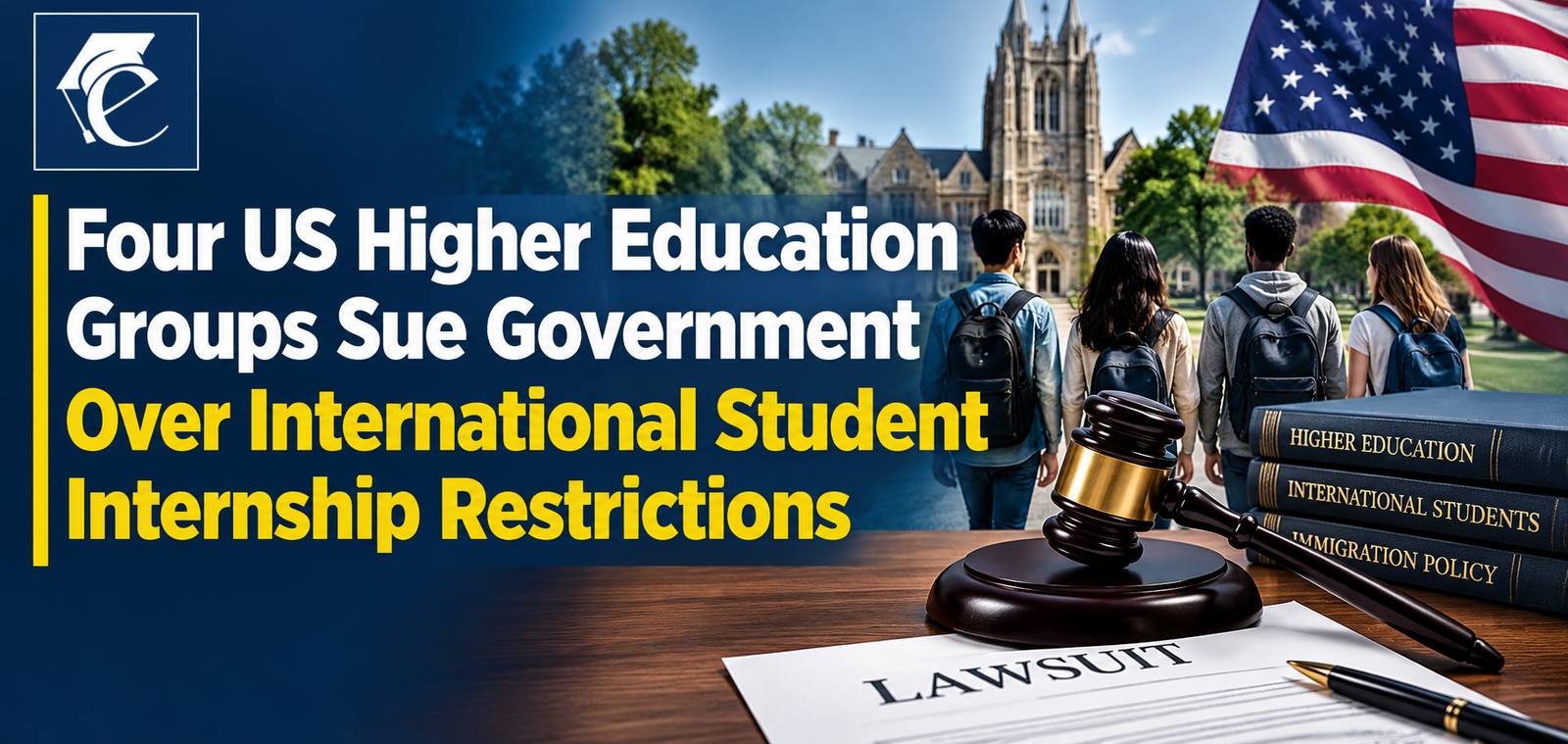
Four major US higher education organisations have filed a lawsuit against federal authorities over changes to the rules governing international student internships, raising concerns about students’ access to practical work experience during their studies.
The Association of American Universities (AAU), Presidents’ Alliance on Higher Education and Immigration, NAFSA: Association of International Educators, and the Association of Independent Colleges and Universities in Massachusetts (AICUM) filed the legal challenge on October 5, 2026. The lawsuit names US Immigration and Customs Enforcement (ICE), the Department of Homeland Security (DHS), and the Department of Justice.
At the centre of the dispute is Curricular Practical Training (CPT), a programme that allows eligible international students on F-1 visas to participate in internships, cooperative education placements and other practical training opportunities related to their academic programmes.
The associations argue that the government’s revised interpretation could significantly restrict access to international student internships, disrupting established university practices and students’ career plans.
What Has Changed Under the CPT Rules?
This legal case stems from two statements that the Student and Exchange Visitor Program of ICE released in August 2026. According to the associations, the statements created a new interpretation of the conditions of authorisation of the CPT.
Under the new interpretation, the practical training will be eligible only in cases where it is obligatory for all the students taking a certain degree course.
Earlier, universities were able to provide students with opportunities to take part in practical training as long as it was connected to the curriculum of the university and was relevant to the student’s academic program.
The new interpretation can thus negatively impact those students who take internships that give them credits or some other benefits in addition to being not obligatory for the graduation process.
The associations claim that this new interpretation contradicts with the framework that universities have been using for over 35 years now. Moreover, the government has created it without any official rule-making procedure or public consultations.
Universities Report Disruptions to Students
The policy change has already led to uncertainties among American university campuses. Some universities have been said to be halting the authorization of CPT placements due to the assessment of their responsibilities according to the new guidelines.
The outcome of this process is that students that had arranged internships way ahead of time may lose their employment chances and postpone professional growth or industry experience.
International student internships are a factor that plays a significant role in students’ decision making when selecting to study in the U.S. Internships help students to implement their theoretical skills, build up professional contacts, and learn about employment culture prior to entering the labor market.
Colleges and companies also rely on predictability of regulations for planning internship programs, recruitment, and immigration compliance.
The associations emphasize that the uncertainty around CPT might impact not just students but also academic programs, research and employers looking for international employees.
What Are the Associations Seeking?
The plaintiffs have filed a suit against the government at a federal court in Massachusetts requesting it to act to prevent the enforcement of the changes by the government.
The complaint contends that the interpretation is procedurally unsound and may result in very dire ramifications for the universities and the individuals authorised to conduct practical training.
It is also contended by the government that CPT should comply with the current regulations and that practical training is an essential component of an approved curriculum.
The lawsuit will test the legality of the administration’s interpretation and the process through which it was introduced. The court’s decision could have significant implications for how universities evaluate eligibility for international student internships.
Implications for International Students
This case contributes further to the uncertainties regarding international students’ working options in the United States. International students should consider carefully any advice provided by universities and any shifts in immigration policies.
For the time being, the solution depends entirely upon the legal process unfolding. In the absence of a court order, which would alter the status quo, students and universities have to comply with federal guidelines.
This case emphasizes the need for proper regulation of practical training programs. The solution to the case can have serious implications for international student internship programs, the practices of university compliance, and the United States’ ability to attract foreign students who are interested not only in gaining educational qualifications but also practical skills.