
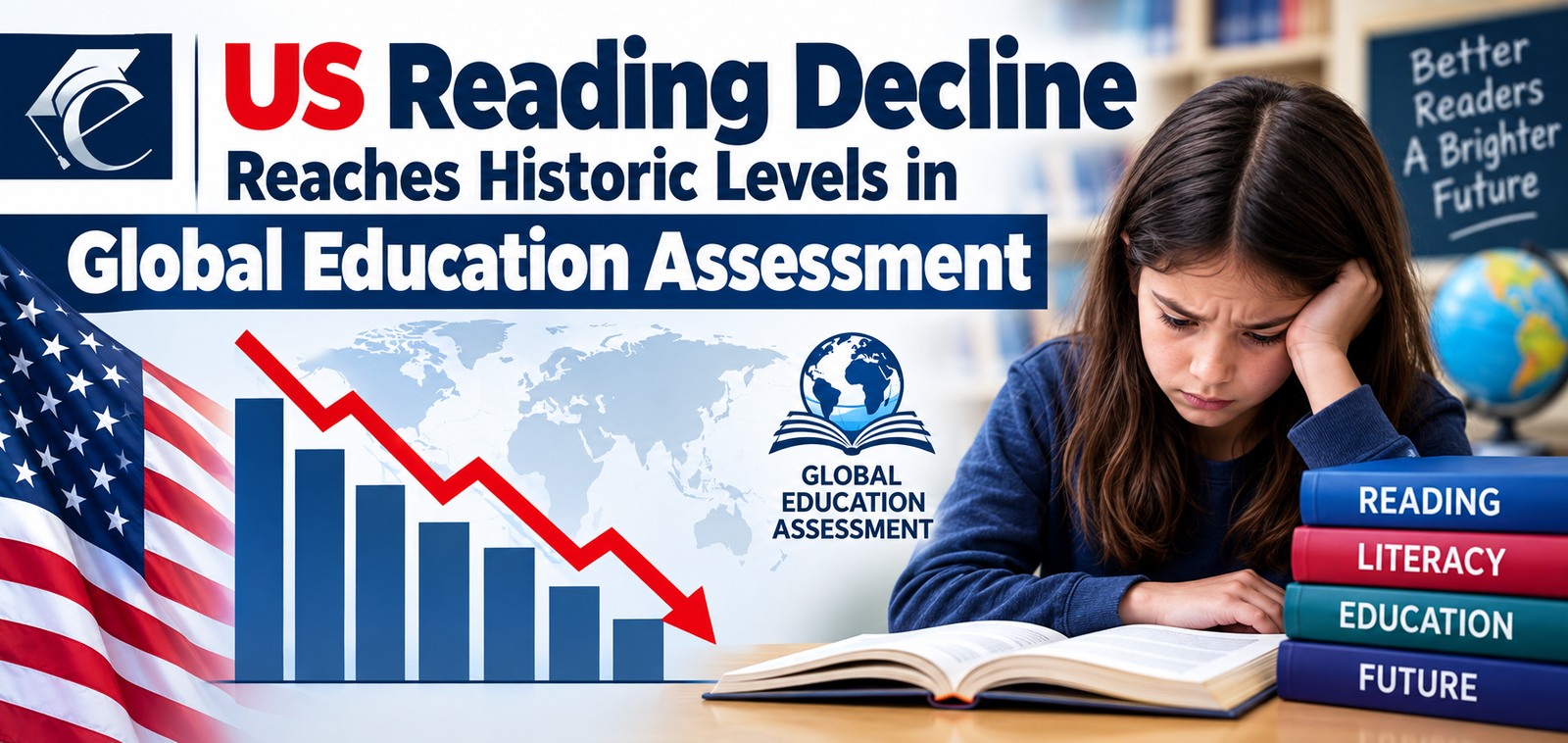
The United States is facing a growing education challenge after the latest international assessment revealed that reading performance among American students has fallen to one of its lowest levels in nearly a quarter century. The findings, published through the OECD’s 2025 Programme for International Student Assessment (PISA), place renewed attention on the impact of digital distractions, changing learning habits, and declining student engagement. The latest results suggest that the US Reading Decline is part of a broader global trend, but the deterioration in American performance has become particularly concerning for educators and policymakers.
A Historic Setback for American Students
The Program for International Student Assessment (PISA), arguably considered one of the most important assessments of educational achievement, examined more than 760,000 fifteen-year-old students in 91 countries and economies. These examinations revealed that the scores of American students in reading had gone down drastically to the lowest level in the history of PISA, which started in 2000.
In fact, the Decline in American Reading is part of a greater decline in academic achievements in both mathematics and science, but reading has proven to be one of the most worrying aspects of this decline. According to experts, reading ability provides the base for learning any subject, which makes this situation particularly alarming for the future.
These tests revealed that the current reading abilities of students corresponded to those of younger students in past years.
Screen Time Under Scrutiny
Another theme that has come out strongly in the process of analysis is the effect of digital technology on student learning.
As mentioned by the OECD authorities, increased exposure to the screen and less reading for pleasure has led to poor literacy results. It was found out that a lot of students now tend to skim through digital content, failing to practice deep reading and critical thinking.
The US Reading Decline has happened against the backdrop of the era when smartphones, social networks, and short pieces of digital content became the main source of information for teenagers. The educational experts claim that although technology presents great learning chances, its excessive use can change attention spans and approaches to studying.
It was mentioned by the OECD that those students who spent more than five hours a day working with digital devices tended to achieve worse academic results compared to their classmates.
The Role of AI and Changing Learning Habits
The other critical issue raised by scholars is the increasing use of artificial intelligence in educational institutions.
Although AI technologies can facilitate learning if used effectively, the abuse of chatbots and automated help is likely to hinder the development of problem-solving and reading comprehension abilities. The report on PISA analyzed the issue of education in the era of AI and revealed that the over-reliance on technological help often correlated with poor academic performance.
In the context of US Reading Decline, there is an ongoing discussion about how technology can be integrated into schools without undermining basic literacy skills. Many specialists emphasize that in addition to searching for information, it is necessary to learn how to analyze and interpret it.
Parental Engagement Emerges as a Key Factor
In addition to technological problems, the researchers identified one more significant reason for poor educational performance of students, the absence of parental involvement.
A supplementary survey showed that the level of parental involvement in children’s education has fallen in a number of countries. Children who felt more family support demonstrated higher results in their studies, especially in science subjects and literacy-based disciplines.
Thus, the problem of The US Reading Decline became a matter not only of the classroom but also of the surrounding environment that is capable of developing the habit of reading.
Global Leaders Pull Ahead
The most recent rankings also pointed out the increasing disparity between some of the best-performing education systems globally and those which are underperforming.
Education systems from East Asia, like Singapore, Japan, South Korea, Taiwan, and parts of China, continue to perform at the very top in reading, math, and science subjects. Their excellence has brought debates around the quality of their curriculum, teachers’ support, classroom discipline, and effective technology utilization into the spotlight.
With the issue of US Reading Decline becoming more topical, policy makers may start considering the experience of such education systems to address the problem.
Looking Ahead
The current assessment acts as a caution to the fact that literacy is becoming a worldwide problem, but the country with an immediate need to respond to this problem is the US. Apart from having low reading test results, it also affects other areas of students’ performance such as their workforce, thinking, and economic competitiveness.
In order to tackle the US Reading Decline, there will have to be a need to implement programs for improving literacy skills, balance in the use of technologies, parent involvement, and reading for pleasure again. In assessing the results of the assessment, the main message is evident.