
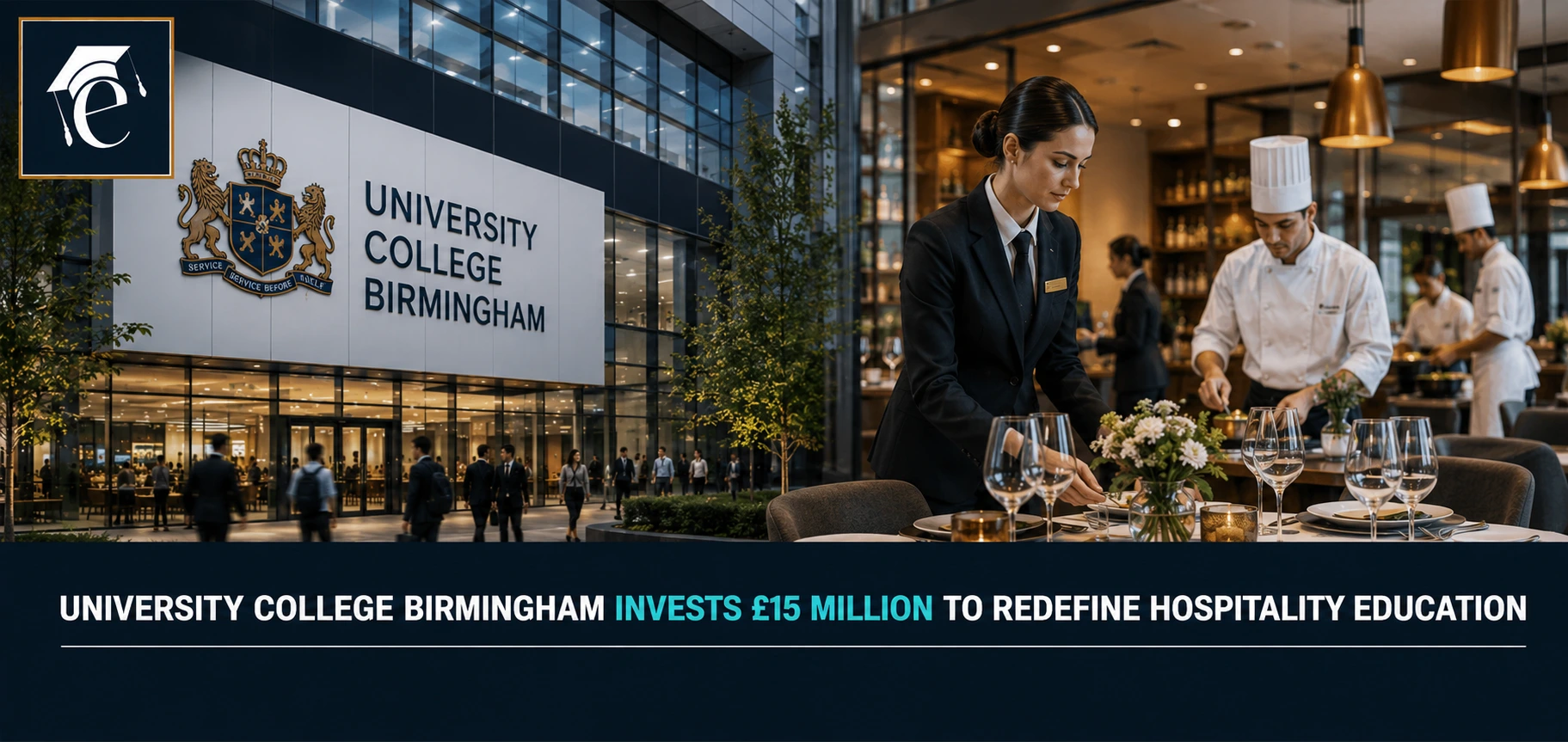
University College Birmingham (UCB) has unveiled a £15 million hospitality investment programme aimed at transforming hospitality education by combining academic learning with live commercial operations. The initiative, known as the University College Birmingham hospitality expansion, is expected to create more than 150 jobs while giving students paid employment, apprenticeships, placements, and practical experience in real hospitality businesses.
The investment reflects a growing emphasis across UK higher education on improving graduate employability by providing students with meaningful workplace experience before they enter the job market.
Acquisition of Landmark Birmingham Venue
The first phase of the University College Birmingham hospitality expansion begins with the acquisition of the former The Cube Hotel and the Marco Pierre White Steakhouse Bar & Grill Birmingham. The landmark property will be redeveloped into a 52-bedroom hotel and restaurant, operating as a fully commercial business while serving as a practical learning environment for students.
The project should be initiated within the next three to four months. Upon its completion, the students who have been studying hospitality, culinary arts, business, and events management will get practical exposure through their interactions with professionals from the industry.
Expanding Hospitality Across Birmingham
The University College Birmingham hospitality expansion extends beyond the acquisition of The Cube. The university also plans to open a neighbourhood restaurant in Harborne, establish a café, restaurant, and bar at its Summer Row campus, and refurbish the existing Restaurant at Birmingham College of Food.
The combined effect of all these locations is that over 150 hospitality jobs will be created, with both experienced staff and students benefitting in terms of employment. The commercial projects are aimed at providing a link between the educational aspect and reality of the industry.
Strengthening Graduate Employability
A key objective of the University College Birmingham hospitality expansion is to improve graduate readiness by integrating work-based learning directly into academic programmes.
Michael Harkin, the Vice-Chancellor and Principal of University College Birmingham, has stated that this investment marks the start of an exciting new era for the college. The venture will equip students with the necessary skills, confidence, and practical experience that employers are increasingly looking for, and also help the city of Birmingham’s hospitality industry through employment.
The move has been praised by industry experts who state that potential students are increasingly interested in those universities that offer both quality academics and practical experience.
Supporting Birmingham’s Hospitality Sector
Apart from education, the University College Birmingham hospitality expansion is expected to boost Birmingham’s hospitality and tourism economy. This will be achieved by establishing new business premises, recruiting seasoned professionals, and involving alumni in the operation and mentorship of students. The goal of the university is to increase the status of Birmingham as a center for hospitality, culinary, and tourism studies.
This will also add to the legacy of UCB in the field of hospitality through its establishment of the Birmingham College of Food, which has brought up many Michelin-starred chefs and hospitality professionals in the past. It is hoped that many alumni will come back and teach the coming generations.
Part of a Broader Investment Strategy
This hospitality initiative is part of the overall investment that the University College Birmingham has made into their campuses as well as the local community. The University has claimed that in the last five years, an investment worth more than £300 million has been made in order to improve learning environments.
Hiring is underway for hospitality specialists to oversee the operations at these new sites.
Outlook
University College Birmingham hospitality expansion is a move away from the traditional way of teaching hospitality by placing the learners in actual commercial settings. In a bid to enhance graduate employability, institutions are coming up with new strategies to combine the theoretical aspect with practical one, which may eventually define the future of higher education.
By setting up commercial hospitality facilities, creating job opportunities for learners, and fostering links with industry practitioners, the University College Birmingham is poised to prepare its learners for an increasingly competitive hospitality industry.