

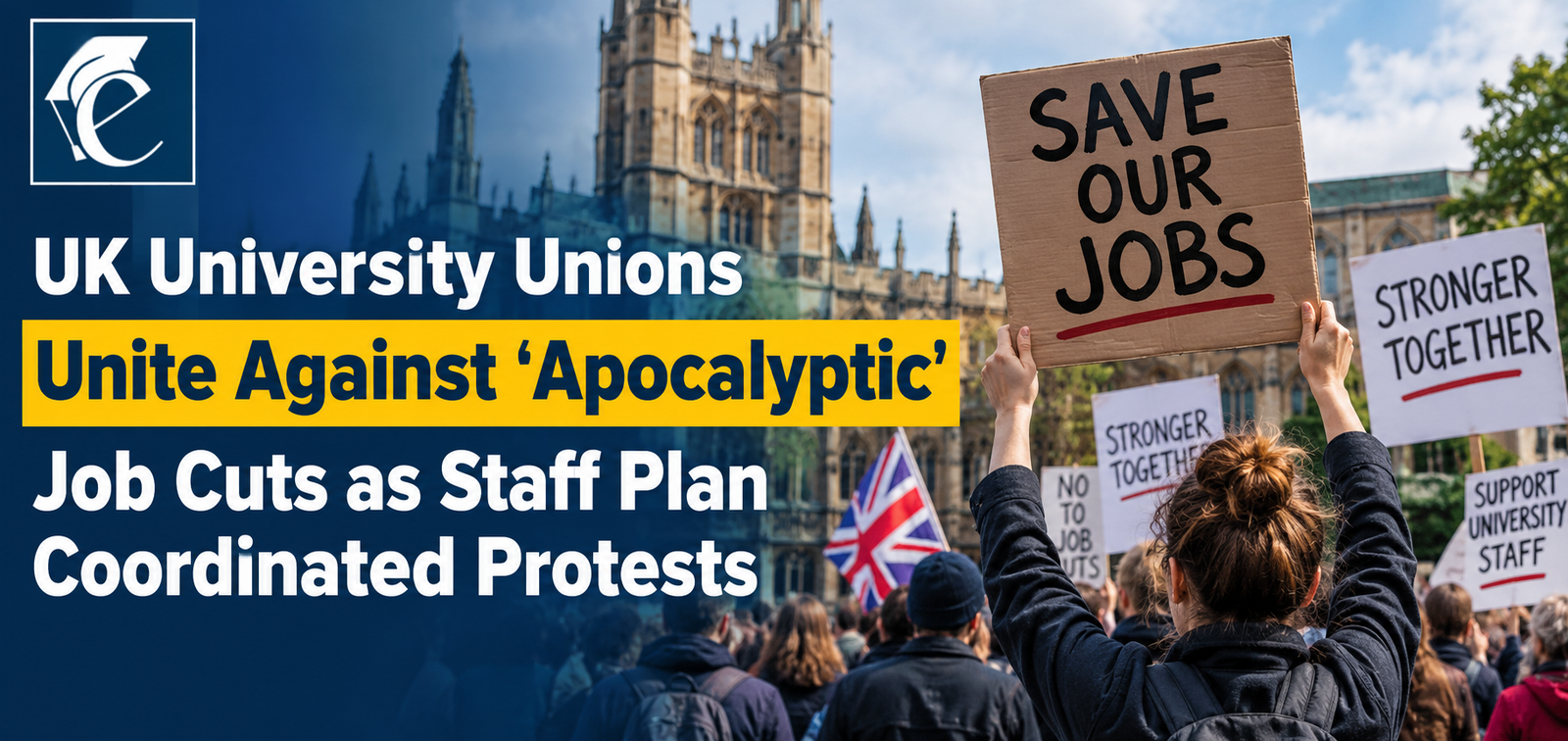
University and College Union (UCU) branches across the United Kingdom are joining forces to challenge widespread redundancies and restructuring across the higher education sector. The newly formed Save HE Committee, comprising more than 15 university union branches, aims to coordinate resistance against what members describe as an escalating crisis threatening jobs, academic programmes and institutional stability.
The coalition includes staff representatives from universities experiencing significant financial pressures, including Goldsmiths, University of London, and the universities of Essex and Nottingham. Its formation follows a summer marked by substantial job-cut announcements across British universities. The campaign against UK university job cuts seeks to ensure that individual institutions are not left to confront redundancies in isolation.
The group has published a manifesto for higher education and scheduled a day of action for October 27, one day before the government’s Budget announcement. Organisers hope the demonstrations will draw attention to the financial difficulties facing universities and the consequences for staff and students. The UCU is also preparing a separate national day of action for November 20.
Pre-Budget Demonstrations Planned Across Campuses
These include university-based demonstrations, and some will even carry out funeral processions symbolizing the consequences of restructuring plans. Nottingham and Goldsmiths branches will dress up as ghosts, ghouls and skeletons symbolizing, according to organizers, the nightmare of the higher education sector.
Other participating organizations include Glasgow, Greenwich, London South Bank, Warwick, Newcastle, London Metropolitan University and University College London. The coalition will involve UCU and Unison branches.
This coalition campaign against UK university job cuts will prove that the challenges being faced by universities are all interconnected and not problems for individual universities. It is believed that a coordinated effort will give more weight to the voice of the staff and will put strong pressure on university management and policymakers.
This timing of the campaign is important since it is before the announcement of the budget by the government. This Budget statement is expected by participating staff to address financial concerns of the universities. But the campaigners have fears that this Budget statement may not sufficiently help universities with budget deficit problems.
Union Members Criticise National Leadership
According to Des Freedman from Goldsmiths UCU, who was in charge of developing the coalition’s manifesto, the idea was born out of frustration over what was perceived as an inadequate response on the part of the country in relation to the extent of redundancies declared in the summer.
While praising the central trade union’s decision to declare a national protest on the 20th of November, Freedman insisted that local branches were forced to organize their own protests in the meantime.
Co-chairwoman of the Greenwich UCU branch and one of the manifesto writers, Ruth Ballardie, also pointed out the frustration felt by her members in regard to their isolation amid dealing with the redundancies at their respective universities.
The criticism reflects a wider concern that UK university job cuts require a coordinated national strategy rather than separate campaigns led by individual campuses.
Manifesto Calls for Collective Action
According to the Save HE manifesto, the crisis of higher education is a result of politics and economics, but not an inevitable reality. This means more collaboration and coordination in order to safeguard jobs, courses, and academic provision.
Andreas Bieler, vice-president of Nottingham UCU, claims that the coordination of actions will prove the relation between the financial problems of various universities and help to expand the campaign beyond the institutional context.
The Save HE coalition also plans to expand their campaign after the events of October 27 and arrange a convention where their manifesto will be promoted and where a larger movement will be built.
The organizers think that the mobilization of the group can bring tangible benefits for the staff who are about to lose their jobs and build a platform to fight against the restructuring of the institution. The Save HE campaign which is focused on the UK university job cuts tries to create a cooperative movement of branches, not just one-day demonstrations.
UCU Announces Nationwide Protest in November
In reply to the accusation, the general secretary of the UCU, Jo Grady, welcomed the mobilization effort by the grassroots movement, calling it a “positive step” towards tackling the crisis. The November 20 national day of action, she explained, would see branches coming together to protest against redundancy, course closures, and the pressure put on higher education.
The opposition to UK university job cuts in the UK will thus not be confined to demonstrations prior to the Budget statement. As the unions demand more of a response from the institutions and the government, the coming weeks may be crucial in terms of how they plan their approach.
The issue for universities goes beyond staffing to that of academic provision, working conditions, and the sustainability of higher education. How the demonstrations translate into policy changes is yet to be seen, but the alliance represents a step up in the determination of university workers to act collectively.