

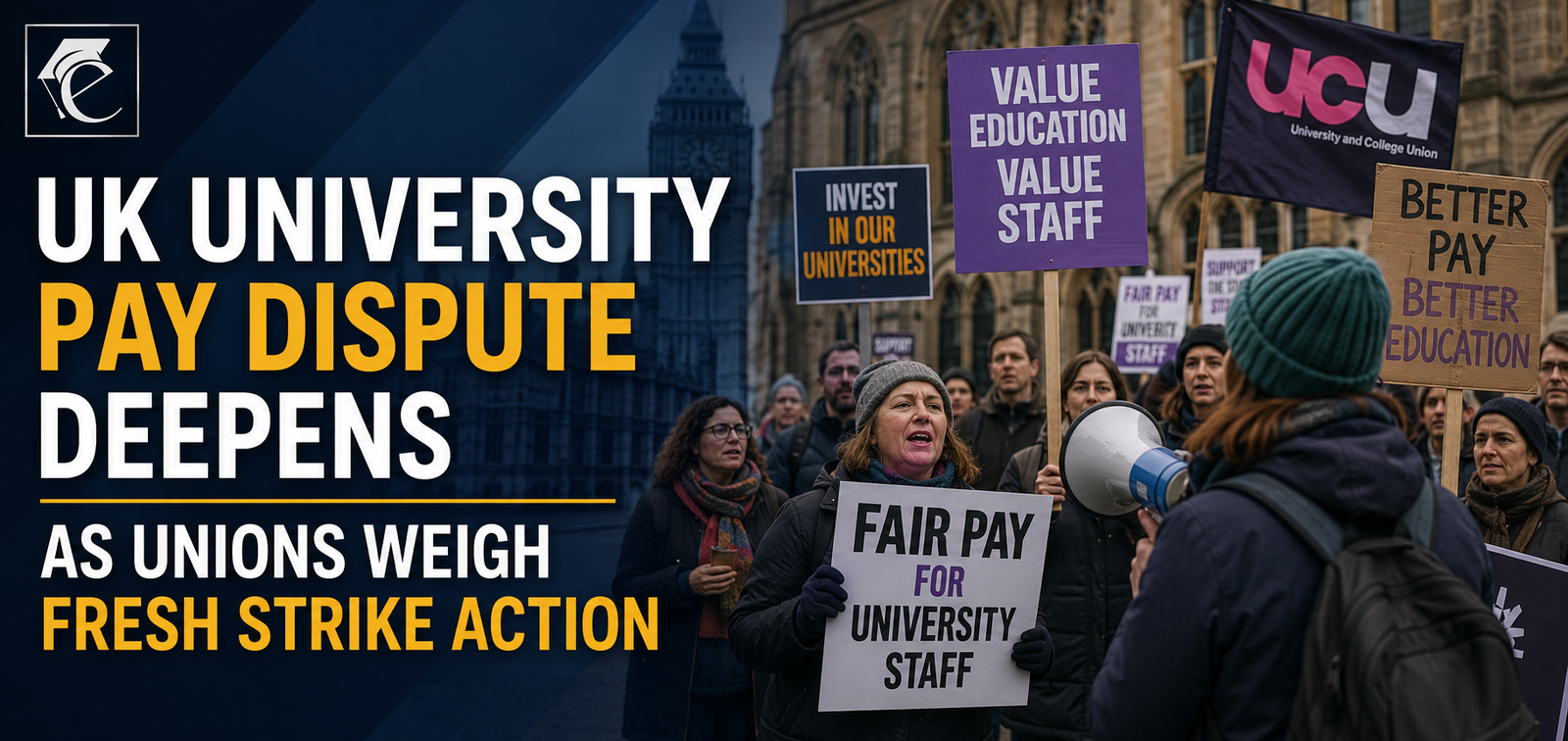
Thousands of university employees across the United Kingdom may have to wait longer for their annual salary increases as negotiations between employers and trade unions remain unresolved. The ongoing UK university pay dispute has created uncertainty for academic and professional staff, with unions now considering industrial action after rejecting the latest pay offer from university employers.
The Universities and Colleges Employers Association (UCEA), which represents higher education institutions in national pay negotiations, has stated that it cannot implement the proposed pay award until unions formally clarify whether they intend to enter a dispute process. As a result, salary increases that would normally take effect at the start of the academic year have been placed on hold.
Why the Dispute Has Emerged
The crux of the issue in UK university pay dispute lies in the amount of pay increase for the 2026-27 academic year. The university employers first made an offer of a 1.5% pay increase, which they later increased to 1.8% for many staff grades, with 2% for some lower-paid staff members. Nonetheless, some major trade unions representing the university staff have turned down the offer because they claim that it does not match the increases in the cost of living.
There are three key unions that are dissatisfied with the offer, namely UNISON, Unite, and the University and College Union (UCU). Union officials have indicated that the staff members of universities have been under persistent salary pressure for a decade and hence require a bigger pay increase.
The disagreement has transformed what began as a routine annual negotiation into a significant UK university pay dispute with potential consequences for students and institutions alike.
Strike Action Back on the Agenda
Industrial unrest threatens to strike Britain’s higher education sector once again. Union leaders are consulting their members regarding possible courses of action which can include strike ballots paving the way for walkouts in the latter part of the year.
It was noted by Unite that close to 90% of those who participated rejected the current offer and that there is a majority who would support industrial action should negotiations not produce a more favorable deal. These feelings are echoed by other unions negotiating with the university management.
Should there be strikes, the activities that may be affected are the teaching process, assessment period, administrative work, and student support programs conducted by universities in the UK. The threat of industrial unrest is important considering the past instances of massive strikes in the sector.
Financial Pressures Facing Universities
The management in universities claims that there are serious financial restrictions. Universities face issues like falling numbers of foreign students, increasing cost of operations, inflation and concerns regarding the financial sustainability in the future.
The employers claim that providing substantial pay increments would be hard in a time when many organizations are trying to reduce costs and examine budgets. There are some universities which have already announced restructuring programs and budget cuts.
This financial reality has complicated efforts to resolve the UK university pay dispute, with both sides insisting that their positions are justified by current economic conditions.
Impact on Staff and Students
Failure to increase salaries has caused disappointment amongst university workers who had been expecting salary increments starting from August. Most of the universities have advised their staff members that once there is a negotiated increment, it will apply backdated to when negotiations were made, but uncertainty is still affecting the workforce’s mood.
Students have not been left out. In previous strikes, students have lost lectures, assessment periods, and marking time due to the strikes. So far, no national strike has been called, but this is still possible.
What Happens Next?
Now, the fate of the UK university pay dispute is in large part determined by whether the sides involved would be able to start negotiating with each other. According to UCEA, the talks continue, but the trade unions are currently consulting their members about the possibility of carrying out any industrial action.
Negotiation might help universities raise salaries and save from disruption in the new academic year. Nevertheless, failure in the talks will lead to strikes that will affect all parties involved. Now, the UK university pay dispute is one of the most important labour problems in British higher education and will have significant influence in the years ahead.