
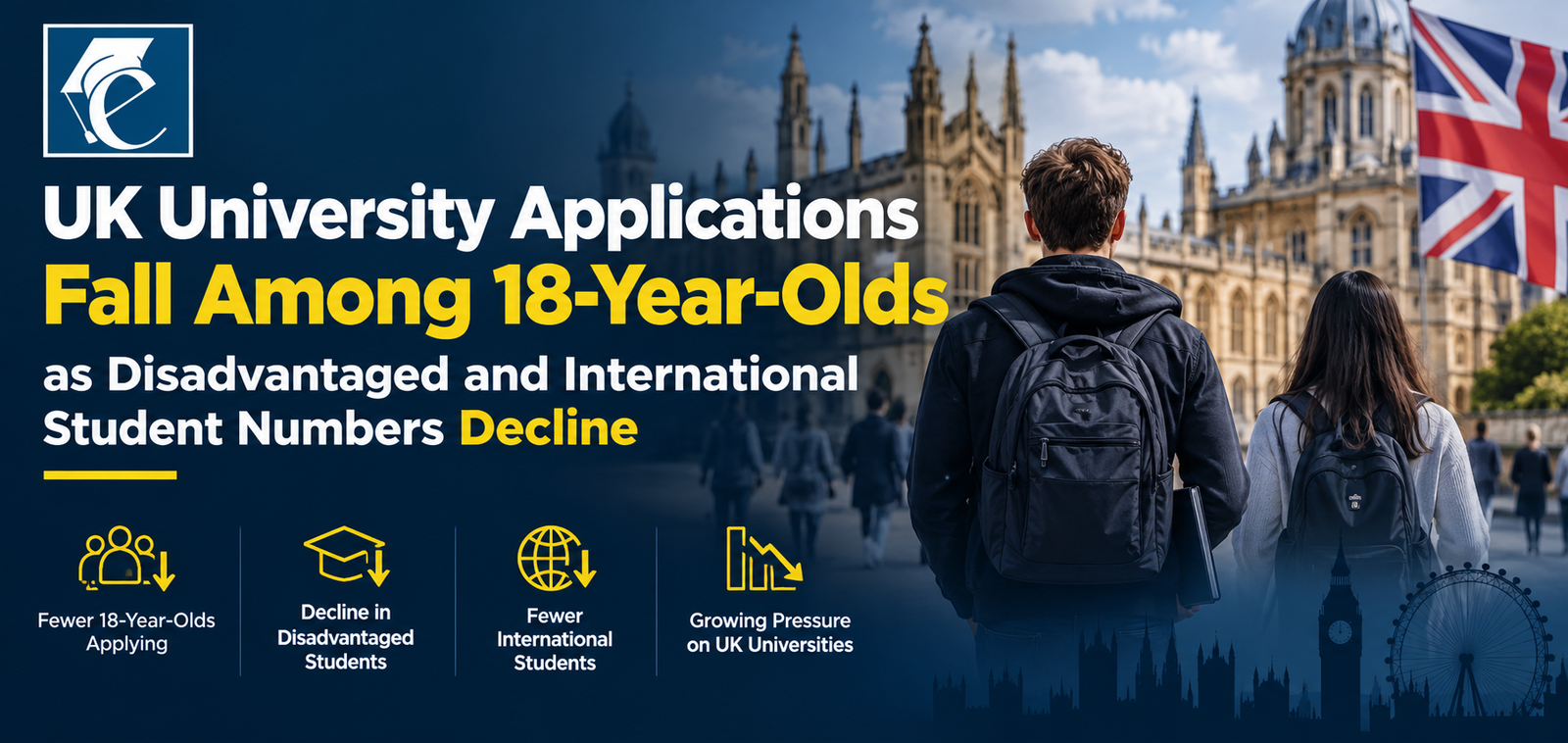
Applications to some of the United Kingdom’s most competitive university courses have fallen among 18-year-olds, raising concerns about future enrolment levels and access to higher education. According to figures released by the Universities and Colleges Admissions Service (UCAS) on October 29, 2026, the number of school-leavers applying before the early October deadline declined by 4.9% compared with the previous year.
A total of 39,020 18-year-olds applied for courses with an October 15 deadline, down from 41,010 in 2025. These applications include programmes in medicine and veterinary science, as well as courses at the universities of Oxford and Cambridge.
The decline in UK university applications 2027 comes after record numbers of students secured university places during the latest admissions cycle. The figures raise questions about whether recent growth in higher education participation can be sustained as demographic and financial pressures affect prospective students and universities.
Overall Applicant Numbers Fall Despite Growth Among Older Students
The fall in the numbers of 18-year-old applicants was partially balanced by the increase in the number of applications from older candidates. In total, there were 6,880 applicants aged 19 registered on UCAS, which means an increase of 16% compared to last year.
There has been an increase in the number of applicants aged 30+, indicating that some potential students are thinking about university at a different stage in life. According to Jo Saxton, the CEO of UCAS, the increase in the number of 19-year-old applicants may indicate their wish to give themselves more time to consider their educational and career options.
Still, it is not enough to offset the decrease in the number of school leavers. Applications for courses with an early deadline fell by 3% overall.
This trend might be of interest to universities that rely predominantly on school-leaver applicants. Universities will be watching further application deadlines to see if it indicates a general decrease in demand.
Disadvantaged Students Face Declining Representation
One of the biggest issues that has come out of the latest figures is the decline in applications from students who come from the most disadvantaged backgrounds.
Applications from under-represented groups dropped by 2% in the United Kingdom overall. While there were drops in applications from the most disadvantaged groups in England, Scotland and Wales, there was a rise in Northern Ireland.
The figures highlight once again the challenges that are financial and social in nature and which may affect people’s decisions in relation to attending university. The costs of tuition, living expenses and doubt regarding whether a university education is worthwhile financially all play a part in people making decisions in relation to education.
Saxton pointed out that the drop in applications from disadvantaged groups was especially worrying, highlighting the need for students to feel confident enough to take up opportunities that suit them.
International Applications Decline Amid Immigration Concerns
The UK university applications 2027 figures also highlight weakening demand from international students. UCAS recorded a 7.3% decline in international undergraduate applicants using its service between 2025 and 2026.
While China continued to be the largest international source market with 5,230 applications, there was a decrease of 520 compared to last year. Applications from the USA dropped by 16.4%, which is equal to 350 fewer applicants, and there was a drop of 7.2% in Singapore. There was also a decrease in applications from Hong Kong.
The data comes as UK universities face changes in immigration policies and fears of visa refusal. International students provide much-needed income through their tuition fees, making the decrease a cause of concern for these universities.
Nevertheless, the UCAS data provides information on those who applied using the admissions service; hence, it does not cover the whole overseas applicant pool.
Medicine Applications Remain Relatively Stable
In contrast to the general trend, there was a slight rise in the number of those applying to study medicine. In the UCAS figures, there were 25,840 applications of all ages and nationalities for medicine, compared with 25,770 in the previous year, showing a rise of about 0.3%.
It can be seen that unlike the general trend, applications for medicine have been relatively stable.
However, the number of applications is just a first indication of enrollments. The deadline for equal consideration in January will give us a clearer idea.
Outlook for UK Higher Education
These numbers from the latest UK university applications 2027 provide early signs of the issues that may be encountered by the UK higher education system.
Universities have to deal with shifting preferences of their applicants, reduction of enrolment of certain underprivileged groups and lower interest from a number of international markets.
Growing demographic pressures may also turn into an issue as the number of young people leaving schools is set to shift towards the end of the decade.
Given that the October figures do not give enough evidence of whether the UK higher education sector will face a decline in its performance, this highlights the need to watch participation trends.