
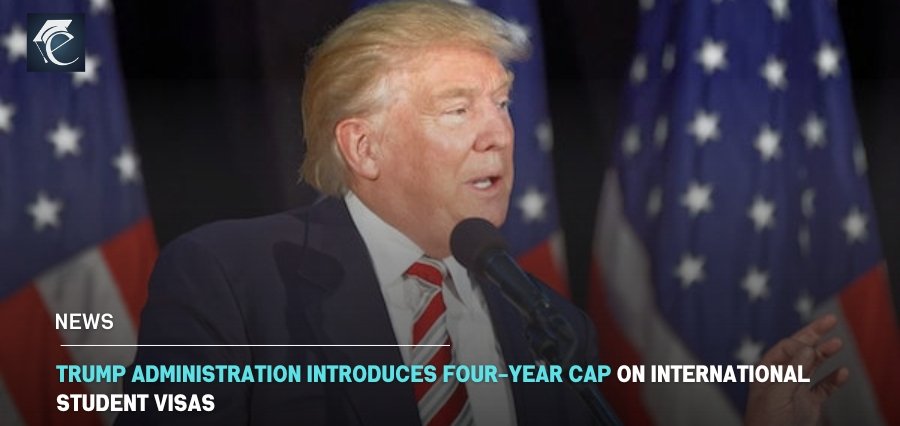
The Trump administration has announced a sweeping overhaul of the United States’ student visa system by imposing a four-year limit on the stay of most international students. The new US Student Visa Rule replaces the long-standing “duration of status” policy, under which students could remain in the country for the entire length of their academic programme as long as they maintained their visa status. The regulation is expected to take effect later this year, subject to the required review process, and has sparked widespread concern among universities, educators, and international students.
Four-Year Limit Replaces Existing Policy
Over the past few decades, international students enrolled on F-1 visas within the USA had the privilege of staying until the end of their study program, including any practical training period after their coursework. According to the new rule concerning US student visas, students will be allowed to stay in the country for the first four years. However, those who take longer programs like Ph.D. degrees will have to get an extension to their visas.
Additional Restrictions for International Students
The updated policy not only entails placing a restriction of time. The US Student Visa rule also imposes stringent requirements for those who wish to change the program of study or even transfer schools. Also, the grace period following the completion of studies has been reduced to 30 days from 60 days. This limits the time that is allowed for graduates before leaving the country or switching to another type of visa.
Administration Cites Security and Oversight
However, the Department of Homeland Security has provided some justification for its actions, stating that the previous system of ‘duration of status’ had a few loopholes, which made it hard to monitor the visa holders. The US Student Visa Rule, according to the administration, seeks to curb the cases of visa overstays and fraud and increase the security of the country through set timelines.
It was also stated that there has been an increased number of students admitted from international countries.
Universities Express Concern
The institutions of higher learning and educational bodies have shown strong resistance to the proposed policy. The leaders of university administrations point out that the US Student Visa Policy will add an additional paperwork burden to those students who are enrolled in long-term educational programs in the STEM areas.
The specialists in the field of education say that making the students apply for renewal of the visa status while studying will cause uncertainty, will not encourage talented individuals to apply for courses in American universities, and will influence research programs which rely greatly on international academics.
Potential Impact on International Students
What This Means for Schools
On behalf of schools and districts, the US education grants 2026 cycle provides an opportunity to receive funding, which will assist in the advancement of teachers, literacy enhancement, and career-oriented education programs.
The current release may just be the initial part of a larger federal education funding initiative, with more grant opportunities likely to be announced later this spring and summer.
Those institutions that match proposals to student achievement, teacher performance, and workforce-related outcomes might be more likely to gain funding.
Conclusion
The introduction of the US education grants 2026 cycle is an important move towards redefining federal education priorities.
The initiative is indicative of a shifting perspective on education as a means to both academic success and economic development, with a greater emphasis on the quality of the teachers, literacy and workforce readiness.
With the introduction of additional funding programmes in the near future, schools around the country will be keeping an eye on the emergence of new opportunities.
The introduction of the US education grants 2026 cycle is an important move towards redefining federal education priorities.
The initiative is indicative of a shifting perspective on education as a means to both academic success and economic development, with a greater emphasis on the quality of the teachers, literacy and workforce readiness.
With the introduction of additional funding programmes in the near future, schools around the country will be keeping an eye on the emergence of new opportunities.
Also Read :- Education Excellence Magazine for More information