
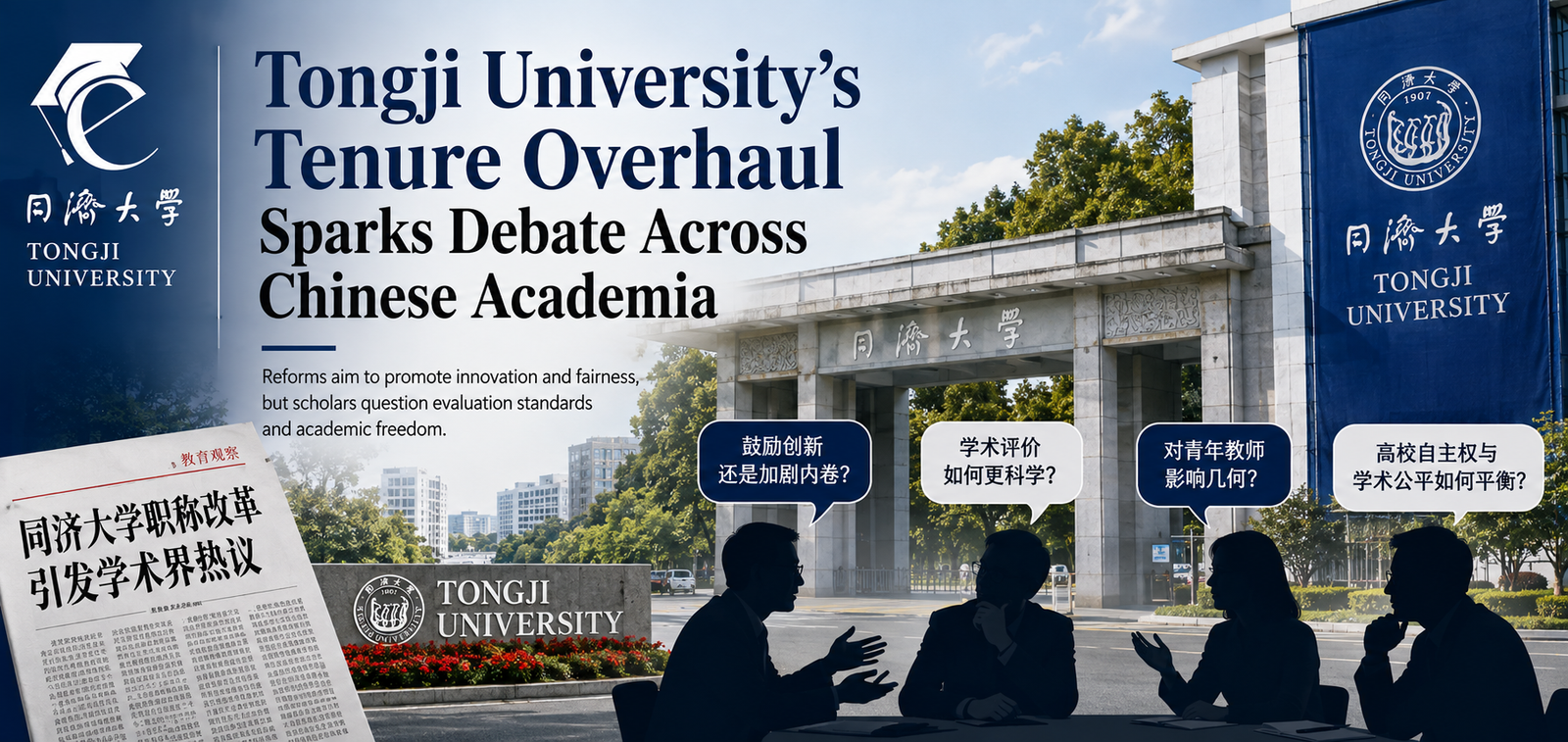
One of China’s leading research institutions has ignited a nationwide debate after announcing sweeping changes to its faculty employment system, a move that many scholars believe could reshape the future of Chinese academic tenure. Shanghai-based Tongji University has decided to abolish traditional tenure protections and replace them with a system of periodic performance assessments for all faculty members.
The decision has drawn strong reactions from academics both within China and internationally, with some describing it as a landmark moment for the country’s higher education sector. Given Tongji University’s status as one of China’s elite “Double First Class” universities, experts believe the policy could influence employment practices across other major institutions.
What the New Policy Means
As per the new policy, the faculty at universities in China would not be able to benefit from the traditional Chinese academic tenure enjoyed by faculty members earlier in the country’s academic institutions. In the terms mentioned in the official notice from the universities, faculty without tenure will be evaluated every three years, and for those having tenure earlier, comprehensive reviews will be conducted every six years, along with interim reviews every three years.
If faculty members do not live up to the performance standards, then there may be various consequences, including salary cuts, demotion, or termination of their service from universities. The new policy marks a clear departure from the concept of job security for academics in China.
Why Tongji’s Move Matters
Dating back to 1907 and considered among the most reputable universities in China, Tongji University holds a high position in the higher education system of the country. As a part of the government’s initiative to develop top universities of the government, its policies have drawn much interest beyond the campus in Shanghai.
According to specialists, this move can become a test case for the reform of Chinese academic tenure. If the system turns out to be successful in the eyes of policymakers and university authorities, then it will be adopted in other universities.
Professor of higher education from the Universities of Bristol and Oxford, Simon Marginson, called this event an “earthquake in Chinese academia.”
Supporters Cite Accountability and Performance
Those who support this reform explain that universities should be competitive on the international level and that the evaluation process will allow maintaining high quality. The top universities in China have been working for many years on increasing their rankings, production, and innovation.
The supporters assume that stricter evaluation will inspire professors to produce throughout their careers, without using the fact that they have job security after getting tenure. This reform correlates with other tendencies in the development of Chinese higher education, which is becoming results-based.
For some university managers, such a change is associated with modern approaches to managing talents.
Critics Warn of Risks to Academic Freedom
Not all people share the belief that the reforms will enhance university life. The opponents believe that relaxing Chinese academic tenure could threaten the freedom of academia and reduce innovation due to risky research.
Tenure is perceived by many people as something more than just security. Traditionally, tenure is seen as protection from any kind of pressure from the institution or from politics; thus, the academics would be able to explore controversial or even unconventional theories.
According to Marginson, the elimination of the guarantee of tenure could reduce the attractiveness of becoming an academic for talented researchers. The other experts state that performance appraisal might increase stress among academics who work in a very competitive sphere.
A Turning Point for Chinese Higher Education
The issue of Chinese academic tenure, in other words, is just one of many debates that the international community of universities is currently facing: the question of how to reconcile responsibility and independence of thought. While universities strive for efficiency and competitiveness, academics insist on the necessity of security and freedom to conduct research.
It is yet unclear whether the Tongji experience will remain an individual case or the start of a larger change. Nevertheless, the decision of the university has already unleashed one of the most vivid discussions concerning the employment of academics in China over recent years.