
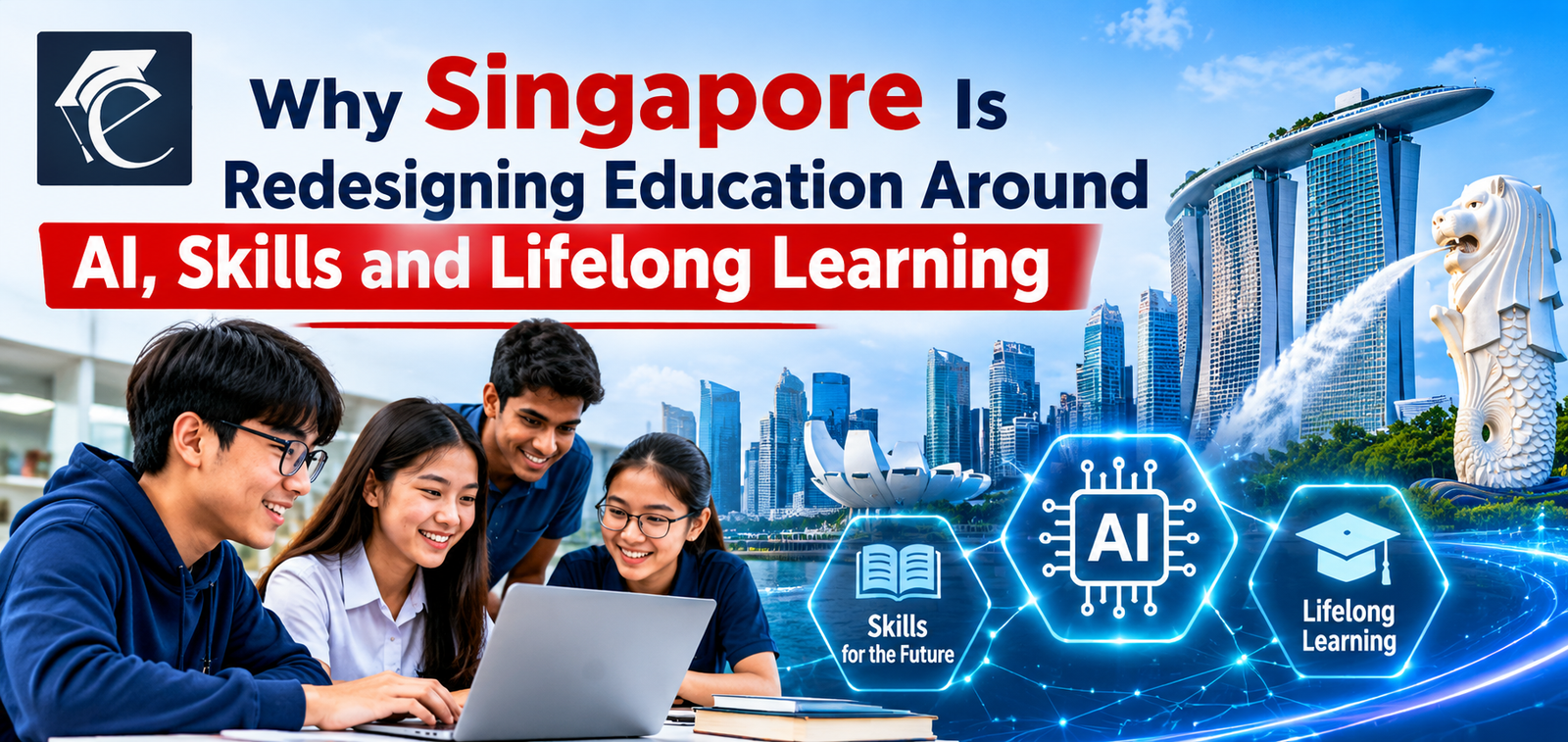
Singapore’s schools were already among the most admired in the world. The country topped the 2022 PISA tables in maths, reading and science, so nobody would have blamed it for standing still. It didn’t. How Singapore is transforming its education system for the future comes down to three moves made at once: ending streaming, bringing AI into classrooms with guardrails, and paying adults to keep learning. The Singapore education system is betting that a good start in school will not carry anyone through a forty-year career.
Why now
Economic strategy explains the timing. One review described Budget 2026 as arguably the country’s most AI-focused budget to date, treating AI as a core economic strategy. The same review noted the creation of a National AI Council. For a country with no natural resources, people are the product, and Education Minister Desmond Lee has said workers will need practical AI skills, from basic literacy to building new AI solutions. Schools, polytechnics and universities are being asked to supply that whole range, which is why the changes in classrooms and in adult learning are arriving together.
Streaming ends, subject levels begin
The structural change is Full Subject-Based Banding. From the 2024 Secondary 1 cohort, the decades-long practice of streaming was scrapped entirely. The first cohort will sit the Singapore-Cambridge Secondary Education Certificate in 2027, which replaces the separate N- and O-Level examinations. Students take each subject at G1, G2 or G3 level according to their strengths, instead of being placed in one stream for everything.
This is the heart of Singapore education reform, and it is as much cultural as technical. The ministry said it wanted a differentiated curriculum while minimising labelling and the stigma that came with streaming. Admissions are adjusting too: from 2026, the fourth content-based subject counts for university admission only if it improves a candidate’s score. Removing a label is easy to announce. Changing how parents, employers and teenagers think about a “G2 student” will take a decade.
AI arrives in the classroom, with guardrails
AI education in Singapore is being introduced in stages, not switched on. The ministry’s framework has four strands: learn about AI, learn to use AI, learn with AI and learn beyond AI. The tools pupils use are MOE-developed rather than general-purpose, accessed through the Singapore Student Learning Space.
Age matters. Mr Lee told Parliament that Primary 4 pupils have the executive functioning skills to begin using educational AI tools under supervision, while Primary 1 to 3 prioritises physical, hands-on learning. Where a task is meant to test independent mastery, students complete it without AI assistance.
The ministry is also candid about what it doesn’t know. In February 2026 it said it had no Singapore data linking student AI use to declining cognitive skills, and was conducting studies. We like that honesty, and more education systems should copy it. Higher education is moving faster: a new committee chaired by Mr Lee will guide AI adoption across universities, polytechnics and the Institute of Technical Education, and baseline AI competency modules are reported to become compulsory across those institutions by 2027.
Adults are now part of the system
The bigger shift is that the Singapore education system no longer ends at graduation. More than 600,000 people attended MOE and SkillsFuture Singapore-supported training in 2025, up from 370,000 in 2015. For many workers, lifelong learning Singapore style starts with a credit, not a classroom.
The SkillsFuture Level-Up Programme, launched in 2024, offers people aged 40 and above a $4,000 credit top-up usable on about 7,500 courses, plus a training allowance of up to $3,000 a month for full-time study. More than 60,000 Singaporeans in that age group had benefited by February 2026, and Budget 2026 extended the programme to reach more people.
AI is now the priority subject. Around 1,600 AI-related courses are supported by SkillsFuture Singapore, and more than 105,000 people took up 137,000 places last year. In March, the manpower ministry said people taking selected AI courses would get six months of free access to premium AI tools. Singapore skills development is reaching employers too: firms with at least three resident employees get a fresh $10,000 credit, and a new grant covers up to 90% of reskilling costs and 70% of job redesign. Delivery is being tidied as well, since SkillsFuture Singapore and Workforce Singapore were due to merge by the third quarter of 2026, giving workers one door for training, career advice and job placement.
The participation problem
Money doesn’t guarantee uptake. One advisory firm’s Budget review noted that only 3 in 10 eligible Singaporeans had used the $500 credit top-up by September 2025, and overall resident training participation fell to 40.7% in 2024. That doesn’t contradict the 600,000 figure. It shows how uneven participation is.
In our reading, the barriers are probably time, employer permission and uncertainty about which course leads where, rather than price. The government seems to know this. It planned a self-diagnostic AI readiness tool on the MySkillsFuture portal, and from 2026 approved courses must link at least 50% of their content to skills the government has identified. That is a quality filter, and also a bet on the state’s ability to predict which skills matter. The honest test of lifelong learning Singapore has built is whether mid-career workers finish courses and change roles, not whether the catalogue keeps growing.
Trade-offs worth watching
Three tensions deserve attention. The first is equity: tools and courses help most those who already know how to use them. The second is assessment. If AI can draft the essay, schools must rethink what they measure, and the first certificate cohort in 2027 will show how far exam culture has really shifted. The third is workload, because teachers are being asked to deliver AI literacy, customised subject levels and pastoral care at once. Singapore skills development in schools depends on whether teachers get time, not slogans.
The Singapore education system is changing its purpose as well as its content. School becomes the start of a learning life, AI becomes something to master and question, and adults get public money to keep up. The plan is coherent, the evidence is honestly incomplete, and results will take years to appear.
If AI education in Singapore produces students who can think without a tool and use one well, and if Singapore education reform reaches the workers who haven’t yet opened their SkillsFuture accounts, the model will be worth copying. If not, it will remain an impressive set of announcements.
FAQ
1. Why is Singapore redesigning its education system around AI and lifelong learning?
Singapore is transforming its education system to prepare students for a rapidly changing world where artificial intelligence, digital technologies and evolving workplace skills are increasingly important.
2. How is artificial intelligence changing the Singapore education system?
AI is supporting personalised learning, educational research, automated feedback and interactive teaching methods, helping teachers and students improve the learning experience.
3. What role does AI play in Singapore’s classrooms?
AI can help teachers identify learning gaps, provide personalised educational support, encourage problem-solving and introduce students to emerging technologies.
4. Why is lifelong learning important in Singapore?
Lifelong learning helps individuals continuously update their knowledge, develop new skills and remain competitive as industries and job requirements change.
5. What skills are Singapore schools focusing on for the future?
Singapore emphasises critical thinking, creativity, communication, digital literacy, problem-solving and adaptability to prepare students for future careers.
6. How does Singapore prepare students for an AI-driven workforce?
Singapore promotes digital literacy, technology education, practical learning and exposure to emerging technologies to help students understand and adapt to AI-driven industries.
7. What is SkillsFuture’s role in Singapore’s education transformation?
SkillsFuture supports lifelong learning by providing opportunities for individuals to upgrade their skills, pursue professional development and adapt to changing employment needs.
8. How does Singapore combine traditional education with digital learning?
Singapore combines classroom teaching, practical activities, digital resources and technology-supported learning to create a balanced educational experience.
9. What challenges does Singapore face in introducing AI into education?
Key challenges include data privacy, cybersecurity, responsible AI usage, digital access, teacher training and ensuring students develop independent thinking skills.
10. What is the future of the Singapore education system?
The future is expected to involve greater AI integration, personalised learning, stronger digital capabilities, industry-relevant skills and continuous learning opportunities.