

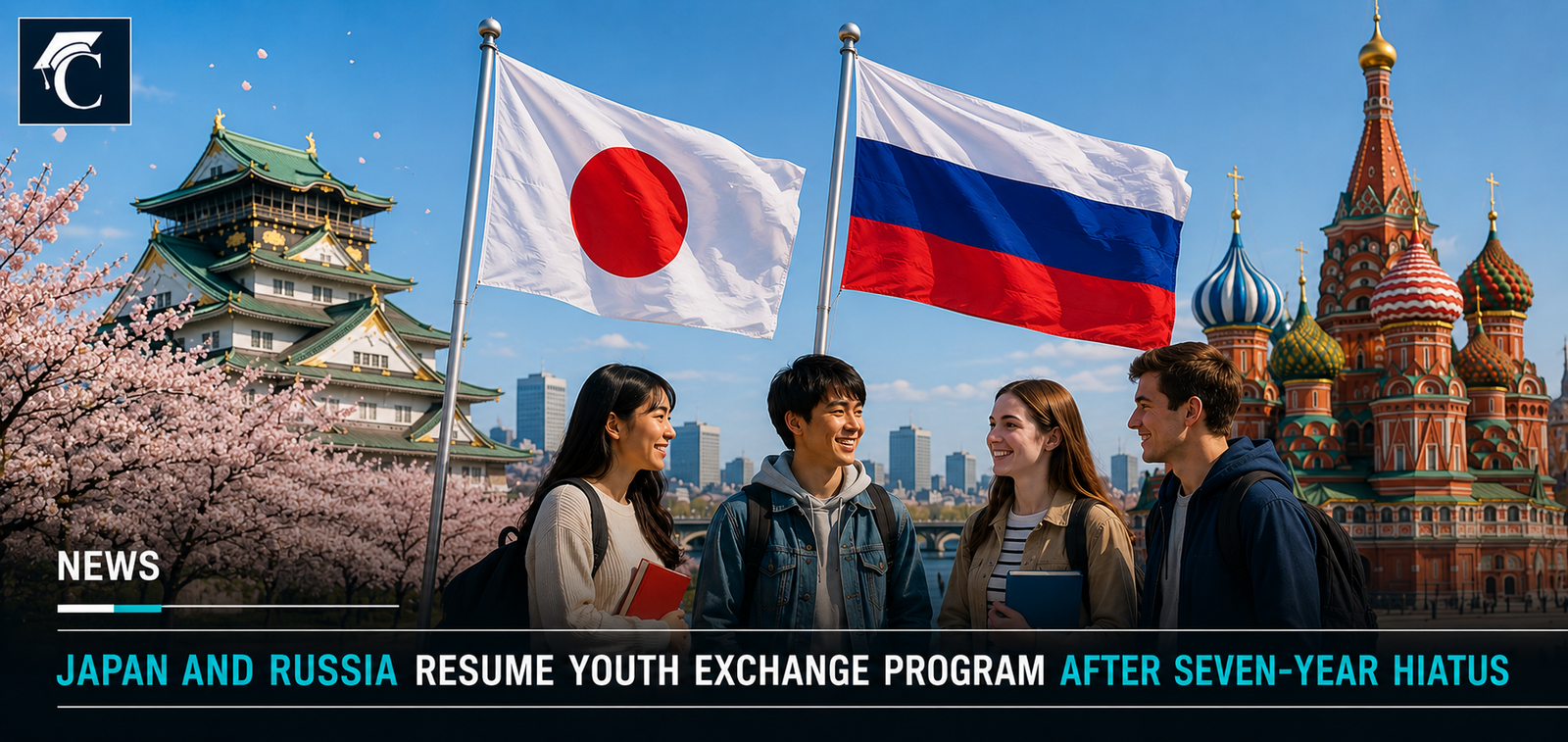
Japan and Russia are set to revive their long-standing Japan Russia youth exchange program after a seven-year suspension, marking a rare instance of educational cooperation despite ongoing geopolitical tensions. The exchange, which will resume in August 2026, reflects both countries’ commitment to maintaining people-to-people connections even as diplomatic relations remain strained following Russia’s invasion of Ukraine.
A Long-Awaited Return
The Japan Russia youth exchange program was last held in 2019 before being suspended due to the COVID-19 pandemic. Plans to restart the initiative were further delayed after Russia’s invasion of Ukraine in 2022, which significantly affected bilateral relations and prompted Japan to impose sanctions on Moscow.
This newly resuscitated program will have 15 Japanese students majoring in the Russian language heading to St. Petersburg for about 10 days. Over this period, students will attend classes in language study, participate in cultural activities, and get involved with Russian students to build a better understanding between them.
Why the Program Matters
Despite differences politically, the Japanese government has stood by the decision to revive the Japan Russia youth exchange. The Ministry of Foreign Affairs of Japan says that there are even more reasons for providing the youths a chance to have a first-hand experience of Russia during times of political friction.
The Japanese government officials think that these educational programs help the younger generation create cultural understanding, language capabilities, and even interpersonal ties which survive political tensions.
Balancing Diplomacy and Education
The reason for all this is that Japan still helps Ukraine and imposes economic sanctions on Russia. Despite the fact that Japan’s general foreign policy remains the same, representatives of the country have managed to differentiate between educational cooperation and political involvement.
Those experts who study international relations point out that Japan Russia youth exchange program has always been a great mediator between the two states. Since its foundation in 1999, about 9,000 people from both countries took part in this program.
Challenges Facing Student Mobility
While the program is being revived, there is not much interest on the part of students in studying in Russia. There are various issues that contribute to this problem, such as the weakened yen, increased cost of education abroad, as well as safety concerns due to the war in Ukraine.
It should be added that it is only a relatively small number of those who wish to study Russian language, literature, history, and regional studies that can be expected to take part. Meanwhile, a growing number of Japanese students have been opting for shorter programs in other Asian countries
The Value of Grassroots Connections
According to education experts, exchange programs like the Japan Russia youth exchange have a special significance that is more than just academic in nature. Interaction between individuals helps to get an insight into other cultures and other social, cultural and political perspectives which might not be possible through any sort of diplomatic conversation.
These interactions will help to foster trust among the youth of different nations, thus ensuring cooperation in the future despite political disagreements. These types of exchange programs offer the benefit of acquiring language skills as well as international experience to the students involved.
Looking Ahead
The revival of the Japan Russia youth exchange is an indication that educational diplomacy still has a role to play despite the geopolitical uncertainty. Although the program targets only a few youths, it is nonetheless an attempt to sustain cultural and academic interaction in the face of political tensions.
With the continued evolution of global politics, the implementation of this Japan Russia youth exchange will be an indication of how education can serve as a bridge for dialogue in times of difficulty in formal diplomacy. It is an investment in the future of Japan and Russia.