

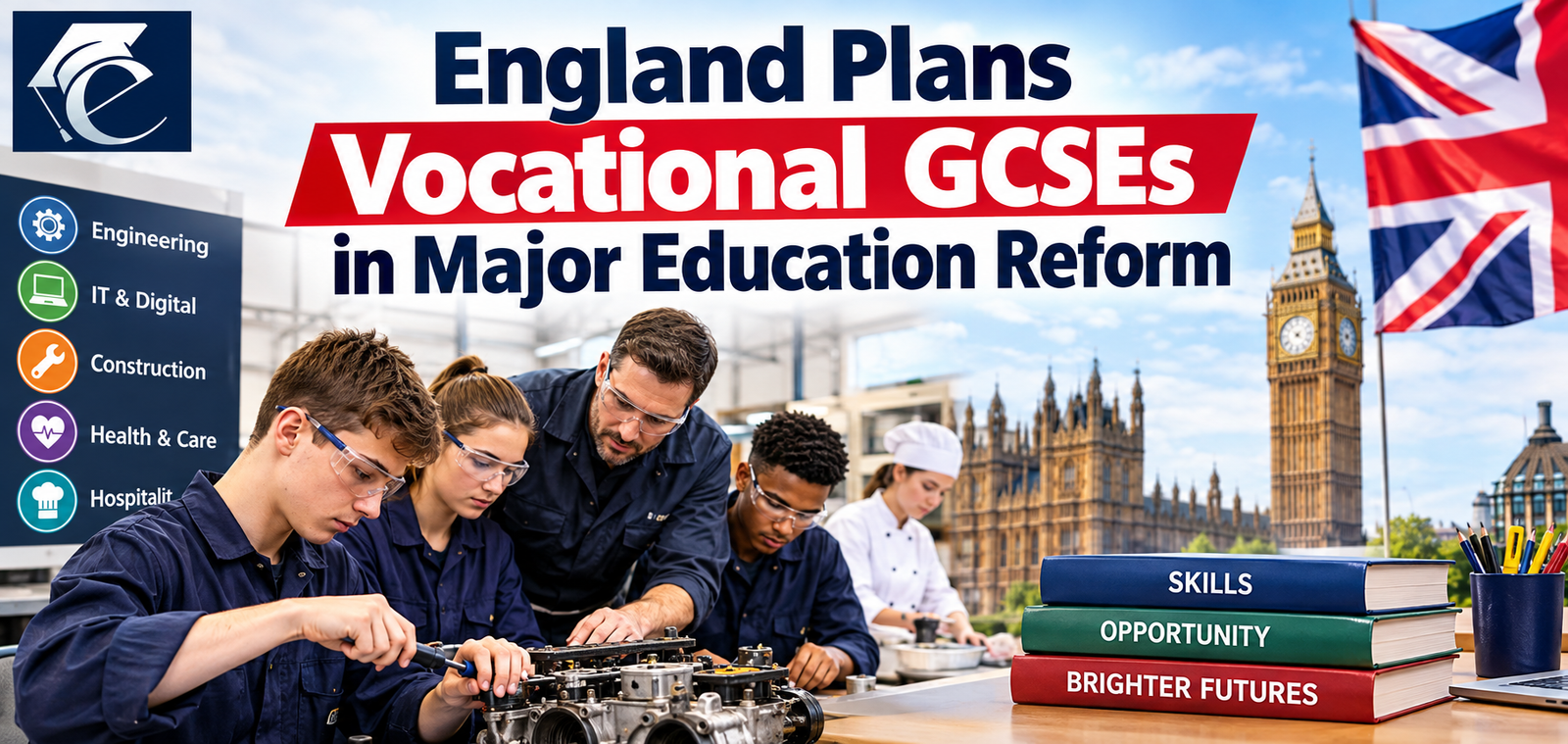
The UK government has announced plans to introduce vocational GCSEs England students can take alongside traditional academic subjects, marking one of the most significant reforms to secondary education in recent years. The proposed qualifications would allow pupils to study practical subjects such as finance, construction, engineering, and digital skills from the age of 14.
Prime Minister Andy Burnham said the reforms are aimed at creating an education system that gives equal value to both academic and technical learning. The initiative forms part of a broader strategy to address skills shortages, improve career readiness, and offer students more diverse routes to success.
Supporters argue that the introduction of vocational GCSEs England could help bridge the long-standing gap between classroom education and workforce requirements.
What the New Qualifications Could Include
Students under the new reforms will continue to study essential subjects like English, Mathematics, and Science but will also be able to undertake qualifications in industries. These industries include finance, construction, digital technologies, and others where there is an increasing need for skilled labor.
The government is convinced that by providing opportunities to learn about these fields early in their academic life, students will be able to make career choices based on information. Technical education has been accorded a lower status than conventional academic education for many years.
Advocates say vocational GCSEs England could create stronger links between schools, colleges, and employers while preparing students for future employment opportunities.
Addressing Skills and Employment Challenges
The move follows increasing worries over youth unemployment and readiness for work in the UK. According to recent findings, almost one million youths are not in employment, education, or training (NEET). Consequently, there is a need for drastic reforms in the skills sector.
While younger individuals’ engagement in apprenticeships has been lower than previously seen, policymakers hope that offering vocational GCSEs England will make more pupils interested in vocational occupations. It is no secret that the industry has repeatedly complained of shortages in areas including construction, manufacturing, engineering, and technology.
Creating Greater Parity Between Academic and Technical Learning
For years now, criticism has been leveled at England’s education sector, claiming that its educational system gives more priority to university preparedness compared to vocational studies. Consequently, students who do well in practical learning have found themselves shortchanged by the educational system.
The introduction of the vocational GCSEs England aims to address such criticisms as it will give technical subjects a similar level of credibility and recognition to ordinary GCSE subjects. There have always been calls from the education sector for technical streams for students to gain industry-specific skills while maintaining high academic grades.
Government officials believe that such an approach can help identify students’ talents that may go unnoticed using purely academic approaches.
Potential Impact on Schools and Employers
If the reform is properly carried out, the cooperation between the school and local industry can be improved. It will provide more opportunities for employers to participate in the process of developing the curriculum, thus making sure that the students get the right skills needed in the region.
Moreover, the schools will be forced to broaden their scope and provide specialized training, possibly having to build new facilities and purchase the required equipment. Such programs have already appeared in some regions of the country.
Supporters believe vocational GCSEs England could help reduce skills gaps while creating a more adaptable workforce prepared for future economic demands.
Looking Ahead
The suggested reform is an important step in terms of secondary education structure within England. With the introduction of vocational and career-oriented courses into the educational system, those responsible for implementing such an initiative intend to give pupils greater chances of becoming successful in the future and also solving labor shortages.
It goes without saying that teachers, employers, and parents will be following the process of creation and delivery of vocational GCSEs England very carefully. Should the initiative prove to be successful, it can change the attitude towards education and employment of the young generation.