
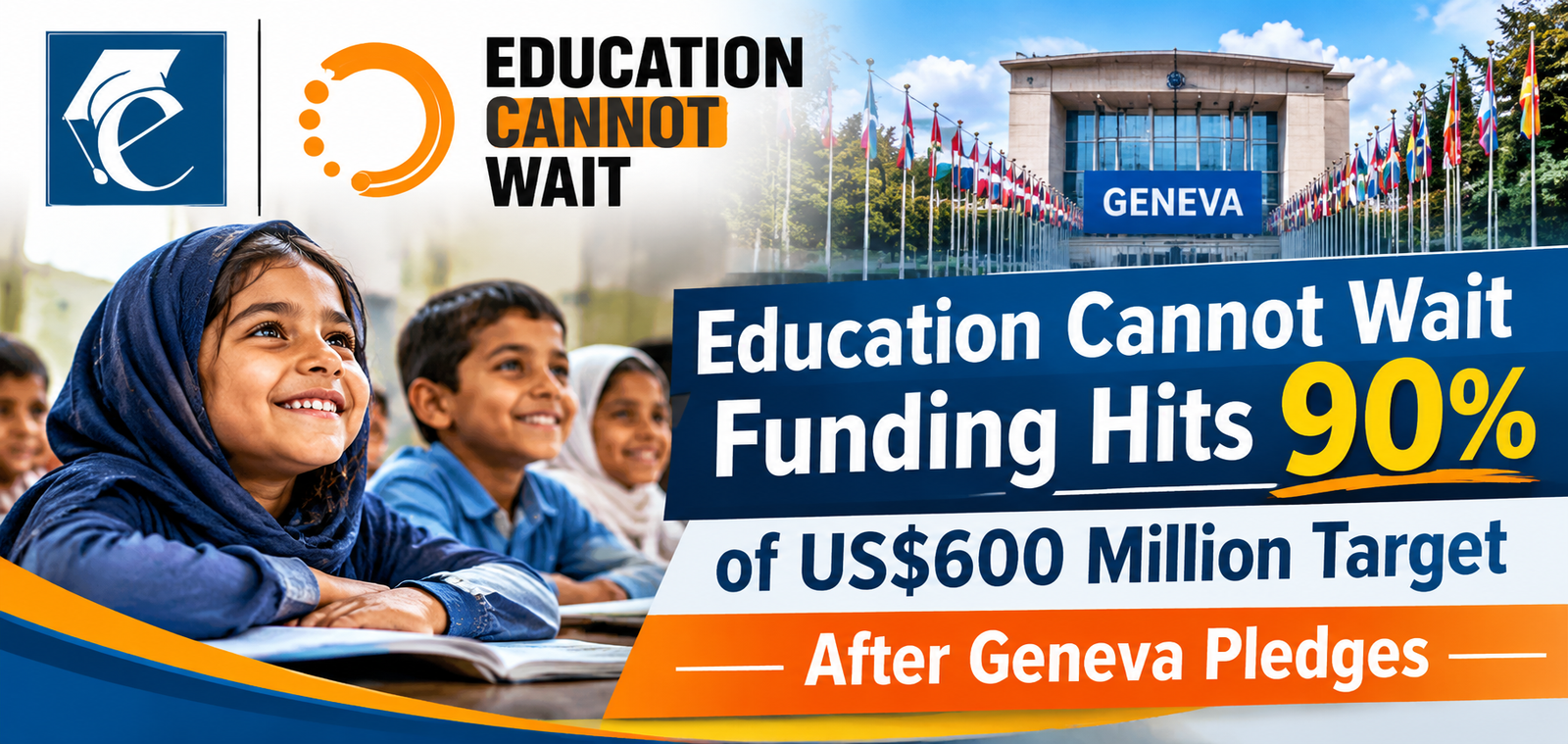
Education Cannot Wait funding took a major step forward this week. At a High-Level Replenishment Conference in Geneva on 5 November 2026, hosted by Switzerland, governments and partners announced US$405.8 million in new pledges to the global fund for education in crises, known as ECW. The announcement moves its “Hope Starts Here” campaign close to its US$600 million goal.
What was pledged
The new money adds to resources the fund had already secured. The totals look like this:
- US$405.8 million in new pledges announced in Geneva
- US$135.8 million already secured through earlier multi-year donor commitments
- US$541.6 million in total, or 90% of the US$600 million target
By simple subtraction, that leaves roughly US$58 million still to raise. Sigrid Kaag, chair of ECW’s High-Level Steering Group, said the commitments give a strong foundation for the 2027–2030 Strategic Plan. ECW itself described Geneva as a major milestone but not the end of the campaign. That is a small gap compared with the original ask, and it shows how quickly Education Cannot Wait funding has grown since the campaign opened in August.
What the money is meant to do
The target is tied to a clear goal: reaching 10 million crisis-affected children over the plan’s four years, half of them girls and including one million children with disabilities. The fund says it and its partners have reached more than 16 million children in crisis-affected countries since it was established. Education Cannot Wait funding is meant to keep that work going into the next strategic period. The plan also leans on local partners: in 2025 the fund channelled 31% of its emergency response and multi-year programme funding to local and national actors, beating its target at the time.
Why the timing matters
The scale of need keeps growing. An estimated 258 million school-aged children and adolescents worldwide are affected by crises. At the same time, money for education is shrinking. When the campaign launched in August, the fund warned that global aid for education was set to fall by US$3.2 billion, a 24% cut that could push six million more children out of school. A September results report added that humanitarian education funding has now declined for a second year and covers less than one-third of assessed needs. Against that backdrop, hitting 90% of the target is notable, and Education Cannot Wait funding now looks like a rare bright spot in a falling market.
Early backers and new ideas
Germany, the United Kingdom and Switzerland made early commitments that secured almost 40% of the target before the conference. Geneva also pointed toward new ways of paying for education in emergencies. Partnership offers and initiatives involving Porticus, the International Finance Facility for Education, the Education Bridging Fund and Swiss cantonal banks were presented as ways to add development finance and private capital to traditional donor contributions. If those ideas work, Education Cannot Wait funding could come from a wider mix of sources than it does today. The mix of sources behind Education Cannot Wait funding may end up mattering as much as the total.
What still needs to happen
Pledges are not yet money in the bank, and the last 10% still has to be found. Delivery will depend on donors turning commitments into payments and on the fund showing results, something it has stressed in its annual reporting, which covered 10.4 million children reached across 33 countries between 2023 and 2025.
For children living through conflict, displacement and disaster, the outcome decides whether school stays open. The progress made in Geneva suggests Education Cannot Wait funding is close to the level its backers wanted, and the next few months will show whether the final gap closes.