
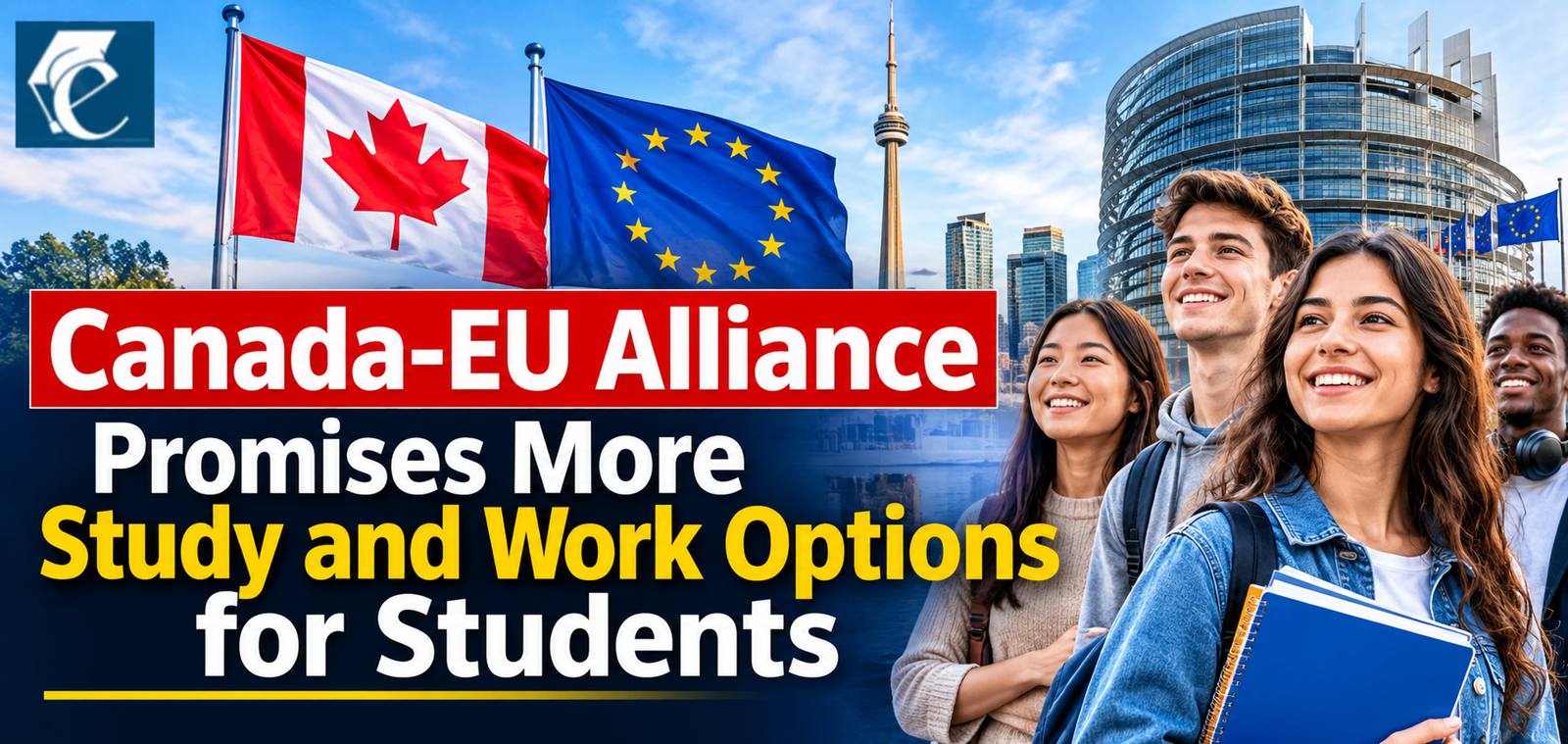
Students in Canada and Europe may soon find it easier to study, train or work on the other side of the Atlantic. The Canada-EU alliance, announced at the end of October, puts education alongside trade and security. According to The PIE News, international education leaders are already paying close attention.
Announced in Montreal
Prime Minister Mark Carney and European Commission president Ursula von der Leyen launched the Canada-EU alliance at the 21st EU-Canada summit in Montreal on 30 October 2026. Its full name is the Alliance for the Future of Canada and the European Union. The plan is to work together on research, innovation, technology and education.
The joint statement describes the two sides as strategically important partners and close friends. Speaking to reporters, Carney and von der Leyen called it the deepest possible partnership between Canada and the EU’s 27 members. Their pitch was stability and opportunity, on a scale they said hasn’t been offered before.
The Erasmus+ Piece
For students, the part of the Canada-EU alliance that could matter first is Erasmus+. That’s the EU’s main programme for education, training, youth and sport. The two sides will now negotiate Canada’s deeper involvement.
Canada already takes part in some strands. A bigger role would send more students abroad, support vocational training and help universities and colleges build partnerships that last. How far it goes is something the talks will settle.
Mobility, Qualifications and Culture
The agreement doesn’t stop at exchanges. Negotiators will look at removing obstacles for young people and at making it simpler for skilled workers and researchers to move between Canada and Europe. They’ll also push for better recognition of professional qualifications, which anyone who has trained in one country and tried to work in another will understand.
There’s also talk of a “next-generation youth mobility partnership” to widen access for young Canadians and Europeans. Culture gets a mention too, with dialogue and exchanges planned between cultural institutions.
What the Sector Thinks
Larissa Bezo, president and CEO of the Canadian Bureau of International Education, told The PIE News the timing matters. Countries are competing hard for talent, she said, and students are dealing with a lot of uncertainty.
Bezo said the Canada-EU alliance reflects something the sector has argued for years: partnerships are built through people, not just trade deals and diplomacy. In her words, the alliance’s big priorities, including technology, competitiveness and security, all depend on talent, and international education is how you build it. She called Canada and Europe natural partners with shared values and long historical ties, and said the aim is a foundation that serves students, institutions and researchers for decades.
What’s Still Unclear
The details are thin. The report doesn’t say when the Canada-EU alliance will start delivering anything, how much money is behind it, or who would be eligible for new opportunities. The Erasmus+ negotiations haven’t begun, and the youth mobility idea is only something the two sides will “explore.”
So if you’re a student hoping to apply for something next year, it’s too early to plan around it.
Why It’s Worth Watching
Still, the direction is clear. Plenty of governments talk about attracting international students, but few put it into a formal partnership with this much political weight. The Canada-EU alliance is a signal that both sides see education as part of their long-term strategy, not an afterthought.
Universities, student bodies and agencies will be looking for answers on Erasmus+ access, qualification recognition and the youth scheme. If the talks go well, the Canada-EU alliance could turn a summit announcement into something students feel in practice.