
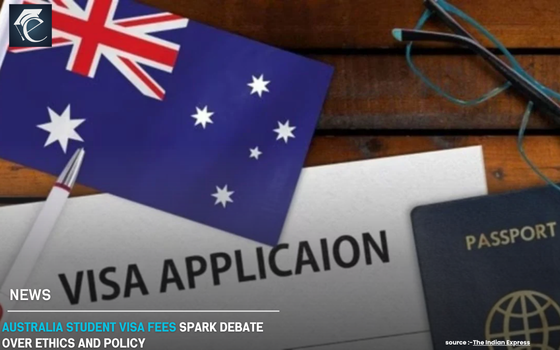
Australia’s immigration system is under scrutiny as rising visa charges and rejection rates bring attention to the growing revenue generated from international students. The issue of Australia student visa fees has become a focal point after new data revealed that the government earned millions from unsuccessful applicants. In March alone, thousands of students were denied visas, yet their application fees remained non refundable, raising serious ethical and policy concerns.
According to the Department of Home Affairs, nearly 4,800 offshore applicants were refused visas in March. Each applicant paid a fee of A$2,000, a sharp increase from A$710 in mid 2024. This has turned Australia student visa fees into a significant revenue stream for the government.
Revenue Growth of Australia Student Visa Application Fees
The amount of revenue raised through Australia student visa application fees is astonishing. In just one month in March, for example, the government managed to earn almost $65 million in visa application fees, including those for declined visa applications. The income growth trend observed within recent years is truly fast.
According to the estimates by international education specialist Keri Ramirez, the total amount of visa application fees from students and their dependants was about $735 million. This figure indicates an enormous change compared to $244 million of the previous year. The vast majority of this money comes from the field of higher education, where the fee payments amounted to $469 million in 2025.
Ethical Issues in Relation to Visa Fees
The skyrocketing cost of Australian student visa fees has prompted controversy among specialists and policy makers. It is argued that collecting a huge amount from applicants in non refundable fees, even when the application gets rejected, is ethically unjustifiable.
According to Keri Ramirez, most countries collect student fees upon approval of their applications and assurance of their eligibility to access education. However, in Australia, a considerable amount is collected, irrespective of whether the application is approved or not. He further recommended that students’ applications should only incur modest processing fees until the visa process is completed.
Migrants specialist, Abul Rizvi, has also been highly critical of the policy, terming it as unethical and self-defeating for a nation hoping to bring talented individuals from across the globe.
Impact on International Students and Education Sector
However, there are other issues at stake besides the revenue of the government. High costs for the visas mean significant losses for students from medium-income countries, who may be discouraged by the possibility of not getting the visa after paying all the money.
While Australia Student Visa Fees has traditionally been an attractive country for international students, high costs and restrictive visa policies can influence the position of this country in the global education market. International students may decide to opt for another location, where the procedure will be more transparent and less costly.
It will also affect the educational sector, whose economic contribution to Australia is considerable.
Changes in Policy and Low Approvals
There has recently been evidence suggesting that approval rate for offshore student visas reached a record low. According to specialists, this phenomenon has to do with changes in policies, as opposed to any possible fraud on the part of the applicants.
Abul Rizvi emphasized that low approval rate can be explained by the government’s attempt to decrease the number of visas to regulate net migration. Being unable to meet their targets, the government seems to be applying strict criteria during visa assessments.
Applications Onshore Exhibit a Different Pattern
Whereas offshores are facing more obstacles, visa applications made onshore follow a different pattern. In March, nearly 91 percent of all visa applications made for higher education in Australia were granted approval.
These differences highlight the inconsistencies in the process and create questions about justice in such a process. They also prove that there is a problem regarding fees paid by students to apply for a student visa in Australia.
Conclusion
It can be seen that the Australia student visa fees have turned into an important topic when talking about immigration policies and international education. The government may gain from the system because it earns money; however, there are people who claim that there is injustice.
Ethical and economic issues should be carefully considered by Australia.
Also Read :- Education Excellence Magazine for more Information