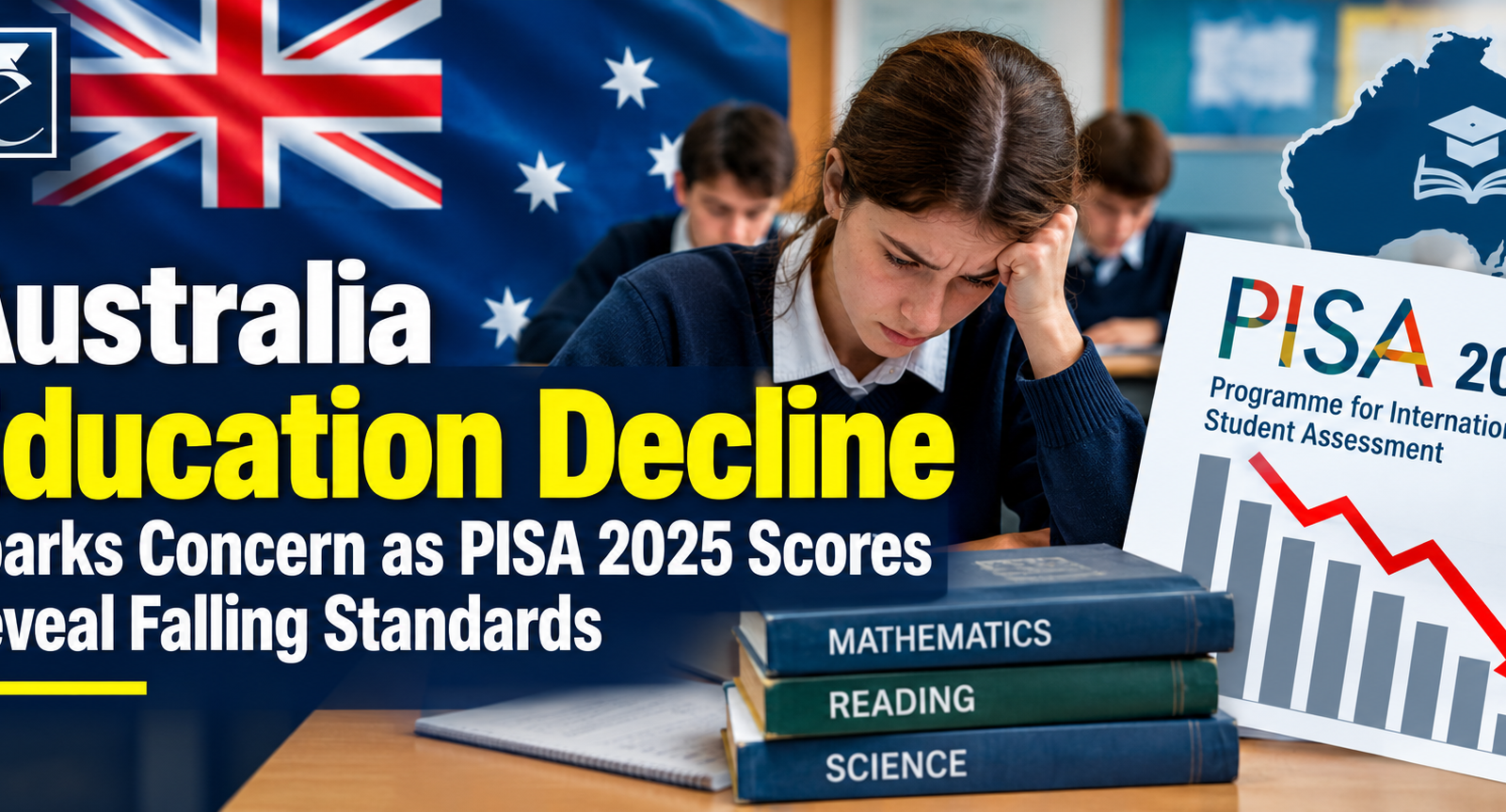

Australia’s education system is facing renewed scrutiny after the release of the latest international student assessment data revealed a significant long-term decline in reading, mathematics, and science performance. The findings from the Programme for International Student Assessment (PISA) 2025 have prompted calls for reforms aimed at improving classroom discipline, reducing digital distractions, and strengthening academic outcomes. The latest Australia PISA 2025 results have reignited debate over the future of education in the country and the challenges confronting students in an increasingly digital world.
Academic Performance Continues Long-Term Decline
The Australia PISA 2025 results show that while Australian students remain above the OECD average in reading, mathematics, and science, their performance has continued a downward trend that has persisted for more than two decades. Australia was placed in 11th place for its reading and science scores, and 17th for mathematics among the nations involved in the survey. The difference between the performance of students from Australia and the highest-performing education systems like Singapore, Japan, and Estonia has increased tremendously.
Education experts have observed that the performance of students from Australia is considerably lower than what was achieved in the early 2000s.
Classroom Disruption Emerges as a Major Challenge
One of the most surprising facts revealed by the report relates to the behavior of students and the state of classrooms. The assessment indicates that Australia is one of the top-performing countries where classrooms suffer greatly from disruptions, as a large number of students experience disruptions due to noise, disorder, and other distractors.
Despite the fact that smartphones have already been banned at Australian schools, there is a concern among politicians that such devices as laptops and tablets may influence the performance of students negatively. It was stated that technologies could help to improve the educational process, but too much screen time could hinder literacy and numeracy skills development.
Government Calls for a ‘Digital Detox’
To counteract the findings in the Australia PISA 2025 results, Education Minister Jason Clare is calling for a “digital detox,” which will assist students in becoming more focused. Suggestions made so far involve analyzing the use of digital devices in schools, improving programs related to literacy skills, and reviewing math teaching techniques.
The government is also looking at successful education systems in other countries, especially those with excellent reading and math scores. It is clear that the proponents for change want Australia to focus on teaching methods based on facts and improved classroom management.
Growing Inequality in Student Outcomes
Disparities are seen between social classes and sectors within schools. Students who attend independent schools still do better than their counterparts in public schools and have learning achievement gaps that can be compared to years of schooling in some disciplines.
Differences between the two genders are also present. Females still score higher on reading tests, while males score better in mathematics. Experts believe that these differences can become bigger if nothing is done to address them.
Students who belong to low socio-economic backgrounds, Indigenous populations, and rural areas are at risk for poor academic performance.
International Context Highlights Australia’s Challenges
The Australia PISA 2025 results occur against the backdrop of other international worries regarding poor academic performance. Several nations have recorded poor reading and mathematics test scores, which they blame on the change in reading patterns, increased use of screens, absenteeism, and reduced student engagement. On the contrary, certain education systems such as England have been able to keep or increase their levels of academic performance.
It is suggested that the problem facing Australia is not just holding their position above the OECD average but turning around a downward spiral that has led to their drop-off in terms of being one of the world’s best performing education systems.
Looking Ahead
The release of Australia PISA 2025 results is a wake-up call for all the education stakeholders. Despite Australian students performing better than their counterparts in many countries around the world, it is becoming quite obvious that it will not take long before the country begins to lag behind.
This period presents an opportunity for governments to implement new reforms that can improve literacy and numeracy, classroom discipline and responsible usage of technologies in the classroom.