
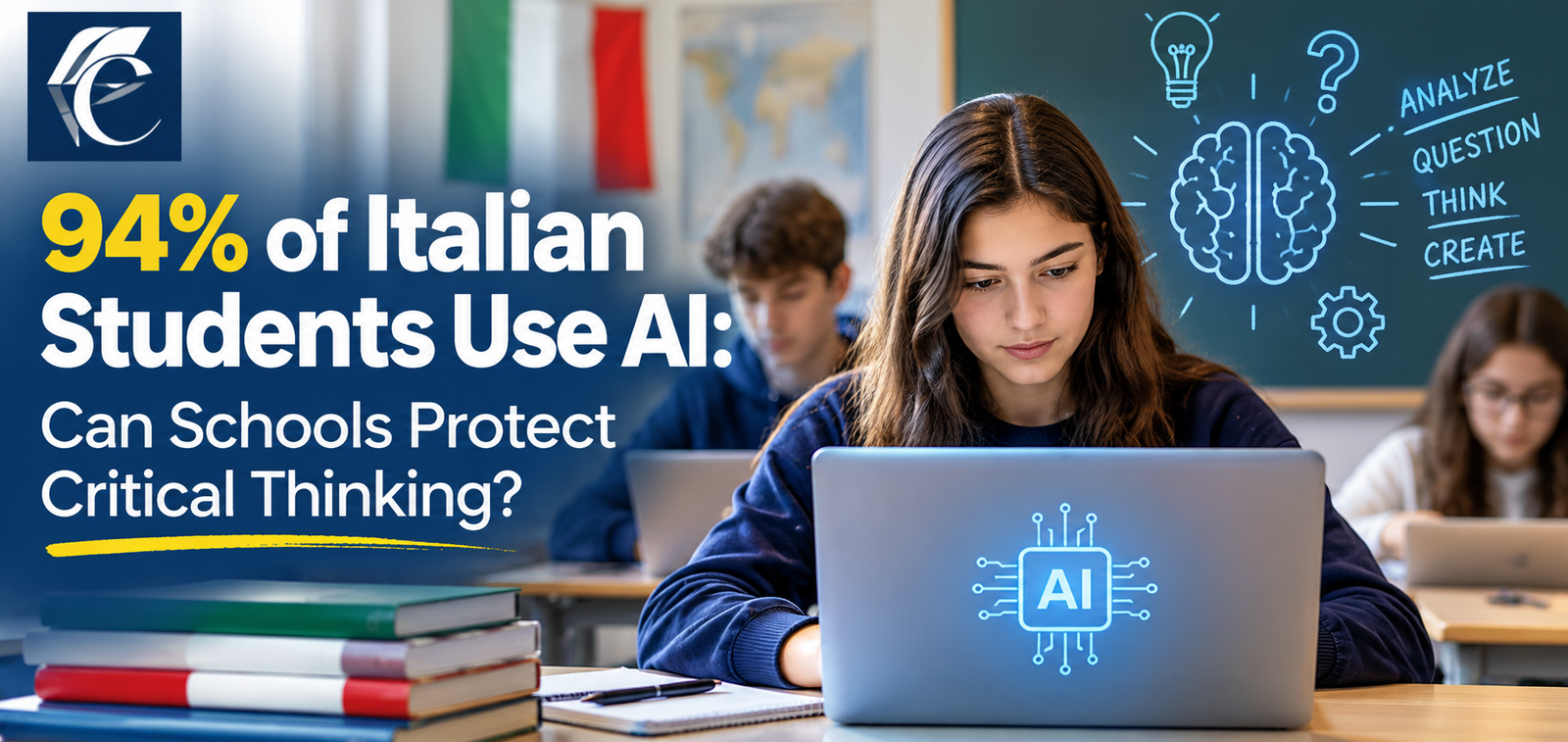
Artificial intelligence has become an integral part of modern education, transforming how students learn, research, write, and solve problems. Across Italy, AI-powered tools are increasingly being used for everything from completing assignments and summarizing complex texts to generating ideas and preparing for exams. What was once considered an emerging technology has rapidly become a daily companion for students navigating academic life.
The widespread adoption of these technologies has sparked a critical debate about the future of learning. With recent reports indicating that a significant majority of students are using AI tools in some capacity, educators, parents, and policymakers are asking important questions about the impact of technology on independent learning and intellectual development. The growing prevalence of AI Use in Italian Schools has created opportunities for innovation while simultaneously raising concerns about the preservation of essential cognitive skills.
As artificial intelligence becomes more sophisticated and accessible, schools face the challenge of ensuring that technology enhances learning without diminishing the ability of students to think independently, evaluate information critically, and develop original ideas.
A Generation Growing Up with AI
The current generation of students is the first to go through the learning process together with sophisticated technologies for generative AI. Modern AI generators are not just digital devices used to provide learners with some information; instead, they can write essays, answer various questions, make presentations, and give explanations to different problems in seconds.
The rapid development of the technologies mentioned above occurs because of a wider trend concerning Students and generative AI in general. The fact is that many learners consider AI as a useful tool that will allow them to save time and be more productive. These tools may be very helpful for those who are overloaded with a lot of work.
The closer cooperation of Students and generative AI influences the studying process as well. Nowadays, there is no need to find a variety of sources and synthesize information manually; students get the opportunity to have instant answers to most of their questions.
The Growing Debate Around Critical Thinking
The role of education is not merely to impart knowledge. It also has to teach students how to analyze, criticize, examine, and interpret information on their own. These processes are a part of critical thinking.
The connection between AI and critical thinking in schools has been one of the most hotly debated issues in recent times. Proponents of the use of intelligent machines in the classroom state that this technology would allow students to get rid of routine work, thus engaging them in more productive activities like creative thinking. Opponents claim that the excessive use of such tools may result in students lacking problem-solving skills.
If learners start using AI tools to get the answers to the questions without understanding the way they have been derived, their intellectual development might suffer. Real education is impossible without critical engagement with ideas.
As discussions surrounding AI and critical thinking in schools continue to evolve, educators are seeking strategies that balance technological innovation with meaningful cognitive development.
Understanding the Connection Between Technology and Learning
Discussion of Critical thinking and AI does not imply any conflict regarding the role of technology in the learning process. Rather, this discussion is focused on ways of integrating these technologies into the learning experience.
Critical thinking and AI can be fostered by the correct usage of AI technologies in learning environments. For instance, students can benefit from AI technology as a means for exploring different perspectives, generating discussion topics, analyzing various data, and receiving feedback on the completed tasks. In all these cases, technology serves as a means for augmenting the learning process and not as something substituting intellectual efforts.
However, issues arise when students use AI to find a quick way out of completing an assignment or avoiding understanding complex concepts. When learners tend to accept all answers automatically provided by machines without considering their validity and further exploration of underlying concepts, it leads to a decrease in critical thinking skills.
The future of this interrelation depends on the approach to learning design.
Why Schools Must Adapt
Indeed, educational systems have adapted themselves in order to adjust to new technologies, which started with calculators, continued with computers, went further to internet and finally reached smart phones. Now artificial intelligence is another step in the development of educational processes, which implies the necessity to change the traditional methods of education and testing.
The fast development of AI Use in Italian Schools makes such adaptation very urgent now. Indeed, teachers can no longer be sure that home assignments done by students were really done without additional help. Therefore, there should be developed the learning environment where understanding, analyzing and creativity take priority over mere information memorizing.
There could be developed the testing methods based on project-oriented activities, group work, oral presentations, class discussion and problems solving. Such an approach will allow to assess the level of understanding and encourage the development of skills not easily replaced by artificial intelligence.
The Role of Educational Policy
The involvement of government leaders in developing policies around the use of artificial intelligence in education is critical for establishing sound practices without compromising on consistency.
The creation of AI education Policies in Italy has been becoming more and more essential in light of further adoption of artificial intelligence. The task of policymakers has been quite challenging since it is necessary to encourage innovations in technologies and preserve the integrity of the education system.
AI education Policies in Italy might include a number of things such as rules for using artificial intelligence in the classroom, teacher training programs, ethics, transparency policies, and assessment practices. The use of AI in education should be guided by educational purposes and minimize possible hazards.
It seems that educational policies will play a pivotal part in the implementation of artificial intelligence in education.
Teaching Students to Think About AI
One of the best approaches to solving the problems with AI is teaching students to use artificial intelligence wisely. Instead of forbidding learners from using AI tools, it would be better for schools to help students see the advantages and disadvantages of those systems.
Students need to be encouraged to fact-check information, use multiple sources of information, spot contradictions and inaccuracies in data provided by artificial intelligence. Such practice will promote digital literacy and the development of critical skills among students.
Additionally, it is crucial to explain to students how AI systems work and how they provide responses to certain requests or questions. With a skeptical attitude towards AI tools, students will turn into active learners, not passive consumers of technology.
This approach will turn AI from a threat to critical thinking into a development tool.
How Can Italian Schools Protect Students’ Critical Thinking?
The central question facing educators today is straightforward yet complex: How can Italian schools protect students’ critical thinking in the age of AI?
The solution may well be found in the combination of curriculum redesign, teacher training, policy development, and student education. Schooling needs to provide an educational experience that is focused on reason, debate, creativity, and problem-solving while incorporating AI in an appropriate manner.
Addressing How can Italian schools protect students’ critical thinking in the age of AI? requires recognizing that critical thinking cannot be developed through technology alone. It emerges through inquiry, reflection, debate, and intellectual challenge. Artificial intelligence should support these processes rather than replace them.
When used thoughtfully, AI can become a valuable educational partner. When used carelessly, it risks reducing opportunities for deeper learning.
Looking Ahead
Artificial intelligence is destined to become a permanent component of the educational process. The issue today is not about whether the students will use artificial intelligence but how the educational institutions will manage their usage in order to help students grow intellectually and learn better.
There are both chances and obligations that come with further development of AI in Italian Schools. Educational institutions have to make sure that their students learn those skills which will allow them to succeed in a complicated world of today.
The development of innovation and education should be balanced in order to take full advantage of artificial intelligence while preserving human skills.
FAQ
1.How widely is AI used by students in Italian schools?
AI tools are increasingly being used by students in Italy for research, homework, writing assistance, idea generation, and studying. Reports indicating that 94% of students use AI highlight how quickly these tools are becoming part of everyday learning.
2. Why are Italian students using AI for schoolwork?
Students may use AI to understand difficult topics, summarize information, generate ideas, improve writing, translate text, or receive help with assignments. The convenience and speed of AI make it an attractive study tool.
3.Can AI improve learning in Italian schools?
Yes. When used appropriately, AI can provide personalized explanations, support language learning, help students explore topics, and give additional assistance outside the classroom. Its educational value depends largely on how teachers and students use it.
4.Does AI threaten students’ critical thinking skills?
AI can create challenges for critical thinking if students rely on generated answers without checking, questioning, or understanding them. However, using AI as a tool for discussion, research, and verification can also create opportunities to strengthen analytical skills.
5.How can schools protect critical thinking while allowing AI use?
Schools can establish clear AI-use guidelines, teach students how to verify AI-generated information, require students to explain their reasoning, and design assignments that emphasize analysis, creativity, discussion, and original thinking.
6.Should students be allowed to use ChatGPT for homework?
Rather than treating AI use as simply allowed or forbidden, schools can define when and how students may use it. For example, students might be permitted to use AI for brainstorming or feedback while being required to produce and explain their own final work.
7.What role should Italian teachers play in AI education?
Teachers can help students understand both the benefits and limitations of AI. They can teach fact-checking, responsible AI use, source evaluation, and the importance of developing independent ideas and reasoning.
8.Can AI-generated information be trusted?
Not always. AI systems can produce inaccurate, incomplete, or misleading information. Students should verify important claims using reliable sources rather than automatically accepting an AI-generated answer.
9.What are the biggest risks of AI use in schools?
Potential concerns include over-reliance on AI, reduced independent thinking, inaccurate information, plagiarism, privacy issues, and unequal access to technology. Schools need policies and digital-literacy education to address these challenges.
10.Can AI and critical thinking coexist in education?
Yes. AI and critical thinking can coexist when students are taught to question AI outputs rather than simply accept them. The goal is to make AI a learning aid while keeping human reasoning, judgment, creativity, and verification at the center of education.