
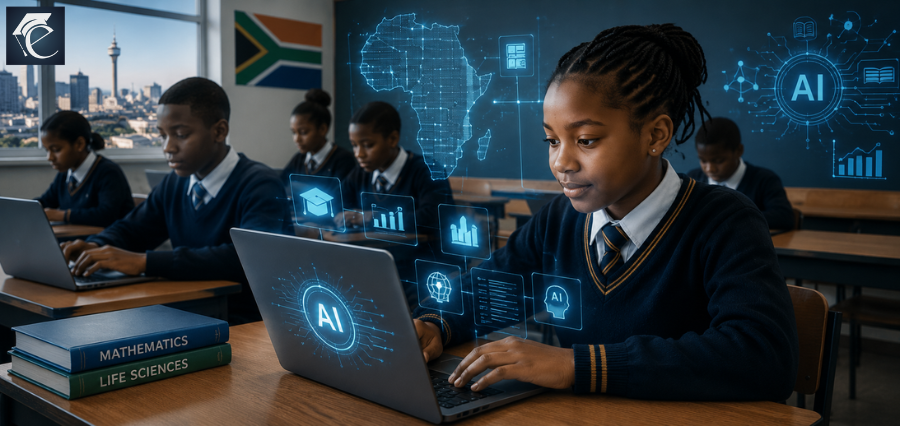
The education sector is experiencing one of the most significant technological shifts in its history. Around the world, artificial intelligence is changing how students learn, how teachers deliver lessons, and how institutions manage educational processes. In South Africa, this transformation is gaining momentum as schools, universities, policymakers, and technology providers explore new ways to improve learning outcomes and expand access to quality education. The rise of AI in South African Education is not simply about adopting new technology. It represents a broader effort to create more personalized, accessible, and effective learning experiences for students across diverse communities.
The Growing Role of AI in South African Classrooms
Artificial intelligence has started to be adopted in education as a tool for improving learning processes. From intelligent tutoring systems to personalized learning platforms, AI may offer some possible solutions for tackling problems that educators in South Africa have been grappling with for a long time.
One of the most significant advantages of AI is its ability to adapt learning experiences to individual student needs. Traditional classrooms often require teachers to deliver lessons to students with varying abilities, learning styles, and levels of understanding. AI-powered systems can analyze student performance and provide customized recommendations, helping learners progress at their own pace. Researchers examining Artificial Intelligence in South African Schools note that adaptive learning technologies can support more personalized educational experiences while assisting teachers in identifying learning gaps earlier.
Bridging Educational Gaps Through Technology
Some of the unique problems which exist in South Africa include lack of equal access to education resources, problems associated with the country’s educational infrastructure, and different quality of education offered in different regions of the country. AI may be utilized to mitigate some of these inequalities through provision of additional educational opportunities in non-traditional classroom settings.
Online tutorials can be used to help students who are deprived of private tutoring opportunities as well as supplemental educational materials to further improve their knowledge in different subjects.
The growth of Educational Technology in South Africa is also enabling students in remote or underserved communities to access learning materials that were previously difficult to obtain. While infrastructure challenges remain, advancements in mobile connectivity and cloud-based learning platforms are creating new opportunities for educational inclusion.
Empowering Teachers Rather Than Replacing Them
The first misconception that comes to mind about artificial intelligence is the idea that AI will take the place of teachers. Most people who have knowledge about AI consider this technology as something that assists teachers in their job but never replaces them.
The teacher is still needed in order to direct students in their learning process, develop their critical thinking skills, and be there for them emotionally and socially. AI could help in the automation of some administrative tasks like grading, lesson planning, content creation, and assessment.
Several studies conducted among South African educators have shown that many teachers try out different tools based on AI in order to make their lessons better.
AI and Personalized Learning
Personalized Learning has turned out to be one of the most promising areas of AI in Education. Every student learns differently but there is always the same standardized way of teaching students. AI can help in overcoming such a problem by creating personalized learning paths.
By constantly analyzing the performance of the students, AI will be able to discover the strengths and weaknesses of the learners, their preferences. The students who need extra help will get that extra assistance while advanced students can get even more challenging material without having to wait for others.
Supporting Multilingual Learning
The linguistic richness of South Africa is an aspect of this country which can bring many possibilities for educators but can also create certain difficulties when it comes to providing all the necessary learning materials.
However, there is a solution that allows to use artificial intelligence to solve such problems as providing multilingual education. There is a number of innovations which have been created using artificial intelligence technology and they allow to enhance reading comprehension of children in several languages used in South Africa such as isiZulu, Sepedi, Afrikaans and English.
The Rise of Digital Learning
The expansion of online learning platforms has accelerated the adoption of Digital Learning in South Africa. AI is playing an increasingly important role in making digital learning environments more interactive, efficient, and responsive.
With the help of AI technology, one can keep track of students’ participation, suggest resources for learning, give immediate feedback, and detect learners who are at risk of lagging behind. This is especially important in distance learning where keeping the students engaged becomes difficult.
Universities and higher education institutions have been looking into the ways AI could help achieve better results and improve efficiency, among other things. It has been found out that the use of AI in higher education will only increase.
However, there are still some problems in relation to the usage of this technology in education. The lack of infrastructure is still one of the major issues preventing its implementation in many institutions, especially in rural areas.
The issue of privacy and data security is another concern to consider as AI algorithms require plenty of student data in order to work effectively.
Finally, there is the problem of proper AI use by students. Even though AI tools can be helpful in the learning process, the overuse of technology can deprive students of the opportunity to develop their critical thinking skills. That is why the main task for educational specialists is to help learners to learn how to use AI properly.
Policy and the Future of AI in Education
With the growing prevalence of AI in society, there is an increasing awareness about the need for governance mechanisms that foster innovation in the context of mitigating ethical issues.
In South Africa, there have been some moves towards formulating a national strategy for AI, focused on advancing digital transformation, fostering responsible AI development, and encouraging technological innovation. This may have huge implications in the future for the field of education by making investments in infrastructure and technological innovations possible.
Success in the future will be dependent on coordination between government ministries, educational establishments, providers of technology, and teachers. Policies should consider innovation alongside equity.
Preparing Students for an AI Driven Future
Other than revolutionizing classrooms, AI is also changing the skills that learners will require in their future work life. With increased automation and intelligence, the traits being sought after in potential employees include creativity, critical thinking, adaptability, and digital literacy.
It is important for educational institutions to not only utilize AI to its full potential but also to make learners appreciate the working of AI technology, its shortcomings, and the effect on society.
Conclusion
The advent of AI in Education heralds a paradigm shift for the nation’s education landscape. From adaptive learning to multi-language support, from smart classrooms to intelligent tutoring systems, there are many opportunities that AI can offer to improve the quality of education, which may not be without challenges but certainly have the capacity to deliver immense benefits.
As Artificial Intelligence in South African Schools continues to evolve alongside broader advances in Educational Technology in South Africa, educators and policymakers have an opportunity to create more inclusive and effective learning environments. Combined with the continued growth of Digital Learning in South Africa, AI has the potential to help shape a future where education is more personalized, accessible, and responsive to the needs of every learner.
FAQ
How is AI transforming education in South Africa?
AI is transforming education in South Africa by supporting personalised learning, providing faster feedback, assisting teachers with lesson planning, automating some administrative tasks, and giving students additional learning support. AI tools can also help adapt educational content to different learning needs and abilities
How is artificial intelligence used in South African schools?
Artificial intelligence can be used in South African schools for personalised tutoring, lesson planning, generating educational materials, language support, research assistance, assessment support, and administrative tasks. However, successful adoption depends on teacher training, reliable technology, internet access, and appropriate policies.
What are the benefits of AI in South African education?
The main benefits include personalised learning, improved access to educational resources, faster feedback, support for teachers, greater accessibility for learners with different needs, and potentially improved engagement and learning outcomes. Research on South African schooling particularly identifies personalised learning and inclusivity as important opportunities.
What are the disadvantages of AI in South African education?
Potential disadvantages include unequal access to devices and reliable internet, inaccurate AI-generated information, privacy concerns, algorithmic bias, overdependence on technology, reduced independent thinking, and difficulties determining whether students have completed work themselves. These concerns are particularly important in a country with significant differences in digital access between communities.
How can AI help South African teachers?
AI can help teachers create lesson plans, develop quizzes and learning activities, explain difficult concepts in different ways, generate teaching resources, provide ideas for differentiated instruction, and reduce some administrative workloads. AI is best viewed as a support tool rather than a replacement for teachers.
Can AI replace teachers in South Africa?
AI is unlikely to completely replace teachers because education involves relationships, emotional support, classroom management, judgement, mentorship, and understanding learners’ social and cultural contexts. Instead, AI is more likely to change teachers’ roles by assisting with routine tasks and supporting personalised instruction.
How can AI help students in South Africa?
Students can use AI as a learning assistant to explain difficult subjects, practise questions, receive feedback, brainstorm ideas, improve writing, translate or simplify information, and study at their own pace. Students should verify AI-generated information and use AI to support learning rather than simply submitting AI-generated answers.
Is ChatGPT being used in South African education?
Yes. Generative AI tools such as ChatGPT have become an important part of discussions about teaching, learning and assessment in South African education. Their availability has raised both opportunities for learning support and concerns about academic integrity, assessment and responsible use.
Can ChatGPT help South African students with homework?
ChatGPT can help students understand concepts, generate practice questions, explain difficult topics and provide feedback. However, students should not rely on it as a substitute for their own thinking. AI can produce incorrect or misleading information, so important answers should be checked against reliable educational source
How does AI affect teachers and educators in South Africa?
AI can reduce some repetitive tasks and provide teachers with new ways to create and adapt learning materials. At the same time, educators need AI literacy and training so they can evaluate AI outputs, identify bias, protect learner information and use AI appropriately in teaching.