
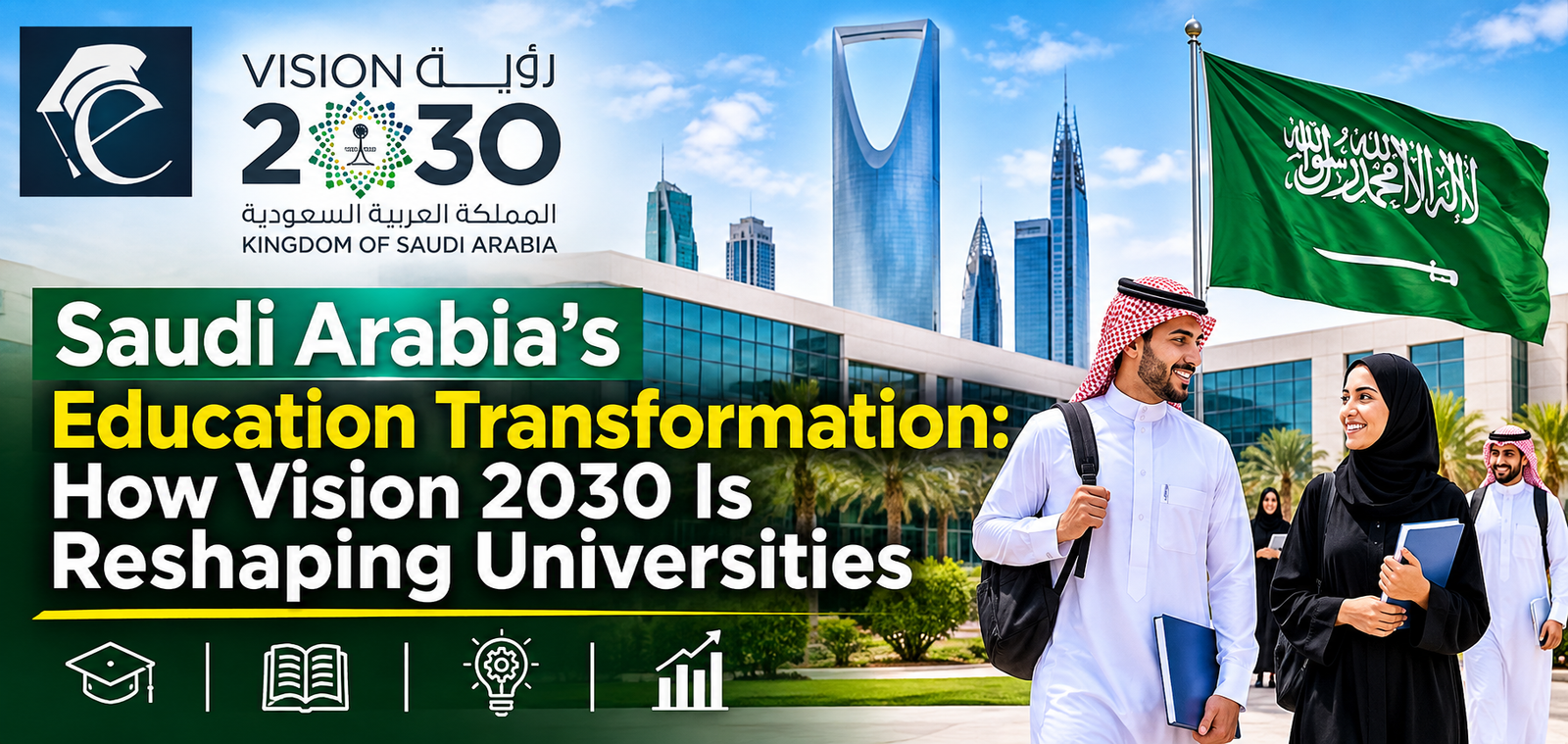
Ten years after Vision 2030 was announced, the Kingdom’s campuses look very different. How Vision 2030 is transforming higher education in Saudi Arabia comes down to a handful of changes: more independent universities, foreign campuses, a push on rankings and a rethink of what graduates should know. Saudi Arabia higher education has moved faster than many observers expected. The hardest tests, graduate jobs and research depth, still lie ahead.
Autonomy first, buildings second
The Saudi Arabia education transformation starts with governance. A new Universities Law, approved by the Council of Ministers, gave public universities financial, administrative and academic independence and let them tailor curricula, fees and fundraising to their own needs. The law also authorised branch campuses of international universities.
The process took time. In early 2021, when Al-Fanar Media wrote about the new framework, just three out of 29 public universities were operating under it: King Saud, King Abdulaziz, and Imam Abdulrahman bin Faisal. Tuition was still free for Saudi students.
In KPMG’s analysis of the situation in Saudi Arabia, the situation became a fork in the road between challenges and opportunities. In our opinion, having more independence in theory will not be difficult; the question is whether it will actually lead to closing poor programs and funding good ones from outside sources.
Rankings: real progress, uneven spread
Vision 2030 education targets include five universities in the global top 200 by 2030. The direction is encouraging. Twenty-two Saudi universities appear in the QS World University Rankings 2027, and a ministry official said the number of globally ranked Saudi universities rose from 25 in 2023 to 33 in 2025. King Fahd University of Petroleum and Minerals ranked 67th in the 2026 QS edition. Further down the table, Qassim University moved from the 801-850 band to 781-790, the kind of steady climb that rarely makes headlines.
Still, one analysis notes that the gains are concentrated in specific institutions and indicators. Whether the five-university goal has been met depends on which ranking you read, so check each table before repeating the claim.
There is a second target worth tracking. The Human Capability Development Program also aims to place two of the Kingdom’s institutions in the global top 100 by 2030. King Fahd University of Petroleum and Minerals already sits inside that line in QS, so the real question is whether a second one can join it, and in which table. A university can be top 100 in a subject ranking, a regional ranking or the overall list, and they are not interchangeable. Ask which one a claim refers to, and whether the source says so.
Foreign campuses arrive
Opening the door to overseas providers is the boldest part of the reform. Five international universities hold foreign investor licences: Arizona State, Wollongong, Strathclyde, the Royal College of Surgeons in Ireland and IE University. The University of New Haven became the first institution approved to open an international branch campus, in Riyadh’s Misk City. It planned to launch with a College of Business and Digital Innovation and an opening class of up to 500 students, growing to around 13,000 across undergraduate and postgraduate levels.
A first intake of 500 will not change the market. What matters is the precedent. The Saudi Arabia higher education sector now has a working model that other overseas universities can copy or avoid.
Regulation is part of the model. The Kingdom has published detailed guidelines for foreign university branches, covering quality and operational transparency, and overseas institutions cite its location and government backing as the draw. For a university weighing a Gulf campus, that clarity matters as much as market size.
Internationalisation runs both ways. The ministry says more than 200,000 international students have benefited from its Study in Saudi Arabia initiative. A 2025 academic review of their experiences, however, examines the challenges they face, which suggests recruitment has run ahead of support.
Degrees that lead somewhere
For years the weak point was the fit between degrees and jobs. A Colliers report found that enrolment in public universities lacked alignment with the job market, with students still favouring humanities and Islamic studies. The Human Capability Development Program responded by reviewing degrees based on their recent and expected employability results. Its stated aim is jobs matching qualifications for 80 percent of Saudi graduates within 12 months. The program’s wider objectives also include expanding vocational training and nurturing an entrepreneurship culture, which suggests the target is more than graduates for traditional jobs.
AI shows the new approach most clearly. At a Riyadh conference in January 2026, the Saudi Data and AI Authority launched a national cross-disciplinary curriculum, and data and AI training is now mandatory for every undergraduate at universities, whatever their discipline. The authority also signed agreements with 14 public and private universities to help deliver it. The authority has already begun training 215 students from 28 universities at its Riyadh headquarters.
Teaching AI literacy to a history major strikes us as sensible. The proof will be in the classroom: qualified instructors, and assessment that means something.
Access is no longer the main problem
Participation is the part of the story least in doubt. UNESCO’s 2026 monitoring report praised the Kingdom’s enrolment rates, with 1.57 million students in higher education. The ministry cites an enrolment rate of 83.88% and a gender parity ratio of 1.01. Online and blended learning helped girls in particular, and the scholarship programme has more than 56,000 recipients. That makes quality, more than seats, the main question for higher education in Saudi Arabia.
Abroad, the picture is similar. Arab News reports that Saudi women make up 434 of the students at “pioneer” universities in the United States, or 45.7% of the total, and at master’s level the split is almost even, 205 women to 209 men. Another 47.3% of that group study engineering, computing, natural sciences or mathematics. If those graduates return to the Kingdom’s labs and workplaces, they are the best evidence that the skills push is working. If they stay abroad, it is a leak.
What could slow things down
Four risks stand out. First, many figures above come from ministry officials and consultancies, so independent verification matters. Second, targets are not results. The 80% graduate placement goal is an aim, and we found no published outcome data against it. Third, autonomy was designed partly to reduce government spending, so weaker institutions may feel the squeeze before alternative income arrives.
A fourth risk is people. Lecturers, assessors and researchers are the scarce input behind every target above, and Saudi Arabia higher education has no ranking table that measures how many it can hire and keep through 2030.
The bottom line
The Saudi Arabia education transformation has already delivered visible change: more independent universities, wider access, ranking gains, foreign campuses and a national AI curriculum. The wider Vision 2030 education agenda now enters a harder phase, where outcomes count for more than announcements.
Watch three signals over the next two years: graduate employment data, research output from mid-ranked institutions, and how students fare at the first foreign campuses. If those improve, the rankings will follow. If they don’t, the headline numbers will start to look hollow.
FAQ
1. How is Vision 2030 transforming higher education in Saudi Arabia?
Saudi Arabia’s Vision 2030 is transforming higher education by modernising universities, improving academic quality, expanding research opportunities, and aligning educational programmes with the country’s economic diversification goals.
2. What are the main goals of Saudi Arabia’s higher education reforms?
The main goals include improving university performance, developing skilled graduates, encouraging innovation, strengthening research, and preparing students for future job opportunities.
3. How are Saudi universities adopting artificial intelligence and digital technologies?
Saudi universities are increasingly integrating AI, digital learning platforms, data analytics, and advanced technologies into teaching, research, and administrative processes to improve educational experiences.
4. How does Vision 2030 improve employment opportunities for university graduates?
Vision 2030 encourages universities to develop industry-relevant programmes, practical skills, internships, and technical expertise that match the changing demands of Saudi Arabia’s labour market.
5. What role do Saudi universities play in economic diversification?
Universities support economic diversification by preparing professionals for emerging industries such as technology, renewable energy, healthcare, tourism, finance, and advanced manufacturing.
6. How is scientific research improving in Saudi Arabia’s higher education sector?
Saudi Arabia is investing in research centres, university laboratories, international collaborations, and innovation programmes to strengthen scientific research and develop solutions for national and global challenges.
7. Are international universities partnering with Saudi institutions under Vision 2030?
Yes. Saudi universities are expanding partnerships with international universities and research institutions to encourage academic exchange, joint research, knowledge sharing, and global learning opportunities.
8. How is Vision 2030 improving the quality of Saudi universities?
The initiative focuses on institutional autonomy, stronger governance, academic accreditation, improved teaching standards, and international competitiveness to enhance university performance.
9. What opportunities does Saudi Arabia’s higher education transformation create for international students?
The transformation creates opportunities through international academic partnerships, scholarship programmes, modern learning facilities, research opportunities, and a wider range of specialised academic programmes.
10. What is the future of higher education in Saudi Arabia under Vision 2030?
The future of higher education in Saudi Arabia will focus on digital innovation, AI-driven learning, advanced research, international collaboration, entrepreneurship, and developing graduates with skills suited to a competitive global economy.