
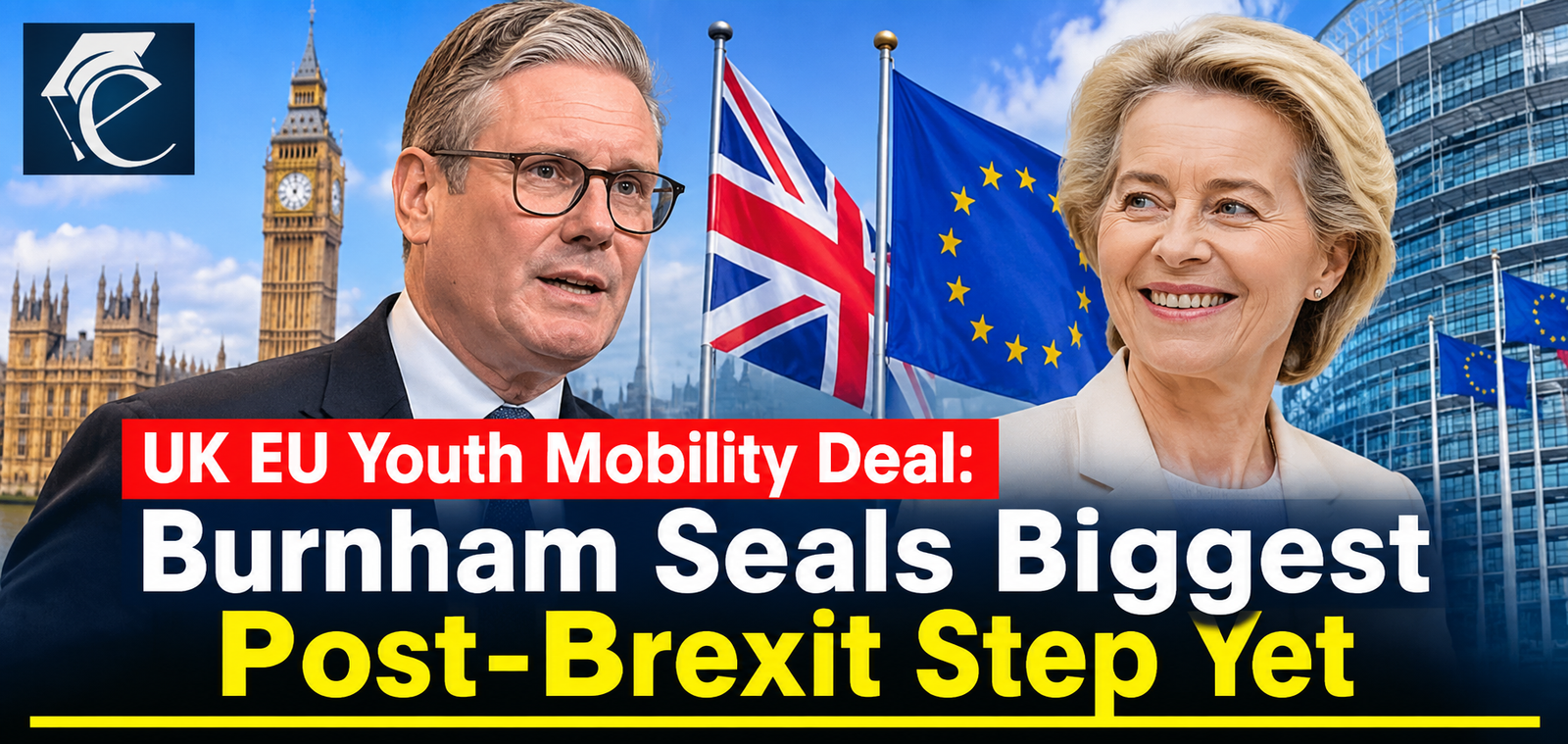
Prime Minister Andy Burnham signed a package of agreements in Brussels on Friday that is being described as the biggest move towards closer ties with the EU since Brexit. The UK EU youth mobility deal sits at the centre of it, alongside agreements on food trade and carbon markets. Burnham says the package opens a new chapter after a decade of drift. The Guardian’s original report was not accessible to me, so this account draws on Associated Press coverage and other outlets.
What Was Agreed
Burnham, European Commission President Ursula von der Leyen and European Council President António Costa signed three agreements covering food trade, carbon markets and youth mobility. Under the UK EU youth mobility deal, up to 100,000 young adults from Britain could live and work in EU countries for up to three years, with the same number of Europeans coming to the UK. The package also includes an emissions trading agreement and a deal to remove checks on food and agricultural goods, which should make exports to Europe cheaper and easier.
The Economic Pitch
Burnham has presented them as a cost-saving measure, ensuring lower food prices at supermarkets and providing employment opportunities for the youth. Speaking on Friday, Burnham claimed that the impact of this move would be an increase in the British economy by 0.5 per cent, higher than his previous estimate of 0.4 per cent. He has also insisted that cooperation with Europe will benefit workers, as well as Britain and the EU. He claimed that “The Brexit we were given has not worked.”
Not Finished Yet
This deal is not a final one. As told by the representative of the EU, the package is contingent on the two sides reaching an agreement on tuition fees for universities within the next six months. The EU wants European students studying in Britain to pay local fees instead of the international ones, but London did not want to do that. There is ongoing discussion of Britain getting access to the manufacturing standards of the EU. Thus, there will be months and years of negotiations ahead; therefore, this deal should be considered just a basis for further talks.
Critics Say It Betrays Brexit
In order to strike such agreements, the UK will have to agree to certain EU rules and standards that it does not have a say in determining. Brexit proponents point out that this compromises British sovereignty. The leader of Reform UK, Nigel Farage, said on the BBC that “the big debate about Brexit is back, and it’s going to become a debate about whether we rejoin or leave”. Proponents of the deal argue that cooperation in the fields of trade and mobility benefits everyday people.
The Rejoin Question
Burnham has indicated that all possibilities are on the table for future relations, including the possibility of rejoining the EU, thereby breaking a taboo in the politics that had never been broken. He has emphasized that rejoining is just one of the many possibilities and certainly not an immediate move. It would require the consent of the British people and also the agreement of the 27 nations of the EU. It looks like the European Union is very cautious of such kind of talk. They have seen seven British prime ministers within a period of ten years and want to know what exactly they want from them.
Issues of Security and Migration
The summit was also about defense cooperation and attempts at curbing irregular migration. “AP sources say that the war in Ukraine and Britain’s powerful military are bringing the two sides together,” says the AP. Costa emphasized that security and prosperity are tightly linked, and so a good partnership is vital.
What’s Next to Watch For
There is another issue on the horizon, the negotiations over tuition fees that can take up to six months to resolve. Also watch for the specifics of the UK EU youth mobility deal that are released in the form of an agreement, including eligibility criteria, and the course of the Brexit debate in the UK.
The Bottom Line
Burnham has fulfilled his major commitment with tangible outcomes, but there is still much more to do. Proponents consider the outcome as something that benefits young people and consumers, whereas the opponents believe that Burnham takes a backward step in terms of the European Union regulations. The UK EU youth mobility deal, along with the entire package, will prove its worthiness in the coming months.