
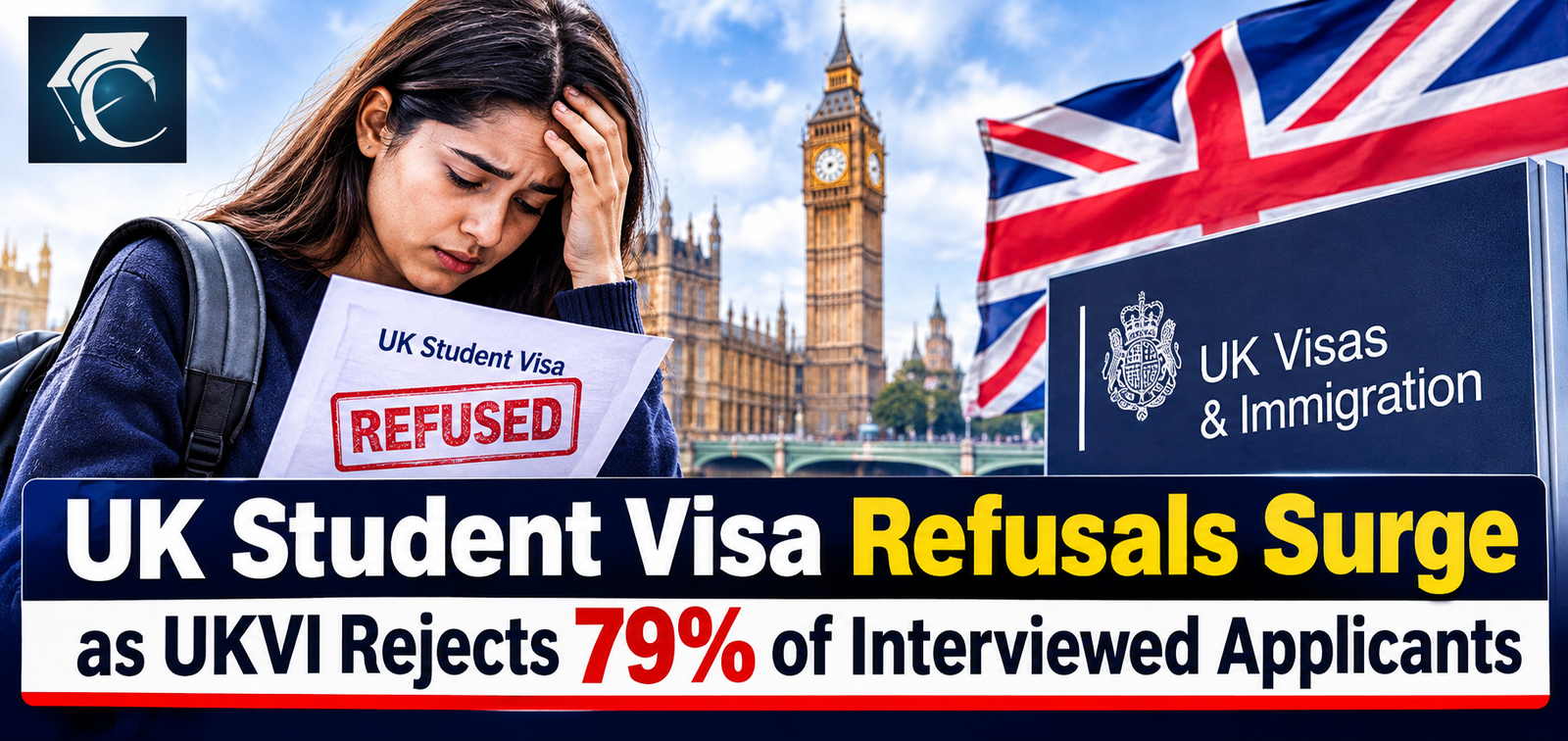
New figures obtained show UK student visa refusals climbing sharply after credibility interviews, with caseworkers turning down roughly four in five of the applicants they questioned over a six-month stretch.
Behind the Numbers of the Headline
In the latest sector briefing paper from UKVI, the number of interviews conducted between May and October 2026 was 11,415. Case officers deemed 9,043 applicants non-credible, which amounts to about 79% of applicants. The caveat that half a year of data does not necessarily represent an entire year is important when looking at student visa refusals in the UK.
Who Gets Rejected the Most?
There is significant variability based on nationality. Nepal had the highest rejection rate, with 92% of applicants being non-credible. India had the next-highest rate, with 89%, followed by Nigeria at 84%, Bangladesh at 79%, Sri Lanka at 79%, and Pakistan at 73%.
More Nigerian Applicants Are Being Summoned
Furthermore, this briefing reveals the applicants who are summoned. During the 2025- 2026 period, the proportion of Nigerian students summoned increased significantly – from 7% to 21%. The UKVI stated that the agency has noticed an increase in applications from Nigeria, which needed further investigation. In fact, the refusal of UK student visa largely depends on which categories of candidates are summoned.
Grounds for UK Student Visa Refusal
The main grounds of credibility refusal were mentioned by UKVI. It is insufficient research of the selected institution, problems with explaining the choice of the UK, as well as lack of relation between the course of study and future prospects. These also include insufficient knowledge of the subject, limited English, and financial problems.
However, the PIE has gathered some more strange cases before, such as the refusal of the students due to inability to state the number of trees on the campus or the location of the nearest bus stop.
Home Office Response
In a speech at a UUKi recruitment conference, Oliver Rae of the Home Office stated that there is no limit to student numbers and that attention should be paid only to the genuine candidates. The official dismissed the argument that compliance is used to control numbers.
Rae acknowledged that “we don’t always get the decisions right” but claimed that interview numbers decreased annually. He attributed that trend to the risk analysis and said that approximately 6,000 students were interviewed in the summer period. The Home Office claimed that numerous UK student visa refusals are a result of a more selective decision-making process rather than a policy change.
The Asylum Claims
Asylum claims continue to cause tension. It was mentioned in the briefing that Pakistani students are most prone to make asylum claims, followed by students from India, Bangladesh and Nigeria. The PIE reminded of the visa brake introduced for Afghanistan, Cameroon, Sudan and Myanmar due to the same reasons. The context is relevant for the discussion of UK student visa refusals.
The Implications
It’s time for interpretation now. The universities and recruitment agents operating in South Asia and Nigeria have to deal with an unpredictable environment, which increases the importance of proper candidate preparation. As we can see from other PIE articles on the topic this week, there are reputational implications here as well; specifically, the president of NUS England stated that changeable rules are damaging Brand UK. If the trend continues, student visa refusals in the UK might impact applicants’ choice of institutions.
As of now, the numbers pose a straightforward question: does the interview pick the right risks, or reject those who have no bad intentions? Without full annual statistics available, UK student visa refusals are going to stay debatable.