
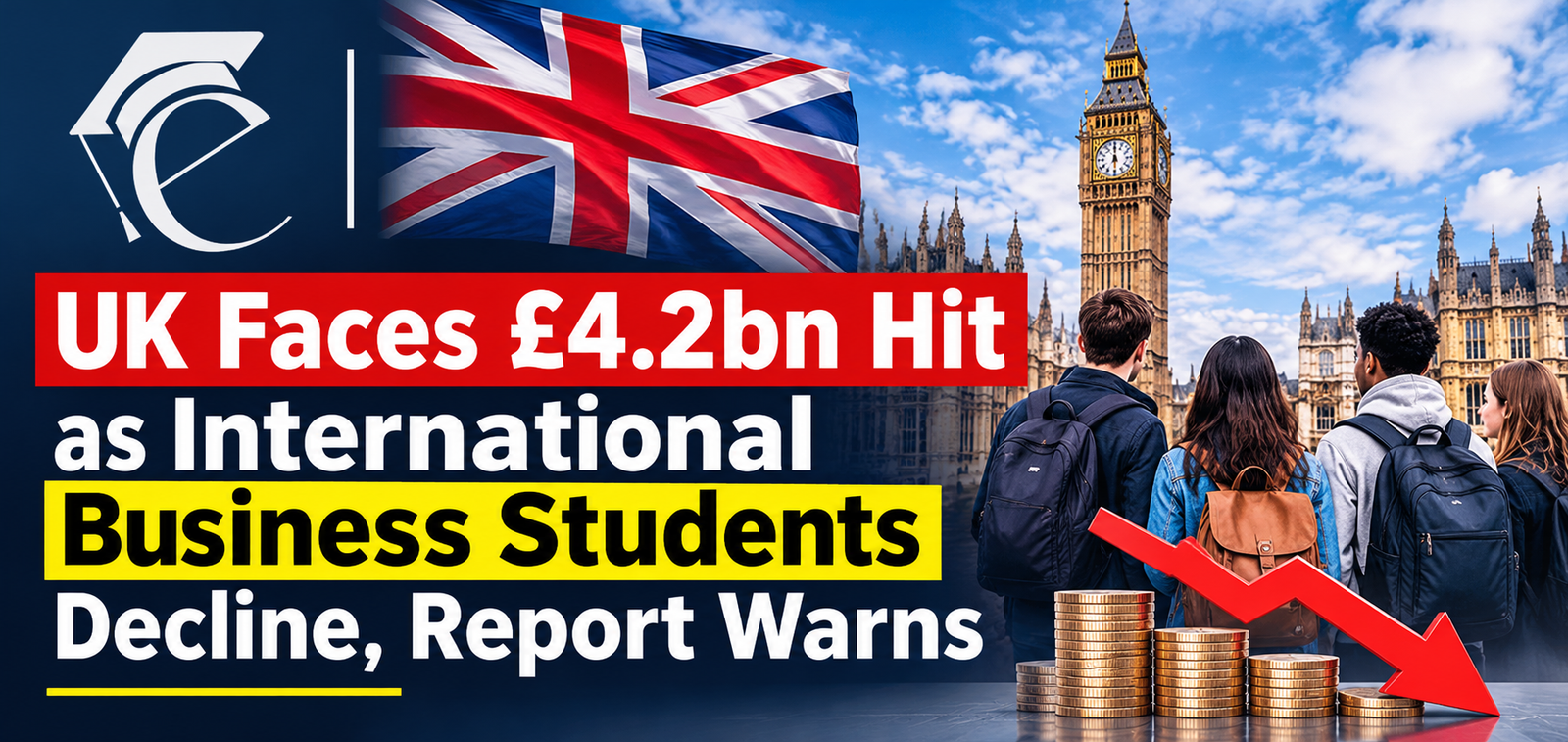
The UK economy could lose £4.2 billion if the number of international business students keeps falling. A new report says enrolments would then return to their 2019/20 level, a 30% drop equal to about 32,300 jobs. The research was carried out by London Economics for the Chartered Association of Business Schools, and it puts a price on the slide in international business students.
A decline already under way
It is well under way. Due to new restrictions on immigration and the exclusion of students’ dependents, enrollment in international business schools has fallen by 18% since 2022/2023 peak numbers.
Any fall would be damaging. A decrease of only 11% from 2024/2025 to 2029/2030 would reduce economic impact by £1.7 billion and lead to the loss of about 12,100 jobs, equivalent to the staffing levels at London Stansted Airport.
Why business schools matter so much
Business attracts most international students studying abroad. One-third of international students enrolled in the United Kingdom study at business schools, more than any other discipline. Each student adds approximately £103,000 to the economy while staying in the country; hence, international business students have a lot of economic significance.
The figures are huge. Out of the total 148,500 international students starting business and management courses in 2024/25, the gross benefits amount to £16.8 billion. Once you subtract the cost of providing public services (£1.5 billion), the net benefits become £15.3 billion, which accounts for almost 40% of the £40.4 billion net benefit that comes from all international students during the same period.
Impact reaches every postcode
As mentioned in the report, the positive impact is not limited to just London or a few university cities. As found by the study, business schools contribute to growth in each postcode. The highest positive impact was found to be in the Coventry South postcode with an economic value of £432 million, or £3,270 per head.
What the industry is saying
Michael Mainelli, who chairs the Chartered ABS International Students Taskforce, has referred to business schools as engines of economic growth and claimed that the recent downturn has cost the nation billions of dollars already. There is another advantage in Mainelli’s opinion. Competing nations are rejecting top candidates, which opens up an opportunity for Britain to bring them in.
According to James Canning from London Economics, there are substantial financial implications for universities involved. Almost half of higher education institutions in the UK have been posting losses recently.
Wider risks for policy
Other than tuition charges, the report also attributes the downturn to the objectives of the government. A decrease in numbers may pose challenges for the UK’s plan to hit its £40 billion mark of education exports in line with the international education strategy. There is also an issue of soft power. Most of the international students in business studies later become leaders of corporations; for example, Sir Stelios Haji-Ioannou of EasyJet and Kumar Mangalam Birla of the Aditya Birla Group.
The bottom line
The bottom line from the report to policy makers is simple. Restriction in immigration has its price, which is illustrated by the figures in terms of what international business students contribute economically. It remains to be seen if the government reverses itself.