
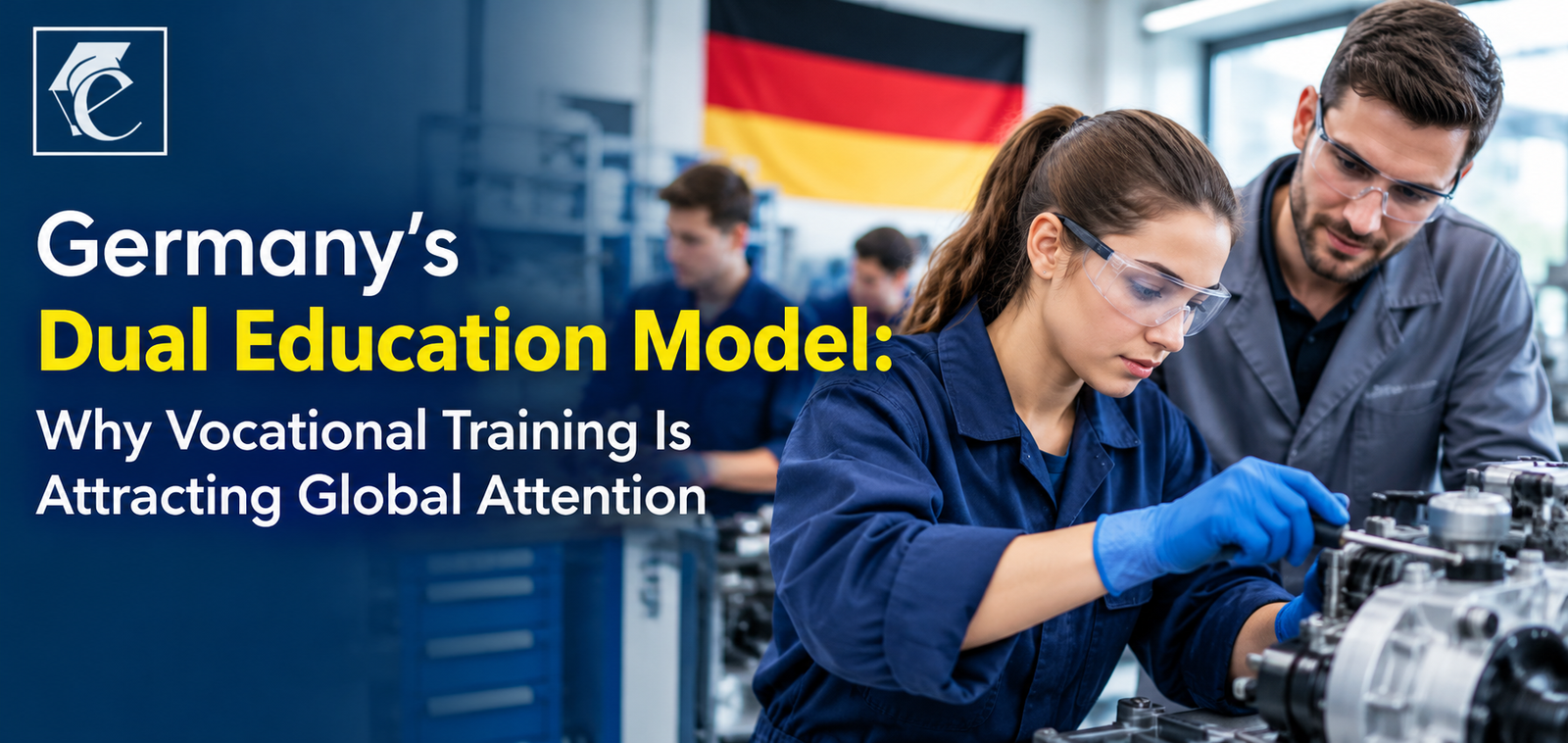
A university degree is often viewed as the traditional route to professional success, but Germany offers another pathway that combines classroom learning with practical workplace experience. Its dual education model allows students to acquire technical knowledge while developing skills directly within companies, creating a closer connection between education and employment.
The Germany dual education system has attracted international attention because it brings educational institutions and employers together to prepare learners for specific occupations. Rather than relying exclusively on academic instruction, students learn how their knowledge applies to real working environments. This approach is particularly relevant as economies seek skilled workers in manufacturing, engineering, healthcare, information technology, and other technical fields.
By integrating theory with practical experience, Germany has developed Germany dual vocational training framework that supports professional development, employer participation, and structured entry into the workforce. Understanding how this model operates can offer valuable lessons for countries looking to strengthen Germany vocational education and improve career opportunities for young people.
Understanding Germany’s Dual Education Model
The most characteristic feature of the dual education system in Germany is the integration of two educational locations – vocational schools and training companies. Students allocate their time between theoretical classes and practical training at a certain job place under the supervision of experts and can thereby get the required knowledge and skills for their profession.
In vocational schools, learners are taught subjects related to their profession as well as theory and general education. In the workplace, students apply theoretical knowledge, learn industry practices, use machinery and learn about professional environment.
The duration of training depends on the profession, but most programs last two to three-and-a-half years during which students are paid by their training companies and earn vocational qualification.
This system is made possible due to collaboration of employers, vocational schools, chambers of commerce and crafts, trade unions and government authorities.
The outcome of this collaboration is the integration of learning process and employment because learners acquire professional skills while employers take part in the process of preparing qualified workers for the future.
How German apprenticeship system Connects Education with Employment
The German apprenticeship system is built around the principle that occupational competence develops through practice as well as study. Instead of waiting until graduation to encounter the demands of a job, apprentices begin gaining workplace experience during their education.
One of the features that makes vocational education in Germany so appealing is that it aims at providing people with skills necessary for employment. One of the problems that many countries have is that their graduates might have qualifications but will not be able to demonstrate practical experience. Vocational education can help to solve this problem since it relates training to occupations.
This is seen from the German example of the way in which cooperation between industry and educational establishments can enhance training process. The former will provide practical knowledge while the latter will ensure that students acquire theoretical knowledge needed for their future occupation.
Moreover, vocational education provides students with the opportunity to become successful in life without attending universities. It gives them an opportunity to acquire specialization, earn money throughout their training period and have a chance to advance in their careers.
However, vocational education is not a universal solution to unemployment and lack of skills among people. Its effectiveness depends on such factors as the quality of training, work experience, involvement of employers and recognition of qualifications. In addition, it should include career guidance for students.
Why Vocational Education Is Gaining Global Attention
One of the aspects that makes Germany vocational education attractive is that it focuses on making people employable. One of the problems faced by many countries is that their graduates can have academic qualifications but be unable to demonstrate the necessary practical experience to potential employers. vocational training in Germany can assist with bridging this gap because it would relate the training directly to occupational needs.
This is shown by the German example of how cooperation between industry and educational institutions can improve the training process. While the former will bring practical knowledge, the latter will make sure that students receive necessary theoretical knowledge to understand their occupation.
Moreover, vocational education offers another way to succeed in life other than going to university. It will give students an opportunity to get specialisation, earn money during the course of training and get prospects for further career development.
Nevertheless, vocational education is not a cure-all method to address unemployment and lack of necessary skills. The success of such education depends on such factors as the quality of training, appropriate work experience, participation of employers and recognition of qualifications. Moreover, it requires career guidance for students.
How Germany’s Dual Education System Prepares Students for Careers
The key advantage of the model is that it allows combining theory and practice. It is not enough for learners to get familiar with the profession; they gradually gain the necessary competences that are necessary to be successful in fulfilling the tasks of the profession.
For instance, a future industrial technician can study technical theory in school and learn how to use equipment, maintain it, and keep safe in a special company providing training. A future learner of a commercial profession can combine theoretical lessons with practice in administration, customer service, or logistics.
Students get the opportunity to become more confident in what they are doing and get guidance from experienced people. Evaluations and tests at the end allow assessing if apprentices gained the necessary occupational knowledge and skills.
Furthermore, the dual education system in Germany allows developing the skills that can be applied everywhere in different professions. Such skills include communication, time management, teamwork, adaptability, and problem-solving.
Even though being graduated from an apprenticeship does not guarantee job placement, getting certain qualifications and gaining relevant experience may help students feel more competitive during job application process.
The Role of Employers and Industry Partnerships
A role of employers is crucial in the effectiveness of the German approach since the work-place training needs time, effort, and qualified supervision. The company must offer a good learning opportunity instead of using the apprentices as extra labour.
The more general context of vocational training in Germany includes collaboration between companies, schools, industrial organizations, and public authorities. The standards and regulations related to the occupation will help to set expectations from the learning process of apprentices.
Industry involvement can ensure that the training program stays in step with innovations and changes in professional requirements. In case when the employers notice new skills requirements, the content of training can be checked and revised.
Apprenticeships can help the companies to plan their workforce and to transmit their knowledge. The experienced workers can share their practical knowledge, and younger employees can offer fresh approaches.
However, participation involves obligations. It may be difficult for smaller companies to offer learning opportunities, and there may be fewer placements for some professions and some regions.
Challenges and Lessons for Other Countries
In spite of all the advantages it has, the model will not work without any modifications in another country, since it relies on existing networks of employers, acknowledged certificates, high-quality training programs and cooperative attitude from industry and educational institutions.
The countries that want to develop Germany dual vocational training fashion should think of whether or not companies are capable of providing training for students and whether or not schools have the possibility to provide necessary technical knowledge. It is also important to pay attention to the social attitude towards vocational professions. In case the apprenticeship is regarded as something that is worse than education at school, students won’t be interested in it even when they can use it for employment purposes.
Another issue that should be considered is accessibility. Students require clear information about occupations, their training, compensation and further opportunities.
The Future of Skills-Based Learning
Advances in technology are shifting the competencies that employees require. Automation, artificial intelligence, digital fabrication, renewable energy, and emerging demands in health care all require employees who have both technical know-how and practical judgement.
The Germany dual education model is an excellent example of how to adapt to this challenge, since on-the-job experience will familiarize students with the technologies and requirements of the time. Yet education programs must also continue to change, and apprentices must get opportunities to hone their skills.
For nations that wish to reform their vocational education systems, the main takeaway from the German case should be less about copying existing institutions than creating enduring relationships between teachers and employers, developing qualifications of merit, and embracing practical experience as a component of career success.
Conclusion
Germany Dual Education System highlights the possibility for linking education to employment through the concept of vocational learning. Through integration of classroom learning, work-related experience, and certification, it gives learners a chance to enter the world of skilled work while giving companies an opportunity to train the coming generation.
Though not devoid of limitations and success depending on how well it is done and its partnerships with industries, the Dual Education System of Germany is very resourceful in terms of providing lessons to other education systems that wish to narrow the gap between education and skills, and increase career prospects beyond academic path.
In the changing economic world, where there are questions regarding how people should prepare for work, vocational learning holds a lot of importance in relation to its long-term implications. It allows learning in line with practice.
FAQ
1. What is Germany’s dual education model?
Germany’s dual education model combines classroom learning at a vocational school with practical, paid training at a company. Students gain theoretical knowledge and hands-on work experience while preparing for a specific profession.
2. How does Germany’s dual vocational training system work?
Students typically sign a training contract with a company and attend vocational school alongside workplace training. The company provides practical experience, while the school teaches technical knowledge and related subjects. Training usually lasts two to three and a half years, depending on the occupation.
3. Why is Germany’s vocational education system attracting global attention?
Germany’s vocational education system attracts international interest because it connects education directly with industry needs. Its combination of practical experience, structured training, and recognized qualifications offers a model for addressing skills shortages and improving transitions from education to employment.
4. Is vocational training in Germany free for students?
Vocational school education within the dual system is generally publicly funded, and apprentices typically receive a monthly training allowance from their employer. However, costs and financial arrangements can vary depending on the programme and individual circumstances.
5. Do students get paid during vocational training in Germany?
Yes. Apprentices in Germany’s dual vocational training system generally receive a monthly training allowance from their training company. The amount depends on the occupation, employer, training year, and applicable agreements.
6. What are the benefits of Germany’s dual education model?
Key benefits include practical work experience, industry-relevant skills, a training allowance, recognized vocational qualifications, and a clearer pathway into employment. The model also helps employers develop skilled workers according to their workforce needs.
7. Can international students apply for vocational training in Germany?
Yes. International applicants may apply for vocational training opportunities in Germany if they meet the relevant employer, qualification, language, and immigration requirements. German-language proficiency is often important, and visa requirements depend on the applicant’s circumstances.
8. How does Germany’s dual education system help reduce youth unemployment?
The system helps young people develop skills that employers need and gain workplace experience before completing their training. This can improve their employment prospects and make the transition from education to work more direct, although outcomes also depend on economic conditions and labour-market demand.
9. Which industries offer dual vocational training in Germany?
Dual vocational training is available across many sectors, including engineering, manufacturing, information technology, healthcare-related occupations, hospitality, logistics, retail, and business administration. Available occupations and training requirements vary by profession.
10. Can other countries adopt Germany’s dual education model?
Yes. Other countries can adapt the model by strengthening partnerships between schools and employers, expanding apprenticeships, developing occupational standards, and involving industry in curriculum design. Successful implementation also requires suitable funding, qualified trainers, and consistent quality assurance.