
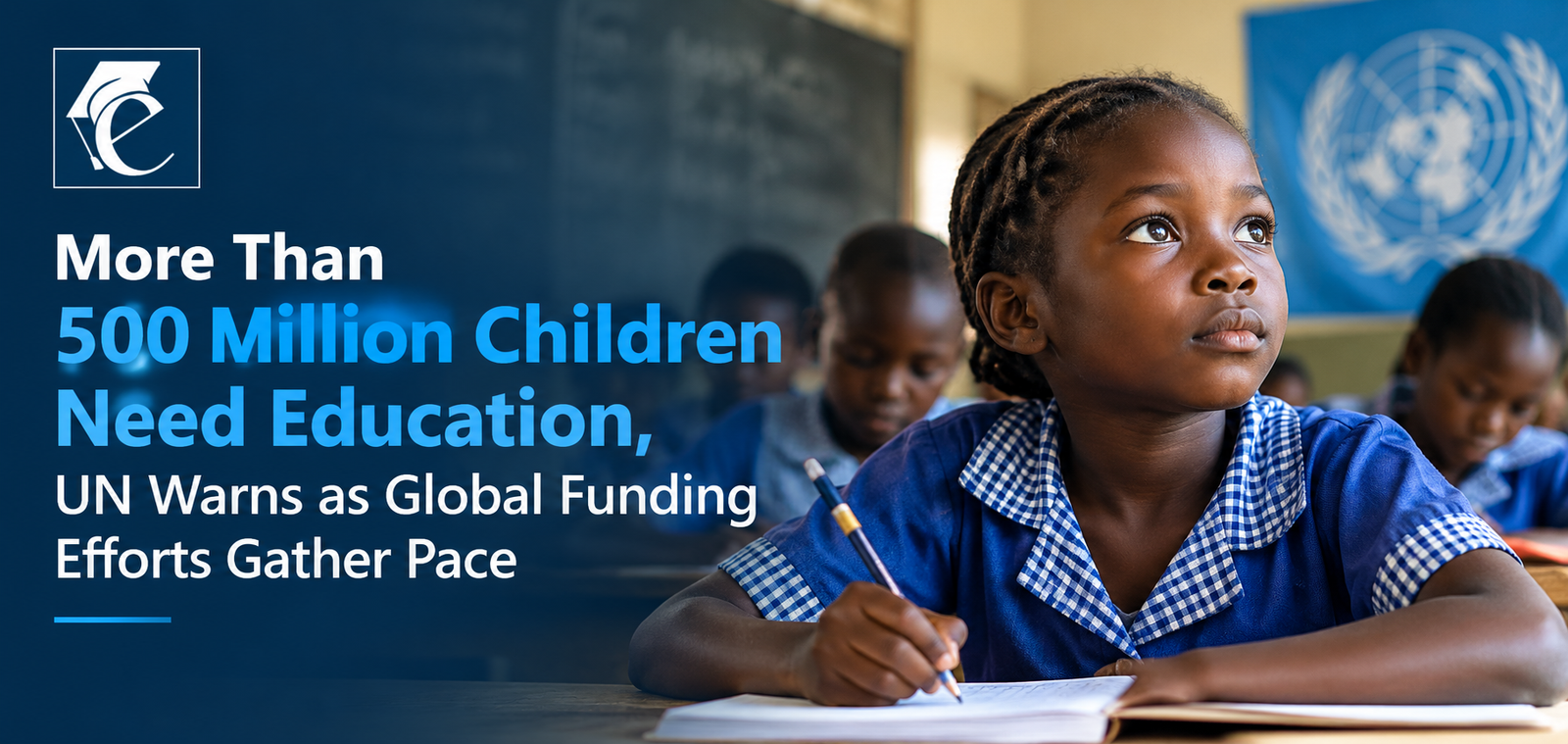
The global education crisis is leaving millions of children without classrooms, qualified instruction or the basic skills needed to build their futures. According to figures presented by Gordon Brown, the United Nations special envoy for global education, 273 million children are out of school, while another 270 million attend school but do not develop adequate reading, writing and mathematics skills. Conflict, climate disasters and insufficient resources remain major barriers to educational access.
War and Climate Disasters Keep Children Away From Classrooms
The scale of the global education crisis becomes most evident in those countries which are facing war and displacement. On a visit to Sudan recently, Maysa Jalbout, director of Education Cannot Wait, saw how an elementary school classroom was full of 120 students in scorching heat without any water or electricity. An 18-year-old girl, displaced because of the war and married off early, was struggling to continue her education.
But that particular school did not have space for hundreds of other children who were waiting outside. It became clear how badly these communities needed more schools, more teachers and more learning spaces. Climate-induced disasters are also causing interruptions to education. Floods in Nepal have damaged communities and infrastructure. This needs emergency support for these children to get back to school.
$3.5 Billion Mobilised to Strengthen Education Systems
The international response to the education crisis has resulted in new funding pledges. The Global Partnership for Education has revealed that $3.5 billion has been raised to assist more than 90 low-income countries to improve their education systems and enhance access to quality education.
This amount of funds has been received through $2.1 billion in confirmed and expected pledges from governments and private organizations, and $1.4 billion of co-funding, which includes $1 billion from development financial institutions and $400 million from philanthropists and private sector partners.
These pledges provide financial assistance to those countries trying to improve their education systems, but the size of needs is enormous. Any interventions in the global education crisis should target those children who are outside school as well as those who are within schools where education results are poor.
Gaza and Sudan Face Severe Education Shortages
The children impacted by conflicts continue to be amongst the most vulnerable. Education Cannot Wait declared an emergency investment worth $3 million for children living in Gaza and the West Bank in order to assist 13,000 children and adolescents. Vulnerable categories of children targeted for assistance include those injured or disabled due to conflict, orphaned children, and unaccompanied and separated children.
As per Jalbout, there are approximately 660,000 children out of school for the third year in Gaza, whereas some 70,000 young children do not have access to pre-school. The organization had also allocated $1 million in order to assist children affected by floods in Nepal get back to their studies.
On the other hand, in Sudan, another $22 million allocation was announced to provide assistance to several hundred thousand children. Still, some 8 million children in the country are currently out of school.
The 2030 Education Goal Remains Out of Reach
Brown has implored governments to make good on their promise of allocating 20% of government spending to education. Brown has also mentioned the UN’s development goals that were set in 2015. These goals include the provision of inclusive, equitable and quality education for all by 2030.
With that deadline around the corner, the issue of the global education crisis poses a number of questions regarding funding priorities, accountability and the ability of international programs to reach children in tough conditions.
The recent commitments are definitely a step forward, yet money won’t solve all problems. The resources should be used to provide these children with access to schools, professional teachers, necessary study materials, and overall assistance of those affected by conflicts and disasters.
For countless children, education does not merely mean a way out of poverty. It means an opportunity to bring some order into their lives, learn basic skills and create something from their life that goes beyond the conditions in which they grew up.