

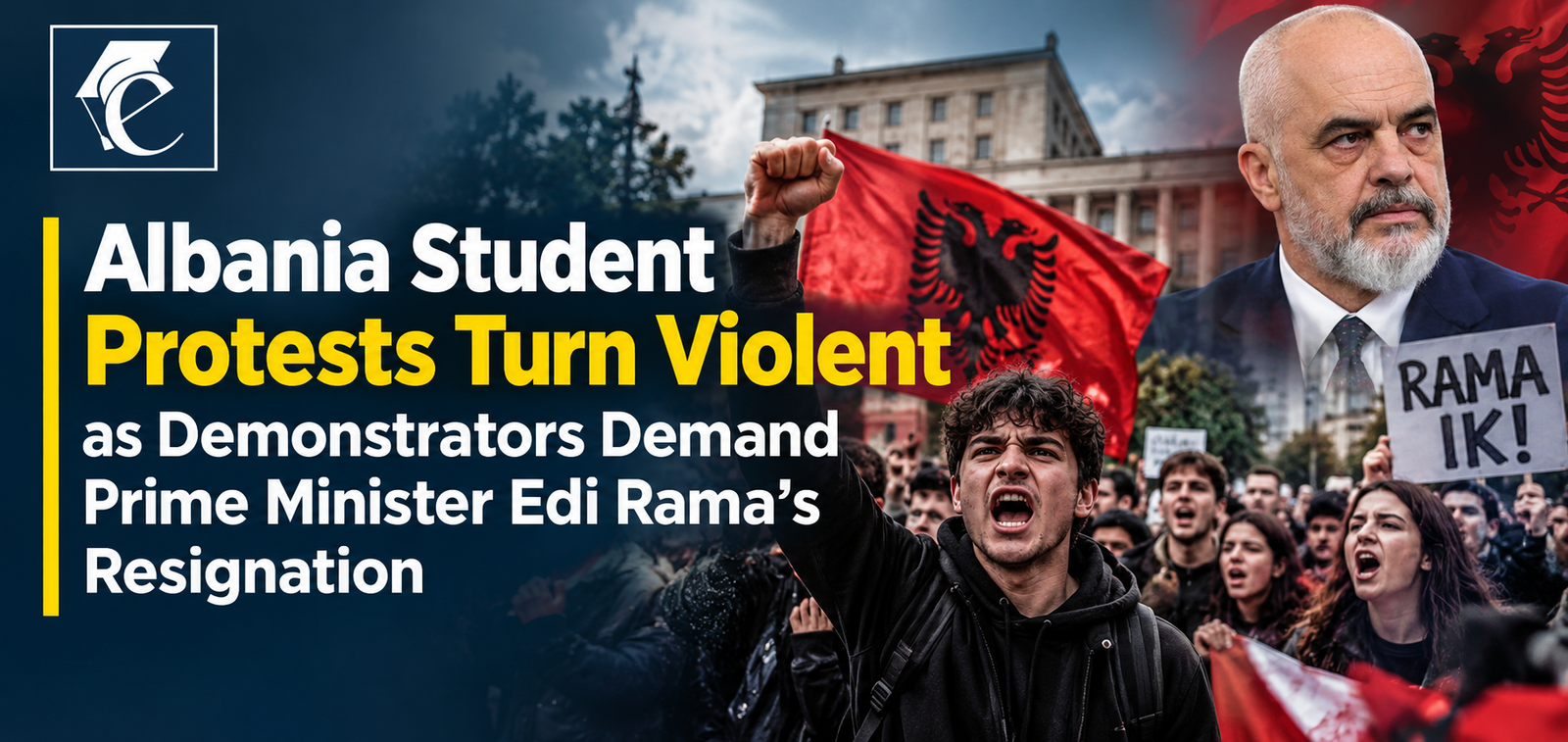
Thousands of demonstrators gathered in Albania’s capital, Tirana, on October 17, as student-led demonstrations demanding Prime Minister Edi Rama’s resignation escalated into violent confrontations with security forces. The unrest, which entered its fifth consecutive day, reflects growing public dissatisfaction over alleged government corruption, unemployment and declining educational standards.
According to Reuters, the Albania anti-government protests witnessed clashes outside the Education Ministry, where masked demonstrators threw rocks at riot police. Security forces responded with tear gas, stun grenades and water cannons. The demonstrations have expanded beyond the capital, creating one of the most significant political challenges to Rama’s administration since he assumed office in 2013.
Albania Anti-Government Protests Escalate into Violent Clashes
Violent activities escalated as groups of protesters found themselves face-to-face with police who were guarding government structures located in the center of Tirana. Some protesters vandalized property and broke windows or started fires in the vicinity of government buildings.
Police used methods of controlling crowds such as tear gas and water cannons. According to Reuters news agency, there is also evidence of the use of rubber bullets by the police on Saturday.
According to the authorities, there were about 500 arrests made with 330 people being released later. There were reportedly 120 officers and 45 protesters wounded in the clashes.
The Albania anti-government protests have increasingly attracted students and young professionals frustrated by limited employment opportunities and what they describe as persistent failures in public administration.
Corruption and Unemployment Fuel Public Anger
The Albania anti-government protests have been driven by longstanding concerns surrounding corruption, economic inequality and inadequate educational infrastructure.
The young protesters believe that the repeated broken promises of the government did not lead to any improvement in the prospects for employment or services.
The protests have also received support from the citizens who earlier protested against a luxurious tourism project that had been proposed for Albania’s southern coastline.
The project, which had the backing of investors like Jared Kushner, son-in-law of U.S President Donald Trump, had encountered protest from the locals owing to questionable land transactions.
Although there were charges regarding land sale connected with the project according to Reuters, but there was no wrong-doing on the part of Kushner who had nothing to do with the villagers’ dispute.
Prime Minister Edi Rama Rejects Resignation Demands
Despite all the pressures, Prime Minister Edi Rama has declined to resign, citing that his government is legitimately democratically elected.
Having won his fourth term in office in 2025, Rama has stressed the dedication of his government to ensuring stability and furthering the EU membership aspirations of Albania.
Commenting on the Albania anti-government protests, Rama has said that his government respects students and will ensure their right to peaceful protest.
Rama has once again restated his goal of ensuring Albania’s membership in the European Union by 2030.
Nonetheless, the ongoing protests and accusations of use of police brutality have raised concerns about how the government will deal with the public’s complaints.
European Union Ambitions Face Growing Challenges
The Albania anti-government protests come at a sensitive moment for the country’s European integration efforts.
Despite other countries in the Western Balkans, such as Montenegro, Albania still represents one of the major candidates for European Union membership. However, corruption and issues related to organized crime have become obstacles to this process.
Instability and prolonged demonstrations can cause an additional burden for the government that will need to prove its ability to reform and protect the rights of citizens.
Demonstrations in Albania coincide with other protests in Europe, where students and younger generations protest against financial troubles and lack of opportunities.
Albania Anti-Government Protests Raise Questions About Political Stability
The ongoing Albania anti-government protests reveal the rising tensions between the Albanian political establishment and the youth in search of accountability and economic opportunities.
Given the demands for Rama’s resignation by protesters and the unwillingness of the government to give up power, the likelihood of more confrontations is possible.
The response of the government to charges against police brutality as well as its readiness to respond to employment and corruption complaints will be followed with interest.
As the Albania anti-government protests persist, their effects might go beyond the domestic political sphere and affect the prospects for reforms and European integration in the country.