
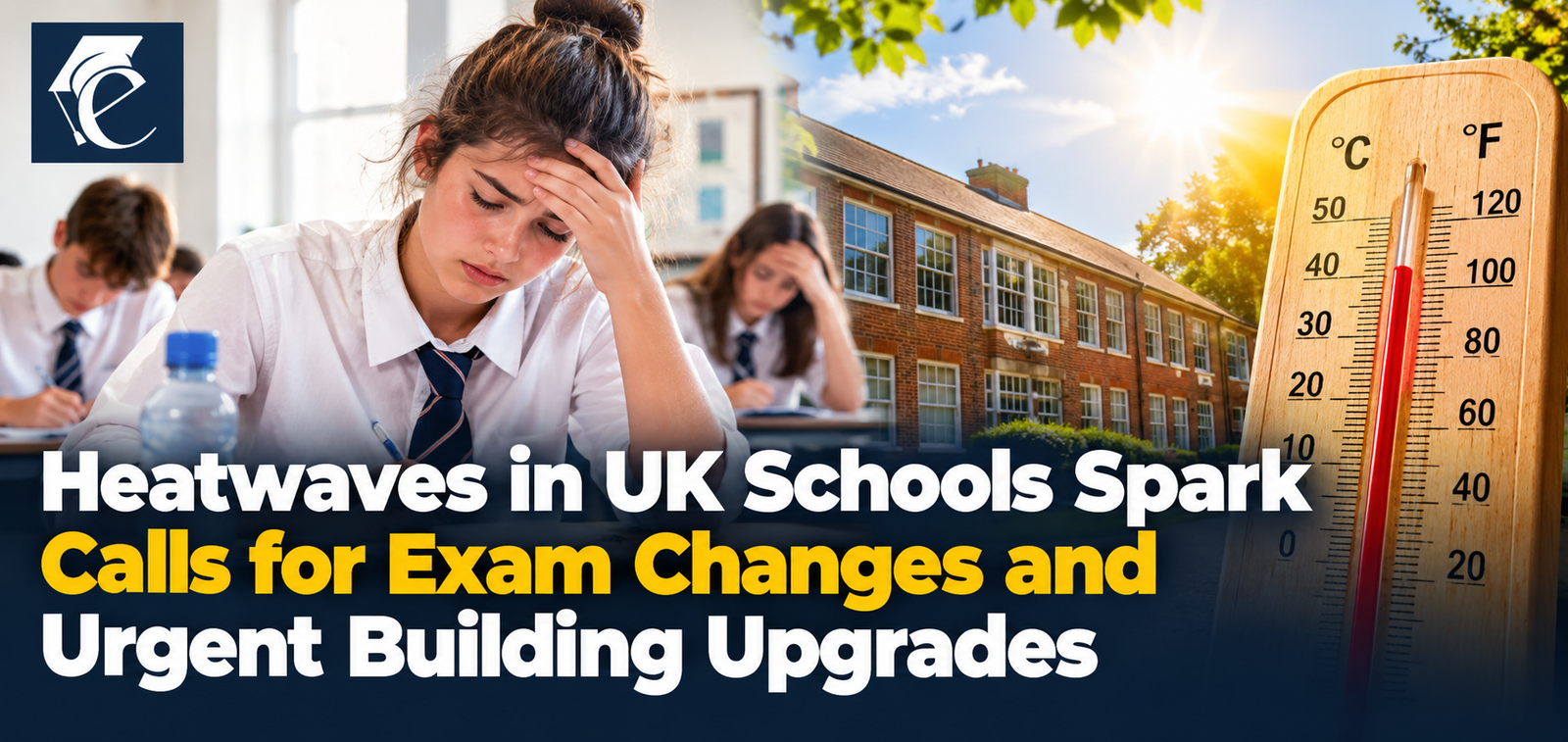
Rising temperatures across the United Kingdom are intensifying concerns about classroom safety, student performance and the future of the academic calendar. Daniel Kebede, general secretary of the National Education Union (NEU), has called for changes to examination schedules, school timings and infrastructure to help educational institutions cope with increasingly severe summer temperatures.
According to The Guardian, classroom temperatures exceeded 40°C during the summer of 2026, forcing schools to close and leaving students struggling to concentrate. The growing impact of Heatwaves in UK schools has prompted renewed calls for government investment in buildings that can withstand increasingly challenging weather conditions.
Rising Temperatures Disrupt Classroom Learning
A large number of schools in Britain have aged buildings that were built without consideration of enduring long stretches of hot weather. Buildings constructed during the Victorian times and in the 1960s and 1970s are often characterized by poor ventilation, shading, and cooling systems.
In the heat wave that occurred in June 2026, teachers complained that students suffered headaches, nausea, fatigue, and inability to concentrate due to the hot classroom environment.
The issue of Heatwaves in UK schools has therefore become more than a question of classroom comfort. It raises concerns about student wellbeing, educational continuity and whether existing school infrastructure can meet the demands of changing weather patterns.
Hundreds of Thousands of Students Miss Lessons
The magnitude of disruption has brought to light the learning challenges posed by warming. According to statistics provided by The Guardian newspaper, there were 760,000 school children in England and Wales who stayed out of class due to the closure of schools owing to heat waves that month. The children lost over 15 million hours of learning time.
The teachers said that classrooms were characterized by students being unable to concentrate and stay comfortable owing to high temperatures. It is said that some students even resorted to lying down on the floors.
This disruption has underscored the need for having a strategy to deal with Heatwaves in UK schools.
Daniel Kebede Calls for Changes to Exams and School Hours
Daniel Kebede has suggested revising the academic calendar so that students may be exposed to less heat during the summer. The ideas put forward include starting classes early, ending classes while it is still cool and considering changes in the schedule of summer exams.
An extension of the summer vacation period has also become another solution being considered. Any modification would have to be coordinated between the schools, the examination boards, parents and the education authorities.
Summer exams are extremely important since students have to take them under pressure and in classrooms that can be very hot, making it harder for them to concentrate. Modifications in the exam schedule would ensure a safer environment, provided there were no clashes with the academic schedule.
Thus, the discussion on Heatwaves in UK schools has raised the question of whether the traditional academic calendar is still appropriate for such warm summers.
Schools Need Urgent Infrastructure Investment
Adjustments in school timetables might bring some temporary solution, but Kebede has stressed the importance of investing more in the buildings themselves. Such improvements might include improving ventilation, exterior shading, insulation improvements and proper cooling system installation.
Upgrading school facilities would enable to keep the classrooms at a comfortable temperature level and avoid possible future school closures. This strategy might contribute to job creation in construction and other related sectors.
Schools lack funds for major renovation works on their own, which is why government assistance would be critical here. Otherwise, they would remain vulnerable to the same problems due to rising temperatures.
Disadvantaged Students Face Greater Risks
The impacts of Heatwaves in UK schools may be especially challenging for those children who come from poor families. Schools located in areas of deprivation may lack facilities to install cooling devices or make the building modifications.
Children, who are forced to stay at home during school closures, will go back to their crowded houses with poor ventilation. Also, parents and caregivers will find it difficult to organize supervision or to take days off.
Such disparities will contribute to the increase of the already existing educational inequality if some schools manage to adapt more successfully to such conditions. In order to avoid such outcomes, public spending needs to be directed towards providing equal access to cool environment.
What Happens Next?
Increasing incidences of heatwave-related disruptions have put the school facilities and scheduling system in focus once again. Examination date changes, alteration of school timing and improvements in the existing facilities can assist schools to get ready for future summers.
This may prove to be costly and require careful planning and coordination among all sectors within the field of education. There are various factors which authorities must consider when they look at the safety of students while meeting the requirements of examinations, childcare facilities and other practical concerns of families.
Heatwaves in UK schools will continue to be a relevant topic of discussion as the debate goes on.