
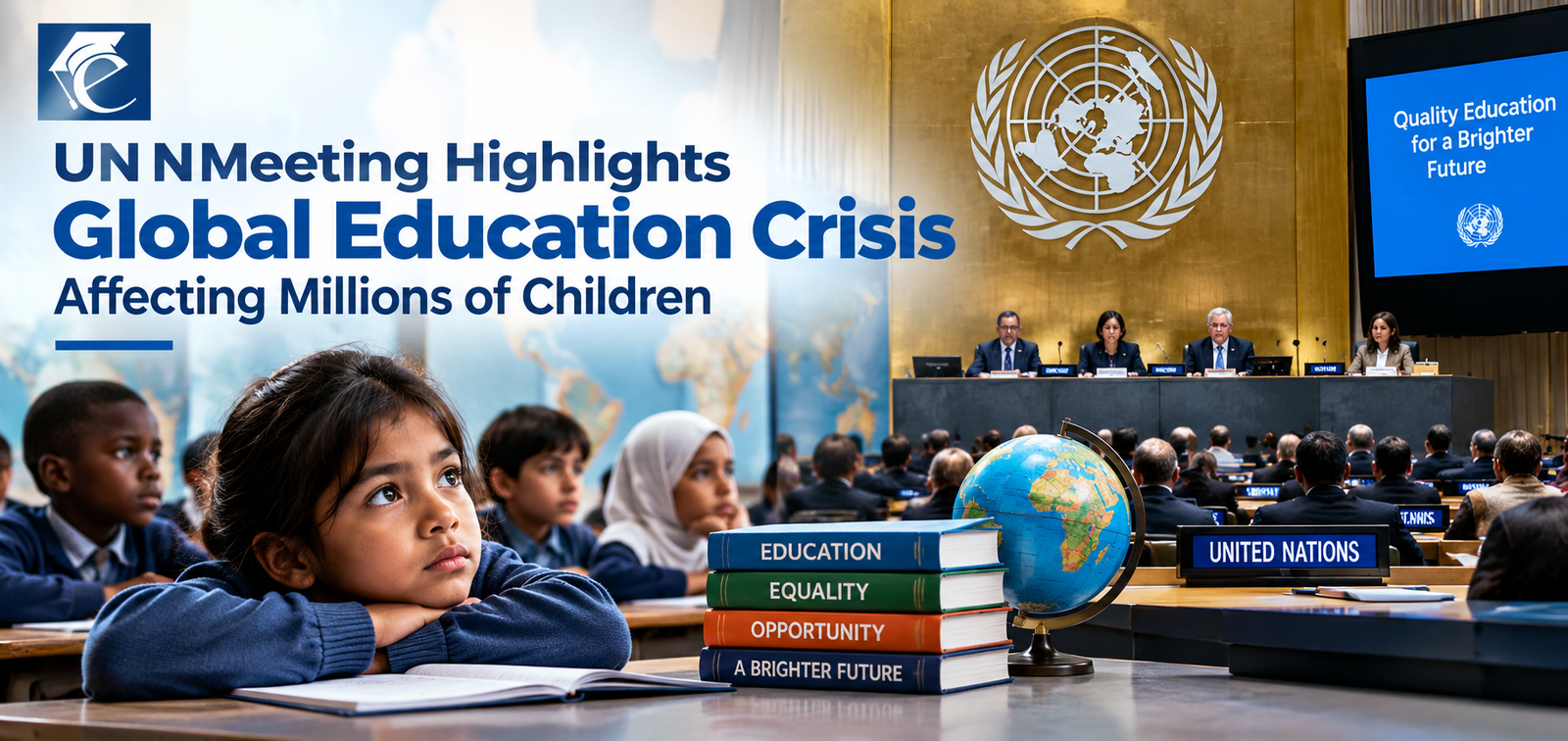
Global leaders and education advocates gathered at a high-level United Nations meeting to address what officials described as a worsening global education crisis, with millions of children around the world still lacking access to quality learning opportunities. The discussions highlighted how conflict, displacement, poverty, climate-related disasters, and persistent inequality continue to disrupt education systems and threaten the future of an entire generation.
Participants emphasized that education remains one of the most powerful tools for reducing poverty, promoting social mobility, and supporting long-term economic development. However, despite progress in some regions, millions of children remain out of school or are unable to acquire basic literacy and numeracy skills, raising concerns about the long-term consequences of the global education crisis.
Conflict and Displacement Continue to Disrupt Learning
Another one of the main themes in the conference was the effect of war on education. Kids growing up in the midst of war face some of the biggest challenges in education, given the fact that schools can be affected in any number of ways – from being damaged or completely destroyed to being used for something else entirely during times of war.
In fact, many humanitarian groups mentioned the fact that instability in the region was having a serious negative effect on education for children. This is demonstrated by the example of Gaza, where hundreds of thousands of kids have been going without proper education for years now, as most schools have either been damaged or destroyed by war.
The meeting also highlighted the educational challenges facing refugee and displaced children worldwide. According to international organizations, refugee students often encounter lower enrollment rates, limited access to secondary education, and fewer opportunities for higher learning compared to their peers. These realities remain a major component of the ongoing global education crisis.
Learning Losses Remain a Major Concern
It was observed that the education sector continues to bear the brunt of interruptions faced by the sector over the last few years. Studies presented during the discussion confirmed that learning losses have impacted students’ performance, especially those from disadvantaged backgrounds. Educational specialists raised concern that without any intervention, the setback would impact students’ career prospects in the future.
The global education crisis goes well beyond students attending school. There are many children in school who are failing to make basic learning gains.
Calls for Greater International Cooperation
The speakers at the UN meeting pointed out that tackling the global education crisis requires cooperation from all these groups mentioned above. It became clear that investments in education infrastructure, teacher training, digital technologies, and inclusion policies were required to provide equal access to education.
Also, several speakers at the UN meeting emphasized the growing role of technology in the expansion of access to education. Although digital learning platforms and artificial intelligence bring new chances for individualized education, it was noted that the uneven distribution of technological facilities might lead to increasing inequalities in education.
Education Seen as Key to Global Development
Throughout the conversations, the leaders made it clear that education is highly connected to other goals of development such as economic growth, social stability, health issues, and workforce development. If the global education crisis does not get any attention, it may negatively impact the development agenda and reduce inequality around the world.
United Nations officials have encouraged leaders to view education as an investment and not as an expense since the education system must be improved in order to create societies that can handle future challenges. With knowledge becoming an important factor in the global economy, education becomes more significant.
Looking Ahead
The conference ended with an urgent call for action towards making sure every child receives safe and quality education. Although a lot needs to be done, there is still hope that it can be achieved with dedication and collaboration. Solving the global education may take a long time, but the leaders in attendance agreed that nothing would be achieved by not taking any action at all.