
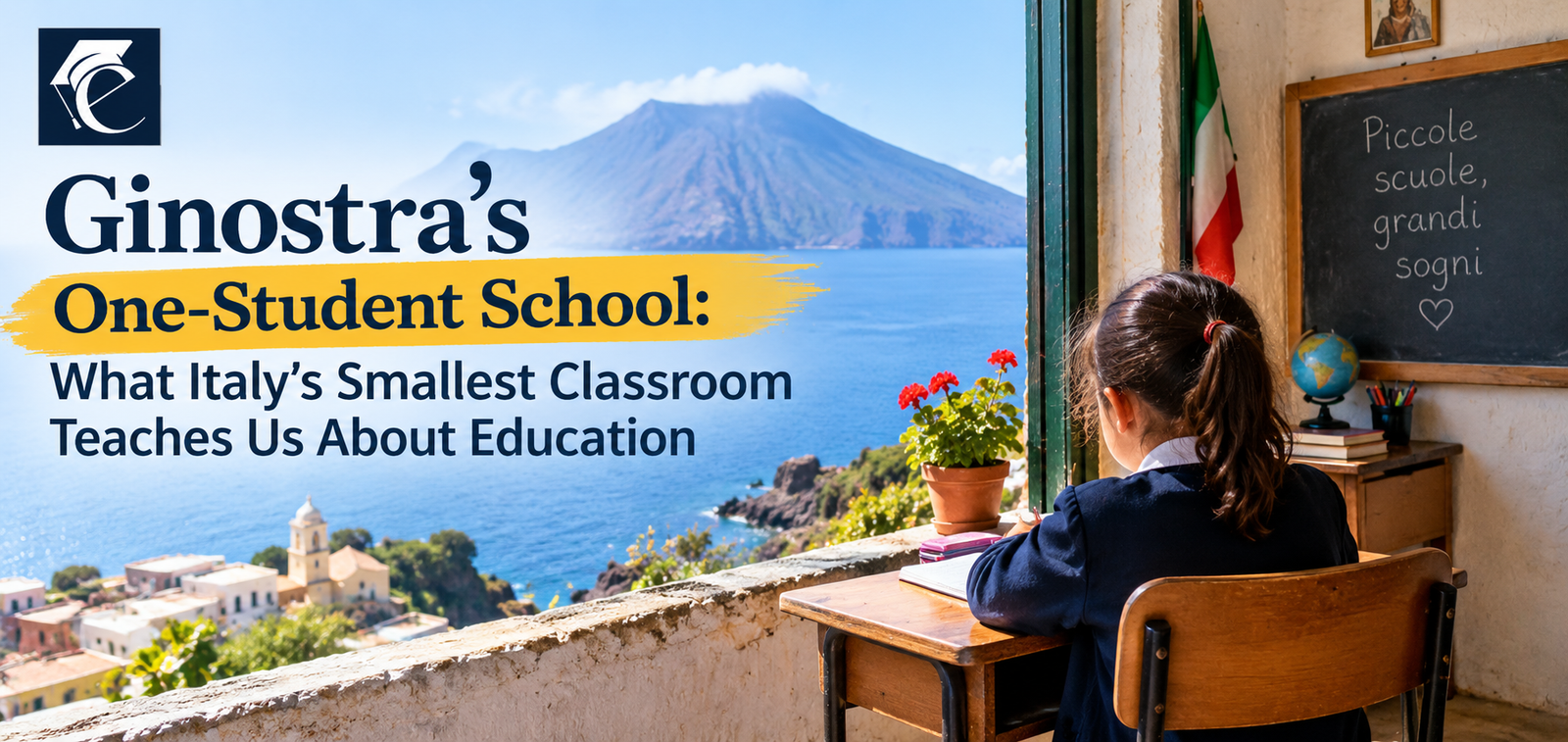
In an age when education systems are often measured by scale, infrastructure, and technological advancement, a tiny school located on a remote Italian island offers a very different perspective. Perched on the volcanic island of Stromboli in the small hamlet of Ginostra, this unique institution has attracted international attention for a remarkable reason: it serves only one student.
The One-Student School in Italy stands as one of the most unusual educational environments in the world. While many schools struggle with overcrowded classrooms and limited teacher availability, this tiny classroom presents the opposite reality. One teacher, one student, and a learning experience shaped entirely around individual attention.
Far from being a curiosity alone, this extraordinary school raises important questions about access, inclusion, community, and the future of education. It reminds us that the purpose of education is not determined by the size of a classroom but by the commitment to ensure that every child has the opportunity to learn.
The Story of a Remote Island Classroom
In one of the most remote towns in Italy, there is a one-student school known as the Ginostra one-student school. This school is made possible because the local authorities consider geography should never be a factor preventing education. Ginostra can only be accessed through the waterways, and the town has a small population throughout the year. Notwithstanding the remoteness of the place, education is offered to the young people within the area.
It is not surprising for the Ginostra one-student school to exist since the country places great emphasis on educational accessibility. In other words, rather than moving the child or making him/her go far away for education, the Italian education system has brought education right to the doorstep of the student.
This may look expensive in the eyes of the economist.
More Than a Classroom
At first, it might appear that the Smallest classroom in Italy is rather straightforward. There are no crowded desks, noisy hallways and no big groups of students working together. But where it falls short of numbers, it sometimes excels with personalization.
With just one student in class, all the lessons could be designed to fit his or her needs, preferences, and learning speed. The teacher would have an opportunity to give feedback immediately and adjust their teaching techniques in a more individual way.
Such level of personalization is what many other educational establishments strive for. While the majority of schools need to cope with educating several dozen pupils at once, the Smallest classroom in Italy provides a great example of individual education.
It facilitates a high level of teacher-student communication.
The Human Side of Education
Schools are generally characterized by their performance indicators, standardized tests, and efficiencies. Nevertheless, one of the main social functions of schools lies within the community.
One-Student School in Italy shows how important the human aspect is. Indeed, its presence supports the existence of the remote community where families do not need to leave their hometown because there is still education for their children.
For small communities located far from cities, schools mean not only educational institutions but something else – the stability and future prospects of generations. The existence of the school may impact family decision about leaving the place or staying there.
That is why keeping the school open for the only one pupil can be seen as an educational investment and investment in preserving the community at the same time.
Lessons for the Italian Education System
Indeed, the case of the small Italian school provides important lessons regarding the overall Italy education system. For a long time, the country has had a tradition of providing access to education in different geographic areas, ranging from mountainous villages, rural territories to remote islands.
The approach to providing support to the school on an isolated island shows that equality means not only applying some standard policy measures but also considering community specificity.
The Italy education system deals with a number of challenges typical for any other countries’ educational systems, such as demographical shifts, lack of teachers, budget limitations, etc. At the same time, there are some ways of solving these problems, demonstrated by the example of Ginostra.
Apart from efficiency, accessibility is also one of the priorities of educational policy.
Understanding the Challenges of Rural Education
The tale of Ginostra is also illustrative of the Challenges of rural education, which have an impact on various communities throughout the globe. Rural schools often encounter numerous challenges such as population decline, scarcity of resources, transportation problems, and teacher attraction and retention.
Challenges associated with rural education may cause substantial discrepancies in education in comparison with urban communities. For instance, rural students often encounter fewer chances of engaging in extracurricular activities and attending specialized courses due to logistic limitations.
Challenges related to rural education include not only difficulties associated with school’s infrastructure but also the challenge of providing high-quality education to small populations of students with little money.
Rural schools manage to overcome many challenges due to great flexibility. Rural schools have to cope with various difficulties and still be able to educate their students successfully.
Ginostra is one of the best examples of how much students can benefit from accessible education despite various difficulties.
The Value of Personalized Learning
One of the most valuable insights coming out of this unusual school experience is that of personalized education. In fact, many studies in the field of pedagogy point out the importance of providing customized learning experiences to students according to their individual needs.
When it comes to larger schools, however, the realization of such a personalized approach might be challenging. Teachers have to operate in various situations within the classroom, dealing with curriculum-related obligations and bureaucratic concerns.
The One Student School in Italy represents the epitome of personalization, where the system adjusts to the needs of the learner rather than the other way around.
Though creating a similar school model may be difficult on a large scale, its core idea can be the impetus for the development of new education practices.
A Global Conversation About Educational Priorities
The existence of a school serving a single student naturally prompts a broader discussion about educational values. Many observers ask, What can Italy’s one-student school teach us about education?
The answer extends far beyond the island itself. It highlights the importance of viewing education as a public good rather than simply a service measured by cost efficiency. It reminds us that educational systems exist to serve learners, regardless of how many there may be.
When considering What can Italy’s one-student school teach us about education?, the lesson may be that true educational equity requires a willingness to meet students where they are, even when doing so demands additional resources and creative solutions.
The school demonstrates that access, inclusion, and opportunity remain foundational principles worth protecting.
Looking Toward the Future
With the continued evolution of educational systems around the globe, technology will most likely prove increasingly useful in bringing together learners irrespective of their physical distances from one another. Virtual learning platforms, classrooms, and resources may solve some of the issues raised above.
However, the story of Ginostra teaches us that education is a human endeavor. Education in today’s schools involves teachers, social interaction and community support.
The One-Student School in Italy may seem small, but it carries an important message that goes much further than the classroom itself. The school is an example of dedication to educational access and community resiliency.
In a world obsessed with numbers and statistics, this tiny institution proves an important reminder – the real value of an education system does not lie in the quantity of students it educates, but in the dedication to each one of them.
FAQ
1. What is Ginostra’s one-student school?
Ginostra’s one-student school is a small rural school in Ginostra, Italy, serving a single student while providing access to essential education within the local community.
2. Where is Ginostra’s one-student school located?
The school is located in Ginostra, a small village on the island of Stromboli, part of Italy’s Aeolian Islands.
3. Why does Ginostra have a one-student school?
Ginostra has a very small population, making it difficult to maintain a conventional school with multiple students. Keeping a local school helps ensure children can receive education without leaving their community.
4. How does a one-student school work?
A teacher provides individualized lessons based on the student’s age, curriculum, and learning needs. The small setting allows lessons to be highly personalized.
5. What can educators learn from a one-student school?
It highlights the importance of personalized learning, teacher-student interaction, flexibility, and adapting education to individual student needs.
6. What are the benefits of a one-student classroom?
Benefits can include personalized instruction, closer teacher-student communication, flexible learning activities, and greater attention to the student’s strengths and challenges.
7. What challenges does a one-student school face?
Challenges may include limited peer interaction, fewer opportunities for group activities, isolation, and the difficulty of providing the same range of extracurricular experiences available in larger schools.
8. Can one-student schools provide quality education?
Yes. School size alone does not determine educational quality. Strong teaching, appropriate resources, curriculum support, and meaningful learning experiences can contribute to a quality education.
9. What does Ginostra’s school teach us about the future of education?
Ginostra’s experience shows how education can become more flexible and student-centered, particularly when schools adapt teaching methods to local communities and individual learners.
10. Why is Ginostra’s one-student school important for education?
It demonstrates that access to education can remain important even in very small and remote communities, while offering a unique example of how personalized learning can work in practice.