
For generations, education was largely measured by what students knew. Success depended on mastering subject content, memorizing information, and performing well on examinations. While academic knowledge remains essential, educators across Canada are increasingly recognizing that knowledge alone is no longer sufficient preparation for the future.
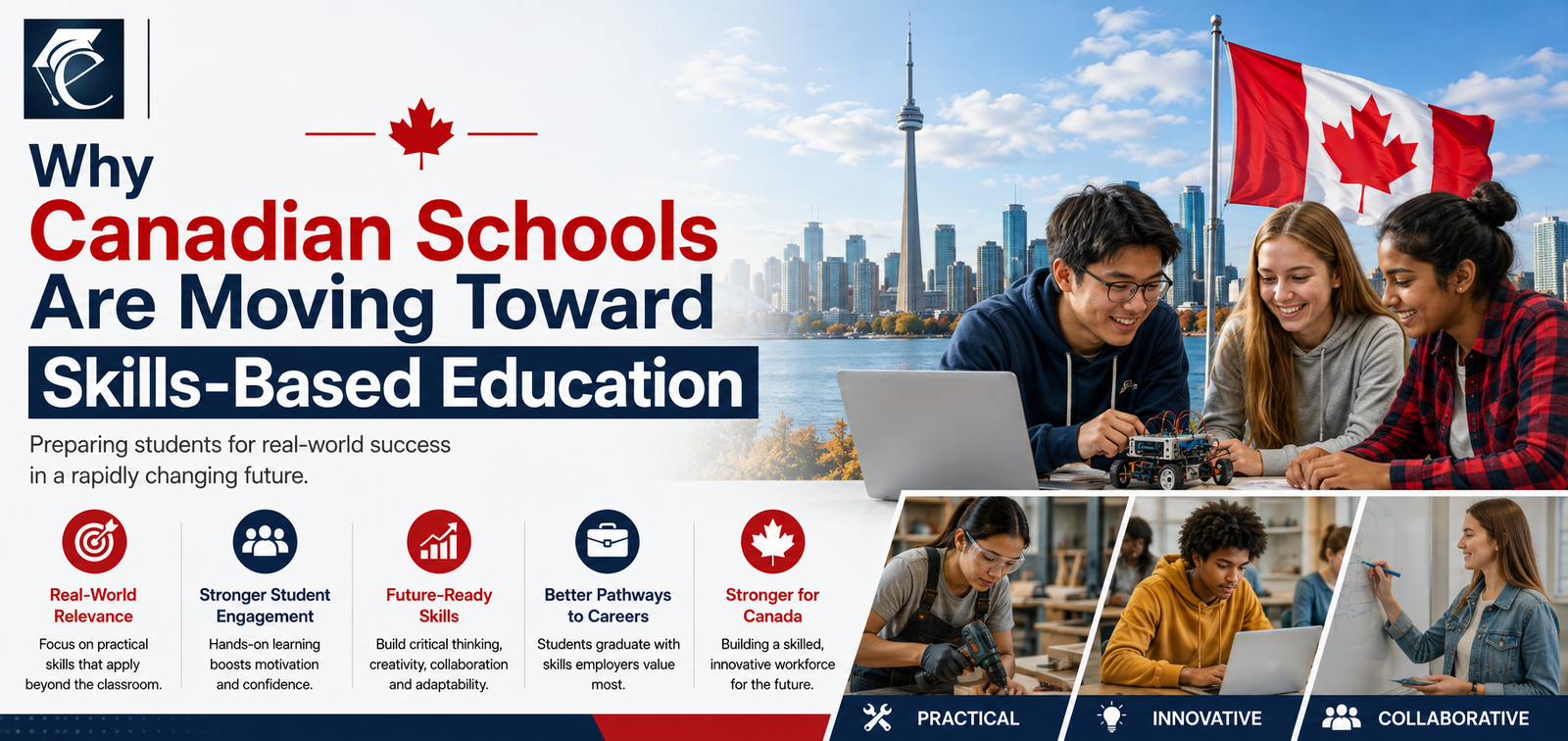
Today’s students are entering a rapidly evolving economy shaped by technological change, automation, artificial intelligence, and careers that often require continuous learning. As a result, Canadian schools are placing greater emphasis on skills-based education—an approach that focuses not only on what students know, but also on what they can do with that knowledge. Across provinces and territories, curricula are being redesigned to prioritize competencies such as critical thinking, communication, collaboration, creativity, problem-solving, adaptability, and global citizenship.
Understanding Skills-Based Education
Skills-based learning, also known as competency-based learning, goes further than traditional teaching methods. Instead of concentrating only on rote learning and taking tests, students are motivated to use their knowledge practically, tackle challenges, work in teams, and showcase their practical skills.
Competency-based learning concentrates on observable combinations of knowledge, skills, and behaviors. Students are required to showcase what they have learned through various projects, presentations, practical applications, and other forms of evaluation apart from examinations.
It does not negate academic learning but tries to relate it to the competencies required by students throughout their lives.
Preparing Students for an Uncertain Future
One of the main reasons why Canadian schools are adopting skill-based education is the changing nature of work.
Most students currently attending school will join career positions that will not be known to them yet. In the modern world of business, employers look out for transferable skills like adaptability, communication skills, creativity, and problem-solving, besides technical skills. The Canada Skills for Success program takes into account the changing nature of work and recognizes some important foundational and transferable skills like adaptability, collaboration, communication skills, creativity and innovation, digital literacy, and problem solving.
It is clear that educational administrators realize that preparing for this future is not just about providing students with information, but rather equipping them with the necessary skills like critical thinking, adaptability, collaboration, and lifelong learning.
A Nationwide Shift Toward Competencies
While Canada’s education system is organized provincially and territorially, a degree of agreement is developing among all parts of the nation with regard to the importance of competencies.
Studies carried out in connection with Canadian K–12 systems have found that most provinces and territories are slowly adopting a competency-based approach to education, at varying paces and in varying languages. Many provinces and territories have started integrating competencies into their curriculum rather than offering them as distinct courses.
The Council of Ministers of Education, Canada (CMEC) has defined six pan-Canadian global competencies including: critical thinking and problem solving; innovation and creativity; learning to learn; collaboration; communication; and global citizenship and sustainability. These competencies have played an important role in the development of curricula for various provinces.
The common vision is a product of the increasing realization that educational success must involve both academic success and life skill acquisition.
Provincial Leaders in Curriculum Transformation
A number of provinces are now seen as leaders in terms of competency-based learning.
The case of British Columbia, whose curricula have undergone redesign, is one of the best-known cases of competency-based learning. The province uses a “Know-Do-Understand” approach where content knowledge is combined with the curriculum’s competencies and the understanding of these competencies.
Another example of a province that has implemented competency-based learning is Quebec. The province incorporates competency-based learning not only in its curriculum but also in its assessments in various disciplines and grade levels. Competencies that are developed by Quebec include intellectual, methodological, social, personal, and communication-related competencies, in addition to disciplinary knowledge.
The province of Nova Scotia is another case where competency-based learning is emphasized through frameworks where learners are asked to demonstrate mastery, think critically, collaborate, and use their knowledge.
Connecting Education to Real Life
One more reason for this trend is the urge to make education more meaningful and relevant.
The conventional approaches in education sometimes find it difficult to provide an answer to the very common question that many students pose to themselves: “Why am I learning this?” Skills-based education helps to overcome this difficulty by encouraging learners to apply knowledge to a practical situation.
When working on solving environmental problems, carrying out research work, engaging in collaborative efforts, or being involved in entrepreneurial activities, students manage to establish a connection between theory and practice.
Rethinking Assessment
With the changing face of education, assessment needs to change as well.
Standardized testing continues to have merit when it comes to assessing particular types of knowledge, but there may be areas of competency, such as creativity, teamwork, communication, and problem-solving, which cannot be assessed effectively through this means alone. This has led to a number of regions within Canada considering the use of alternative assessment strategies.
Some of these include project-based learning, portfolio assessment, performance-based assessments, peer collaboration, presentations, and reflection assessments. The objective is to allow learners to assess their learning through a variety of avenues while also allowing teachers to determine competency in areas that cannot be measured by standard tests.
Challenges and Opportunities
The move to skills-based education, however, does present certain difficulties.
In order for there to be competency-based learning, there will have to be changes made to curriculum planning, teaching approaches, methods of assessment, and professional development programs. Teachers will need to be given help when it comes to devising new ways of instructing and assessing. There continues to be debate about competency assessments as well.
Despite these problems, many teachers see the change as necessary. This is because of the growing complexity of our world today.
Looking Ahead
Education in Canada is going through a slow but significant change. Although literacy, numeracy, sciences, and content knowledge have always been considered the essential aspects of the process of teaching and learning, schools across the country are beginning to understand that to succeed in the modern world, it takes more than just that.
Through promoting such skills as critical thinking, creativity, communication, cooperation, adaptability, and the pursuit of learning throughout life, skill-based education aims to prepare students for the future where both knowledge and flexibility are needed.