
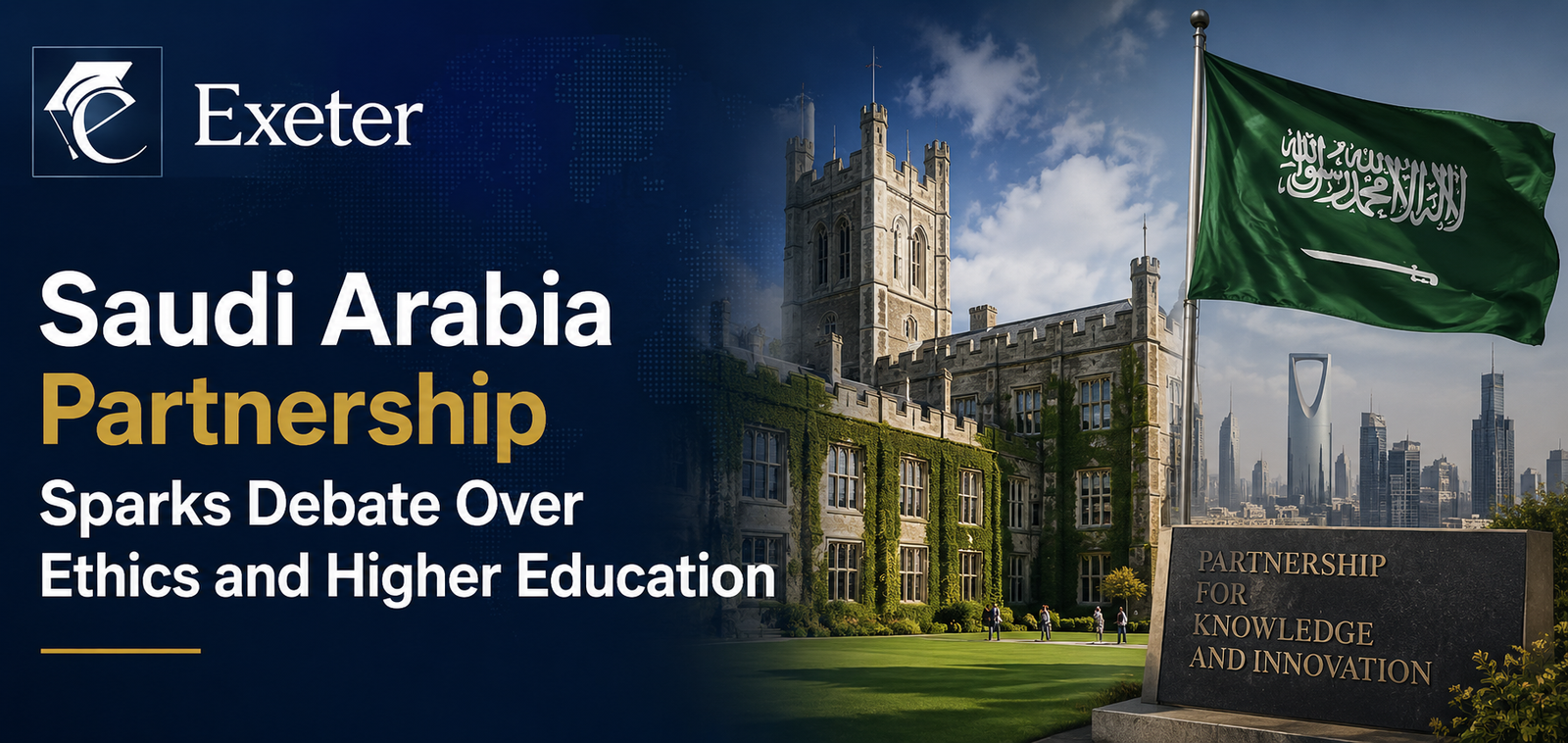
The recently approved Exeter Saudi Arabia Partnership has ignited debate across the United Kingdom’s higher education sector, raising questions about the balance between international collaboration, financial sustainability, and ethical responsibility. The University of Exeter has formally approved an agreement to provide advanced academic training to senior Saudi military officers and government officials, a move that supporters describe as a legitimate educational partnership but critics view as deeply controversial.
The agreement comes at a time when universities across the UK are facing financial pressures and increasingly seeking international partnerships to diversify revenue streams. However, the nature of this particular arrangement has placed the Exeter Saudi Arabia Partnership under intense public scrutiny.
What the Partnership Involves
Under the agreed arrangement, academics from the University of Exeter will be teaching a master’s degree in Applied Security and Strategy to participants at the National Defense University in Riyadh, Saudi Arabia. The course is scheduled to start in the 2026-2027 academic year and will admit about 20 senior military and government officials every year for a period of three years.
The university has characterized the course as an academic course aimed at enhancing the strategic thinking and leadership skills of professionals within defense and government institutions. The university claims that the course is consistent with its general strategy of international engagements and academic collaborations.
The Exeter Saudi Arabia Partnership is also expected to generate significant revenue for the university, making it one of the more substantial international education agreements undertaken by the institution in recent years.
Growing Criticism From Academics
Although there are some economic gains that would be made through this arrangement, the partnership has attracted controversy among faculty members and academics’ trade unions. The level of disapproval has been high because this deal has come at a time when the university has been thinking of making cuts in terms of employment, especially in humanities, arts, and social sciences.
Officials of the University and College Union (UCU) have raised concerns over this deal, claiming that the university administration seems to be willing to seek funding from such sources as the deal is being done alongside cuts on the academic areas that are responsible for the university’s image.
This is part of a bigger discussion happening in the UK universities about the ethics of partnerships with institutions and governments that attract international criticism over civil rights and freedoms.
Human Rights Concerns Remain Central
The main point of disagreement concerning the Exeter Saudi Arabia Partnership is linked to the human rights abuses committed by the latter country. Human rights groups have repeatedly accused the country of abusing freedoms of speech, political opposition, and judicial processes.
It has been suggested that collaboration between education and military or governmental organizations might be seen as an endorsement of the state policy, especially in cases where the programs are related to the training of leadership or strategic skills. On the other hand, some people suggest that education may promote communication and cooperation.
In this way, the distinction in views has become the hallmark of the discussion on this issue.
Exeter Defends the Agreement
There have been numerous defenses from the university regarding the Exeter Saudi Arabia Partnership, in which international partnerships go through thorough academic and moral scrutiny prior to being approved. It has been made clear by the university that educational interaction with international partners is an essential aspect of their mission and makes up a part of their impact around the world.
It has also been pointed out by the university that the partnership is part of a broader picture of cooperation between the UK and Saudi Arabia in terms of defense, education, and professional development. Military training and education have existed for many decades now between the two countries in various ways.
A Wider Debate for Higher Education
This dispute about the Exeter Saudi Arabia partnership is not limited to one particular college. Indeed, universities all over Europe and North America face an increasing number of issues related to where funding comes from, who the partners are, and how to reconcile the need for money with the values of academia.
As universities continue to search for alternative ways of earning money during times of economic change, international partnerships will most certainly gain importance and, consequently, public attention.
Looking Ahead
The Exeter Saudi Arabia Partnership Program is more than just an educational partnership because it has taken center stage in the wider discourse of ethical considerations, international relations, and the future of higher education institutions. Although proponents of this partnership see it as an opportunity to engage globally and exercise influence in academia, opponents remain wary of its potential to contradict the values taught by universities.
As the program gets ready to take off, the debate is likely to rage on. It could even provide the basis of a case study for universities around the world at this time of increasing globalization of education and diplomacy.