
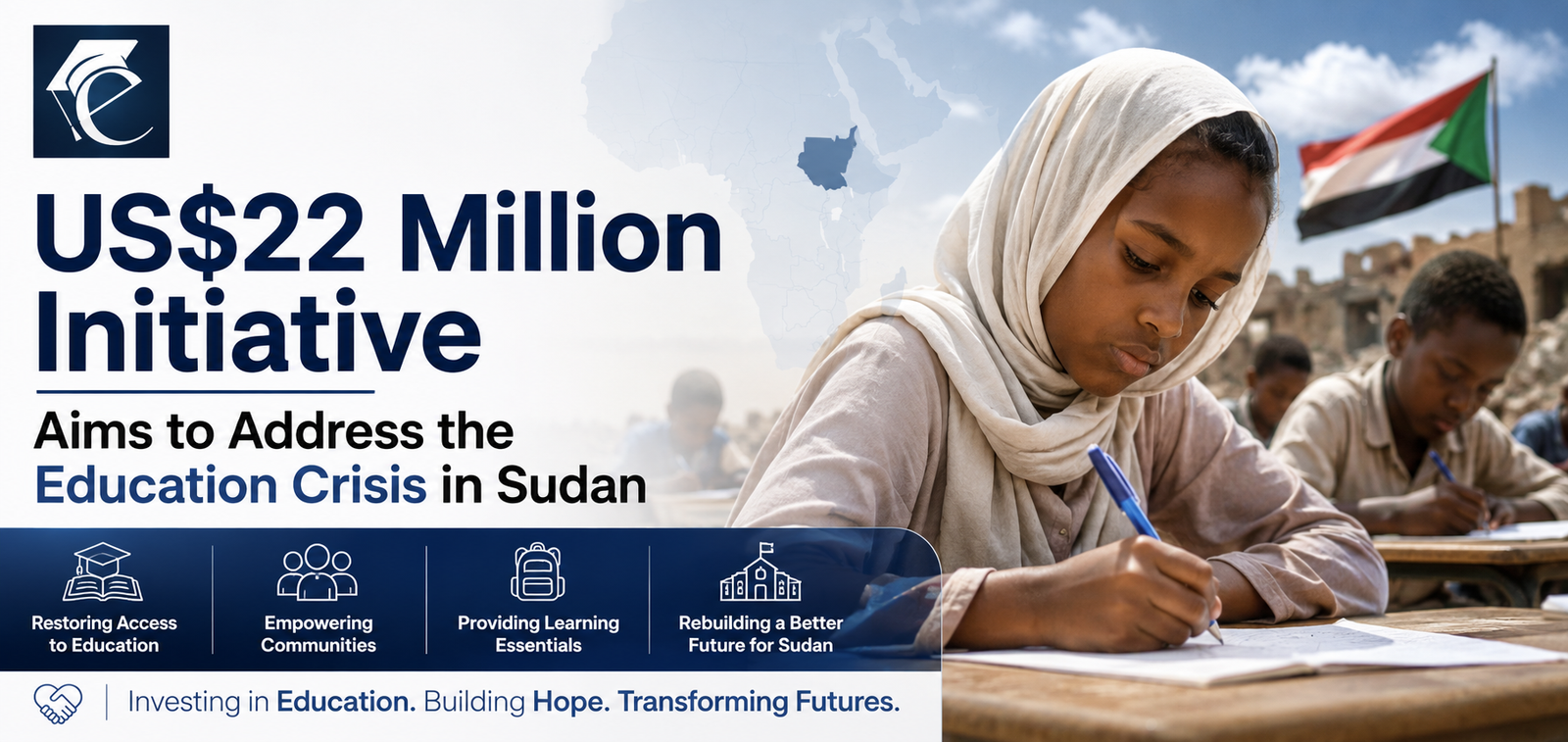
A new US$22 million funding initiative has been launched to support nearly 200,000 children and adolescents affected by conflict and displacement in Sudan. Announced by Education Cannot Wait (ECW), the global fund for education in emergencies, the program seeks to restore access to learning for some of the country’s most vulnerable communities. As the Education Crisis in Sudan continues to disrupt the lives of millions of young people, the investment is expected to provide critical support to children who have been deprived of education due to ongoing instability.
The three-year initiative will focus on regions including West Darfur, South Kordofan, and Gedaref, where conflict and displacement have had a particularly severe impact on schools and learning opportunities.
Understanding the Education Crisis in Sudan
The Education Crisis in Sudan has taken a turn for the worse due to the onset of the conflict in April 2023. Millions of children have been reported not attending school, and many schools have been destroyed, closed down, or made inaccessible. This is putting an entire generation of kids at risk of missing out on a learning opportunity that could change their lives.
Not only does this affect them academically, but it also has had impacts on the safety and well-being of the kids, as well as their social development. Many families have been displaced and forced away from their homes, which has made education increasingly hard to access.
Reaching Nearly 200,000 Children
In the newly launched program, it is expected that almost 200,000 children and youth would be positively impacted through both formal and non-formal learning opportunities. In this regard, emphasis will be placed on internally displaced children, refugee children, and host communities lacking educational capacity.
Girls and children with disabilities would receive special focus in this effort to ensure that the assistance would reach those who usually experience the greatest challenges accessing education. This program will be an integral part of the efforts aimed at tackling the Education Crisis in Sudan, especially in those areas affected by conflict.
More Than Classroom Learning
It does not just stop at educational support for children. Apart from providing them with educational materials and access to school, there will be mental health and psychosocial assistance provided in order for children to be able to deal with the traumatic events they have been exposed to.
Training teachers, engaging the community, and improving the learning environment will also be included in this project. In addition, there is an emergency response included in the project in order to guarantee that educational support will be provided even when future disruption takes place because of either humanitarian or climate change issues.
Collaboration at the Local Level
The plan will be put into practice by means of collaboration between the international organizations and Sudanese community organizations. Save the Children will spearhead the process along with other organizations including Plan International, LM International, among others.
It is important to note that a considerable amount of funds will go into national and local organizations due to an increased focus on community-based initiatives. Local participation is viewed by experts as key to achieving sustainable progress in solving the problem of Education Crisis in Sudan.
Looking Ahead
Even though US$22 million is not sufficient to completely solve the Education Crisis in Sudan, the program is an important step towards bringing back the learning process for thousands of children who have not been able to get their education due to conflicts. Through access to education, psychological counseling, and community-level action, the initiative will not only provide relief but also increase resilience.
Continued work of humanitarian agencies on solving challenges in Sudan cannot ignore investing in education, which is important for safeguarding the young generation and helping create a more stable future. The success of this initiative can be seen as a model for addressing educational interruptions in other areas.