
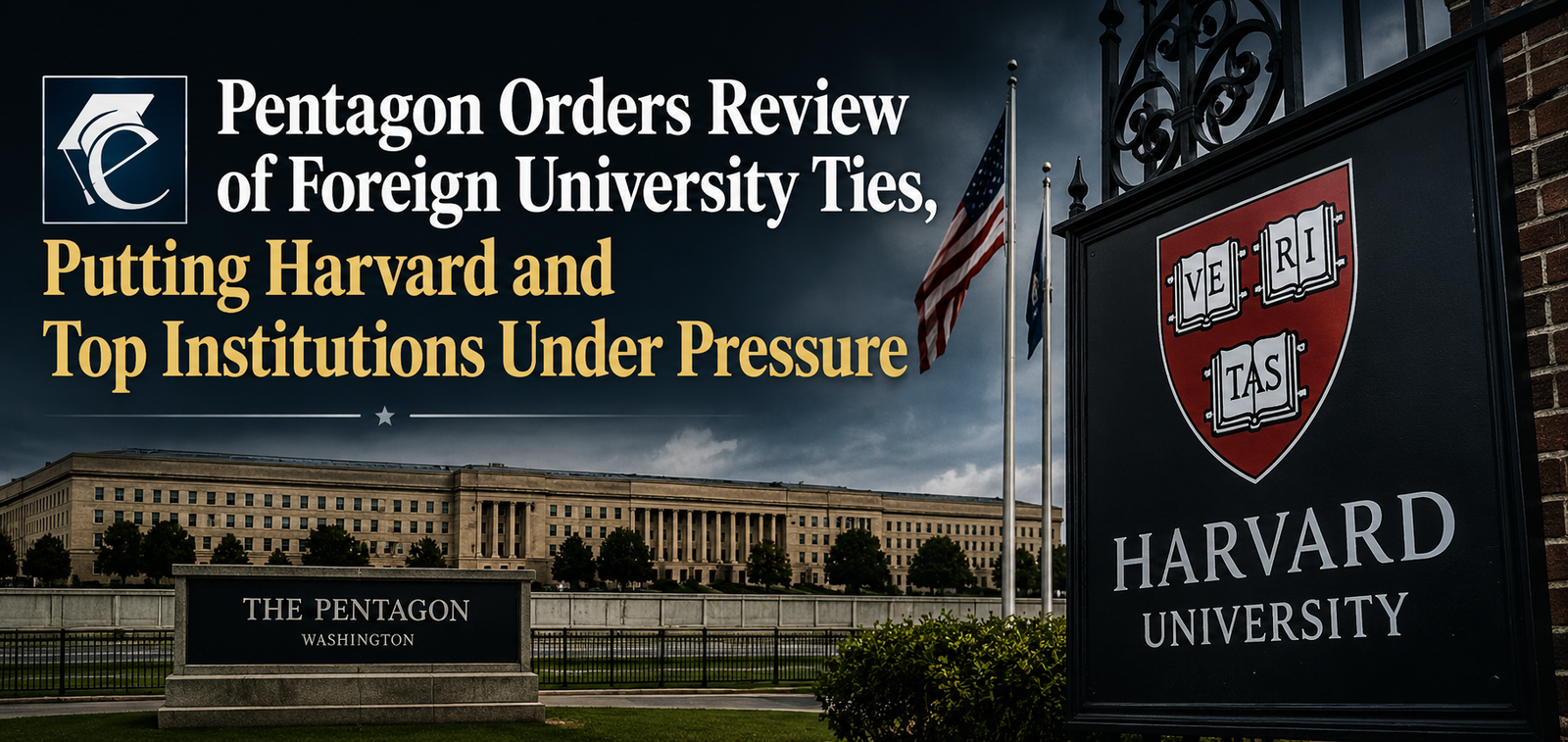
The U.S. Department of Defense has ordered 30 leading American universities to conduct an immediate review of their academic, financial, and research partnerships with foreign institutions, warning that failure to comply could result in the loss of federal funding. The move places some of the country’s most prestigious institutions, including Harvard University, the Massachusetts Institute of Technology (MIT), Johns Hopkins University, Georgetown University, and the University of California, Berkeley, under heightened scrutiny.
The directive marks one of the most significant federal interventions in higher education in recent years and has brought renewed attention to concerns surrounding foreign influence in American research. The ongoing Pentagon university funding review is part of a broader effort by the Trump administration to strengthen national security safeguards around federally funded research programs.
Focus on Foreign Partnerships
As per the Pentagon, universities have to review their cooperation that might be with any institution that is listed in the new list of foreign organizations maintained by the US government in terms of its 130 foreign entities posing a possible threat to national security. Of the foreign entities listed, most are from China, with some other foreign institutions being from Russia and Iran.
The idea is that federally funded research should not end up aiding the technological development of any country that is seen as a rival. As a result, the Pentagon university funding review requires universities to identify problematic relationships and, if necessary, terminate them before the August 31 deadline.
Harvard Finds Itself in the Spotlight
While the Pentagon never published the entire list of colleges and universities affected by the probe, there are reports saying that Harvard University is among those universities being subjected to the probe. In fact, the university has been receiving more federal scrutiny lately because of its involvement in issues including foreign funding disclosures and campus policies.
The congressional investigators have recently scrutinized an organization associated with Harvard University that was allegedly used to accept some research grants funded by foreign entities. Even though Harvard University denies doing anything wrong and claims that it never tried to get around federal disclosure rules, the issue raised more questions about the university’s international relations.
For many observers, Harvard’s inclusion highlights how the Pentagon university funding review extends beyond routine compliance checks and reflects a wider debate about the role of foreign funding in American higher education.
Supporters and Critics Clash
The advocates of the Pentagon’s move claim that universities getting millions of dollars in grants from the government are supposed to follow stringent security measures. The Department of Defense said that research on advanced technology, artificial intelligence, engineering, and any other innovations which have anything to do with national security need more oversight to ensure that they are not misused by the government of other countries.
But the critics say that the Pentagon university funding review may lead to some confusion among the universities and the researchers who are working with foreigners in a legitimate manner. Some higher education bodies raised a question if universities were being considered as a threat to security without any evidence.
The Chinese Government has also criticized this move, saying that the Washington Government is politicizing academic exchanges.
Broader Implications for U.S. Higher Education
The current Pentagon university funding review is widely viewed as part of a larger shift in U.S. policy toward academic institutions with international ties. In recent years, federal agencies have been monitoring any collaboration that takes place between universities and China, due to espionage concerns.
Should universities end up being compelled to cut off any ties with China, the effects might not be limited to the universities themselves but may include research groups, student exchange programs, and even joint scientific studies. According to experts, the result of this review will determine how universities handle any foreign connection for many years to come.
Looking Ahead
With the August 31 deadline drawing near, the country’s universities are scrambling to analyze many international alliances. The analysis provided to the Defense Department will go into the decision of whether or not institutions can still qualify for federal research grants in the coming future.
In connection with the Pentagon university funding review, there will be more discussions regarding the balance between national security and academic freedom. Regardless of the outcome of the initiative, whether it will improve research security or become an obstacle to international cooperation, it is expected that its effects will last in the coming years.