
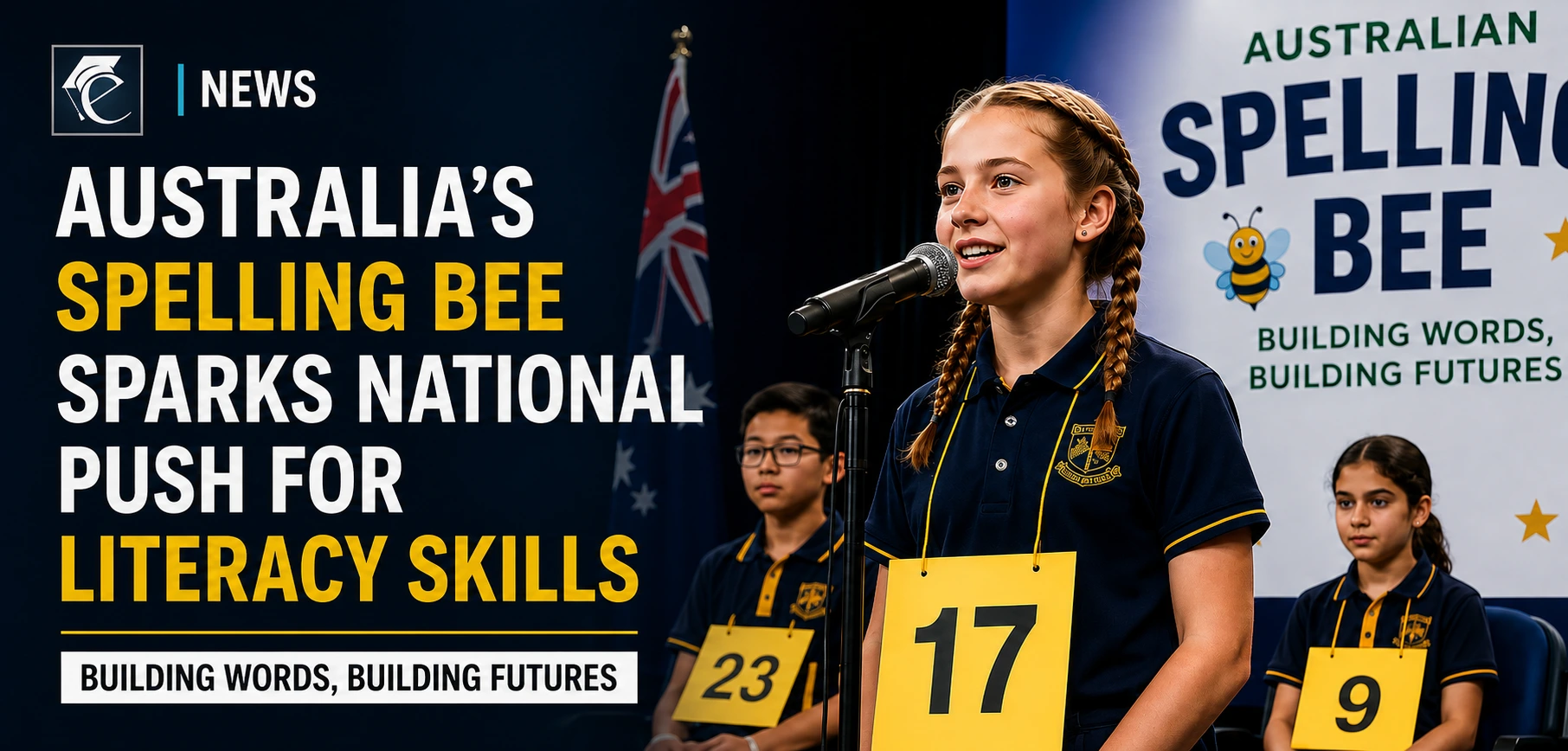
Australia’s commitment to strengthening literacy has received a significant boost as the 2026 Prime Minister’s Spelling Bee records its highest-ever opening week participation. More than 27,300 students have already registered through over 1,800 teachers, marking a 58% increase compared to the same period last year. The remarkable response highlights a growing consensus among educators that reading, writing, and spelling deserve renewed attention as schools face increasing pressure to balance expanding curriculum demands with foundational learning.
The surge has also reignited discussions around Australia literacy education, with teachers, school leaders, and academics advocating for greater emphasis on essential language skills that underpin every stage of learning.
Record Participation Reflects Growing Interest
Organized by Kids News, the Prime Minister’s Spelling Bee has grown to become one of the biggest literacy programs in Australia for primary and middle school children. Students in Year 3 through 8 are eligible to participate in the program, where the difficulty level increases round after round.
Participants can register for the program until 21st August, and state finals will be held between late August and early September. It is expected that this year the number of participants will top last year’s number of 82,000+ participants.
Education experts say the overwhelming response demonstrates that families and schools increasingly recognise the value of Australia literacy education in preparing students for long-term academic success.
Teachers Call for Greater Focus on Core Learning
Despite the continued rise in participation numbers, there is still a widely held view among educators that this particular competition underscores a wider problem faced by schools across Australia.
According to Angela Falkenberg, who is the President of the Australian Primary Principals Association, the role of the school in society has been evolving steadily to include an ever-widening scope of social problems from which schools cannot escape.”
“While all these programs can be considered good and important, they take away the time needed to teach children reading, writing, and arithmetic.
The debate has become central to discussions surrounding Australia literacy education, with educators calling for policies that better protect classroom time dedicated to foundational learning.
Why Literacy Remains the Foundation of Learning
Literacy continues to be seen as much more than a subject to be taught by education scholars; rather, it is the foundation for success in all other subjects.
As explained by Professor Pamela Snow of the School of Education at La Trobe University, learners who face difficulties in literacy skills in their early years of primary school will continue to struggle with their studies. Studies indicate that learners who do not meet the required reading standards by year three have little chance of being able to catch up on their own without educational intervention.
Learners with good literacy skills can understand mathematics, science, history, and communicate within each discipline.
This makes continued investment in Australia literacy education essential not only for individual learners but also for the nation’s long-term educational outcomes.
Spelling Plays a Bigger Role Than Many Realise
While spelling bees seem easy enough, experts believe that their significance is far greater than just improving vocabulary.
According to Associate Professor Tessa Daffern of La Trobe University’s SOLAR Lab, the ability to spell well is one of the best measures of good writing skills. Children who automatically know how to spell words do not spend much mental energy on words themselves; instead, they can concentrate on structuring their thoughts, arguments, and presenting them effectively.
Spelling used to be considered memorisation, but now it is viewed as an important element of literacy.
This perspective continues to strengthen support for initiatives promoting Australia literacy education through engaging classroom activities.
Competition Encourages Learning Beyond the Classroom
The Spelling Bee conducted by the Prime Minister seeks to make literacy fun and at the same time promote a spirit of healthy competition.
They conduct spelling tests within time frames based on the academic year of the participants. This is free for students from Australia, whether they study in school or are homeschooled. The Spelling Bee program has seen participation from almost 300,000 students.
The programme also encourages families to become involved in reading and vocabulary-building activities, extending the benefits of Australia literacy education beyond school hours.
A National Conversation About the Future of Education
The record breaking level of interest shown in this year’s Spelling Bee comes during a very important time in the development of education in Australia. With ongoing conversations about the importance of curriculum priorities, teacher workloads, and student wellbeing, literacy has been making its way back into the discussion as a priority in Australia.
Many experts in education believe that despite the need for preparing our children for the more technological and complex future ahead, success still hinges on having good literacy skills. Without literacy, there would be no way that students could harness the power of new technology and learning in their future.
The excitement surrounding the event indicates that Australians understand that improving literacy education in Australia is not just about creating good spellers but ensuring that our young people are equipped with vital communication, comprehension, and critical thinking skills.
As the number of participants increases, the Prime Minister’s Spelling Bee is a testament to both the power of language learning and the importance of literacy skills.
Also Read :- Education Excellence Magazine for More information