
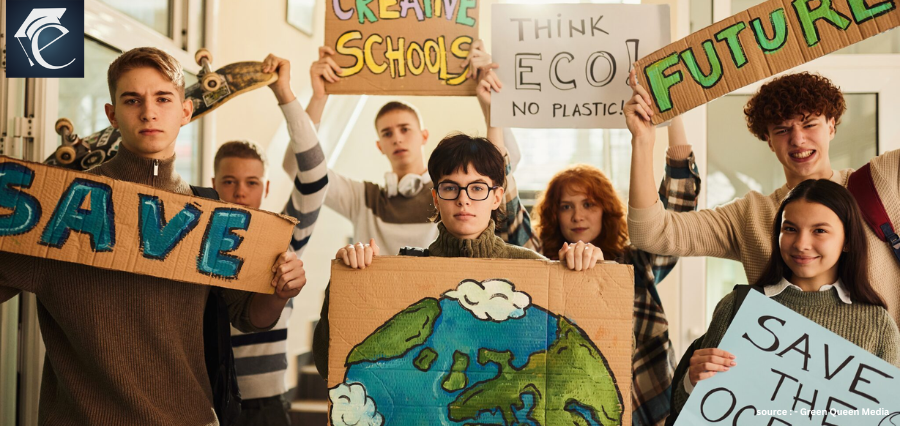
The world is facing environmental challenges that affect every country, community, and individual. Rising temperatures, extreme weather events, melting glaciers, and pollution are no longer distant concerns, they are part of everyday life. This is why Climate Change Education has become one of the most important subjects in modern learning. It helps students understand the causes and effects of environmental changes while encouraging responsible action for a sustainable future. Schools, colleges, and institutions now recognize that teaching environmental awareness is just as important as teaching science or mathematics. Strong Climate Change Education prepares young people to protect the planet and make informed decisions for future generations.
What Is Climate Change Education?
Climate Change Education is a process of educating students on global warming, environmental sustainability, carbon emission, renewable energy, and human influence on nature. It gives scientific knowledge and practical awareness of environmental responsibility.
Such an education can assist learners to comprehend the role of everyday activities like transportation, consumption of energy, managing wastes, and industrial expansion in causing climate issues. It also educates potential remedies such as conservation, recycling, and green innovation.
This is not only to deliver information but also to inspire long-term action and responsibility.
Why It Matters in Schools Today?
Learners are increasingly living in a world that is directly impacted by climate-related catastrophes. Across the world, floods, droughts, wildfires, and erratic patterns of weather are increasingly becoming common.
This renders Climate Change Education very important in schools. By learning about these problems at a young age, students are better-equipped to make responsible decisions in their everyday lives. They are taught that it is not only the governments that should take care of the environment, but also individuals.
Education is awareness, and action is awareness. This is what makes climate learning a mandatory aspect of academic systems all over the world.
Building Environmental Responsibility
Among the most powerful advantages of climate education is the fact that environmental responsibility is formed at a very young age. Students start to realize the importance of water conservation, plastic waste reduction, electricity saving, and promoting environmentally-friendly practices.
Such tiny measures may appear to be mere trifles, but they bring about long-lasting behavioral change. Students can understand that sustainability begins with daily choices through Climate Change Education.
Such an attitude contributes to the creation of a generation that appreciates nature and realizes that it is necessary to save resources and the future.
Encouraging Critical Thinking and Problem Solving
Climate challenges are not simple and need innovative solutions. Students have to be taught how to critically think on issues of environmental challenges and not just to memorize facts.
Climate Change Education promotes the discussion of renewable energy, sustainable agriculture, green transportation, and policy policies. It educates the students on the connection of science, economics, politics, and society in environmental concerns.
Such learning enhances critical thinking and equips the students to be future innovators, researchers, and accountable leaders.
Creating Community Awareness
Students tend to take classroom lessons back home and into society. As they get to know about climate responsibility, they also affect parents, siblings, and neighbors.
Indicatively, a student who is taught about waste segregation can promote recycling at home. Anyone who is educated on water conservation can contribute to lessening the amount of water wasted in the home on a daily basis.
This demonstrates that Climate Change Education is not limited to schools but it raises awareness in society.
Challenges in Climate Education
Regardless of its significance, environmental topics in many schools remain secondary subjects. A shortage of resources, the obsolete curriculum, and teacher training are able to decrease the efficacy of climate education.
Climate change could also be perceived as something that would happen in the future by some students instead of being a pressing issue in their lives. It is because of this that practical and engaging teaching methods are made much more important.
Climate learning requires more effective programs, practical projects, and institutional reinforcement in schools to be meaningful and lasting.
The Future of Education Must Include Sustainability
The future of education should equip students with real-life challenges and climate change is one of the biggest challenges mankind has to deal with. Without the awareness of being environmentally responsible, academic success will not suffice.
CCE must not be a standalone lesson but rather a part of subjects. Even social studies, economics, geography, and science can help to understand the environment better.
With sustainability in education, the students will be better equipped to create a safer and healthier world.
Conclusion
Climate Change Education remains a relevant area of focus because the environmental issues are increasingly becoming critical globally. It educates learners on the impacts of human activities on the earth and the role of making responsible decisions to make a difference. In addition to awareness, it develops critical thinking, promotes green careers, and motivates community action. Behavior can be molded by education, and climate learning can be used to mold a sustainably and responsibility-based future. Climate Change Education is an important focus of schools, which can enable them to raise a generation of people who are able to defend the Earth in the coming decades.
Also Read :- Education Excellence Magazine for More information