
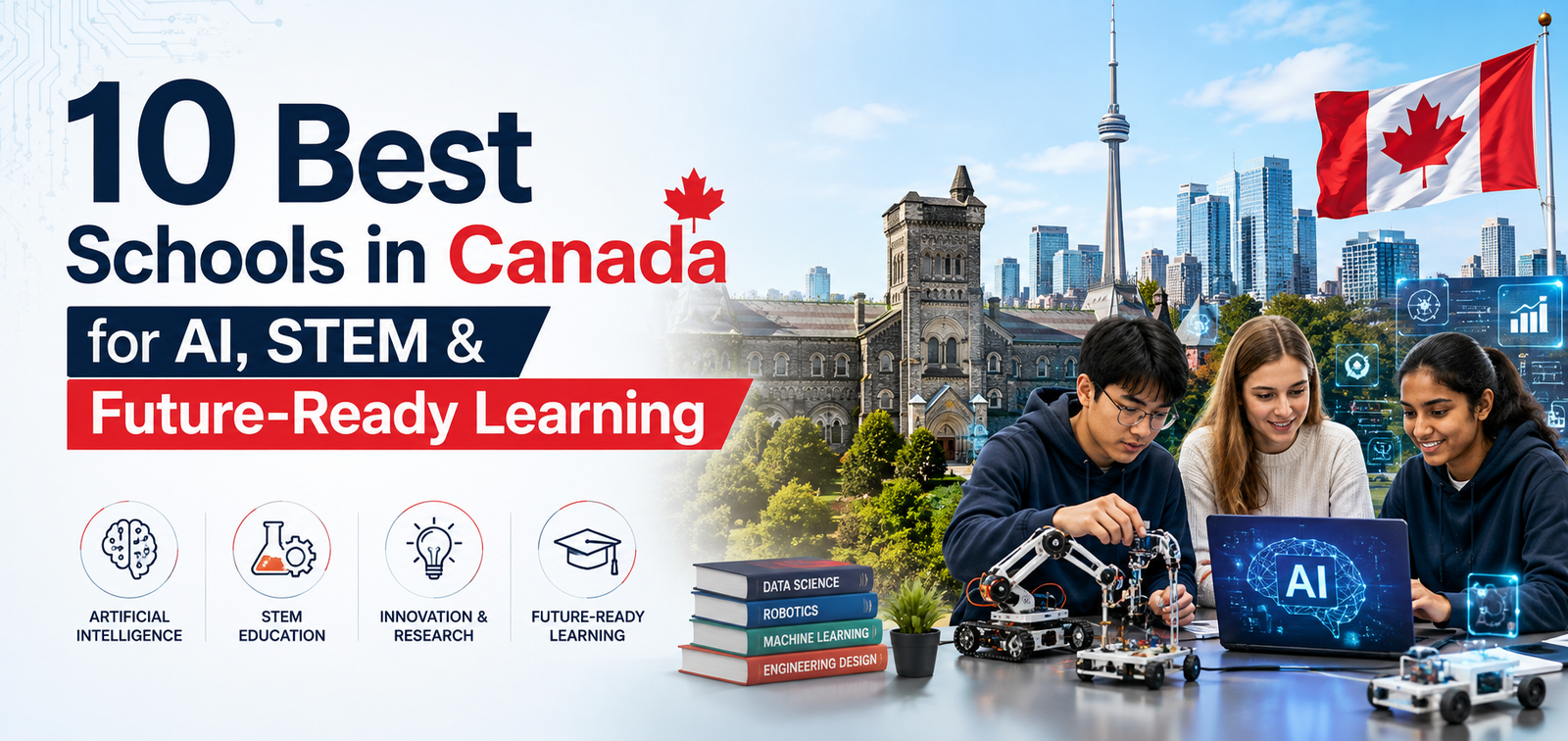
With artificial intelligence, automation, robotics, and digitalization continuing to disrupt industries across the globe, the approach to learning is changing as well. Besides traditional methods of teaching, there is an increased focus on project-based learning, coding clubs, robotics championships, maker spaces, engineering projects, and various AI-related programs that provide students not only with theoretical background but also practical skills.
As one of the leading countries in terms of technology, research, and innovations, Canada can be considered a good place to study for those who want to become future-oriented individuals. There are many schools in Canada that gained popularity for implementing science, technology, engineering, and math in their curriculum, developing the creative and critical thinking skills of students.
For families seeking the Best Schools in Canada for STEM 2026, the following institutions stand out for their commitment to innovation, technology integration, and preparing students for an increasingly digital future.
1. Ashbury College (Ottawa, Ontario)
Ashbury College has managed to build a good name when it comes to excellence and innovation. Technology is widely used at the institution and students are also encouraged to do cross-disciplinary projects that involve science, engineering, and design.
The advanced science labs, technology-supported classes, as well as participation in robotics and programming activities, enable the students to build the analytical skills needed in the future.
Its commitment to innovation has contributed to its reputation among the best Canadian schools for coding robotics and STEM.
2. Upper Canada College (Toronto, Ontario)
Upper Canada College is well known for its innovative approach to education. The college puts great stress on the use of technology, entrepreneurship, and learning by doing.
It is common practice for students to work in teams on tasks related to engineering, computer science, and innovations. Innovative spaces for learning help students learn by experimenting and exercising creativity.
Additionally, the college benefits from its location in Toronto, which boasts a highly developed technology environment.
3. St. George’s School (Vancouver, British Columbia)
St. George’s School has made a name for itself through its combination of academic excellence and innovative technological educational opportunities.
STEM programs in St. George’s include robotics, coding, engineering, and advanced scientific studies. There is emphasis on exploring new technologies while establishing a strong background in math and sciences.
The school’s commitment to innovation makes it one of the leading future-ready schools in Canada.
4. Webber Academy (Calgary, Alberta)
Webber Academy is renowned for its focus on critical thinking, innovation, and technology-based learning.
The students get involved in activities that encourage investigation of ideas related to engineering, computer sciences, robotics, and entrepreneurship. Webber Academy has even earned some national acclaim because of its outstanding STEM teaching initiatives.
With its combination of quality education and application of technology, Webber Academy prepares its students for future professions in dynamic industries.
5. Appleby College (Oakville, Ontario)
Appleby College has continued to emphasize innovation in education. The learners are advantaged through learning spaces that embrace modern learning, digital literacy, and projects that link concepts of STEM with practical issues in the real world.
The incorporation of collaboration, creativity, and technological integration guarantees that learners gain competencies beyond academic success.
Its programs are frequently highlighted among the best schools for AI education in Canada because of their strong emphasis on future technologies and computational thinking.
6. Crescent School (Toronto, Ontario)
Crescent School is keen on practical learning through initiatives involving science, engineering, and technology.
Students engage in robotics teams, innovation competitions, programming activities, and collaborative designs aimed at fostering creativity in problem solving. This learning culture stresses adaptability, leadership, and technological literacy.
With companies integrating AI technology, such educational environments prepare learners for the future.
7. Stratford Hall (Vancouver, British Columbia)
Stratford Hall provides students with a learning environment that incorporates the International Baccalaureate program along with an emphasis on innovation and inquiry.
The curriculum at Stratford Hall promotes the use of technology, scientific study, and engineering in addition to a lot of digital tools, right from a young age.
This educational model aligns closely with the growing demand for AI education in Canadian schools and technology-focused learning pathways.
8. Lower Canada College (Montreal, Quebec)
Lower Canada College is now recognized as one of the top schools when it comes to academic excellence and innovations.
The students are able to make use of science facilities that are state-of-the-art, computer-enhanced classrooms, and after-class activities centered around robotics, engineering, and computer sciences.
This approach ensures that students learn both technical and leadership skills that will help them in their future careers.
9. Southridge School (Surrey, British Columbia)
The Southridge School enhances its reputation through a heavy focus on innovation, entrepreneurship, and STEM education.
Students are engaged in various programs that foster critical thinking, technology skills, and problem-solving. Facilities are equipped for coding, robotics, engineering, and science education.
These opportunities help position the institution among the best Canadian schools for coding robotics and STEM for families seeking comprehensive future-focused education.
10. Branksome Hall (Toronto, Ontario)
Technological innovation is infused within the whole educational process at Branksome Hall. The students participate in group projects that make use of science, engineering, math, and technology.
The educational institution emphasizes creativity along with technical education to ensure that its students can thrive in different environments. Branksome Hall also has great international connections and emphasizes innovation.
Its commitment to preparing students for evolving industries makes it one of the notable future-ready schools in Canada.
Why AI and STEM Education Matter More Than Ever
Skills associated with artificial intelligence, data analytics, programming, engineering, cybersecurity, and digital solutions will be more needed in the future workforce.
Canada has positioned itself as a leader in AI research and innovation, with many institutions of higher learning across Canada providing specialized courses in artificial intelligence, machine learning, robotics, and computer science.
At the K-12 level, there are initiatives aimed at equipping learners with digital skills through coding programs, robotics, maker spaces, engineering challenges, and curriculum that emphasizes technological skills. Initiatives like CanCode have also helped to increase coding, robotics, AI, and digital literacy skills in schools across Canada.
As a result, AI education in Canadian schools is becoming increasingly important in helping students develop the skills required for future careers.
Characteristics of Future-Ready Schools
There are some features that help in distinguishing future-oriented schools from the traditional system of education:
Technology Integration
Technology is integrated in all subjects and not considered as a subject by itself.
Problem-Solving via Project Work
Real-life problems are solved by students working in teams on projects.
STEM-Oriented Teaching Program
Science, Technology, Engineering and Mathematics (STEM) subjects form the core curriculum for the students.
Coding and Robotics Training
Coding and robotics along with automation become part of the curriculum for young children.
Innovation and Entrepreneurship
Schools provide environment that encourages innovation and entrepreneurship among the students.
These factors are increasingly influencing parental decisions when evaluating the best schools for AI education in Canada.
Looking Ahead
Future education cannot be simply based on academic results anymore. In order to become successful, students must know how to adapt, innovate, work with others, and keep up with developing technology.
Leading Canadian schools recognize the need for such skills and incorporate STEM-based education, programming, robotics, artificial intelligence, and other innovations into their curriculum. They give their students all the necessary knowledge and skills for them to succeed in the digital economy in the future.
Those who are interested in the Best Schools in Canada for STEM can see that the schools from the list below are good examples of modern and innovative education.
FAQ
Best engineering universities in Canada for international students
University of Toronto, University of Waterloo, McGill University, University of British Columbia, and University of Alberta are among the leading choices.
Top 10 universities in Canada
University of Toronto, McGill University, University of British Columbia, University of Alberta, McMaster University, University of Waterloo, Western University, University of Ottawa, Queen’s University, and University of Calgary.
Top 10 universities in Canada for international students:
University of Toronto, UBC, McGill, University of Waterloo, McMaster University, University of Alberta, Western University, University of Ottawa, Queen’s University, and Simon Fraser University are popular options.
Best universities in Canada for international students for masters:
University of Toronto, UBC, McGill, University of Waterloo, McMaster University, University of Alberta, and Western University offer strong master’s programs and research opportunities.
What does future-ready learning mean in education?
Future-ready learning combines academic knowledge with practical skills such as digital literacy, AI awareness, creativity, communication, collaboration, critical thinking, and problem-solving to prepare students for changing careers and technologies.
Which Canadian schools are best for coding and robotics?
Schools with dedicated robotics clubs, coding programs, engineering projects, maker spaces, and hands-on technology activities are strong options. Programs supported through initiatives such as CanCode and FIRST Robotics Canada can also provide valuable STEM experiences.
Why is AI and STEM education important for Canadian students in 2026?
AI and digital technologies are changing education and the workplace. Early exposure to STEM, coding, AI, and problem-solving can help students develop skills relevant to future study and technology-driven careers. Canada also has a growing AI ecosystem and offers numerous AI-related study programs.
How can I choose the best AI or STEM school in Canada for my child?
Compare the school’s STEM curriculum, AI and coding opportunities, robotics facilities, extracurricular activities, teaching approach, academic results, student support, location, and overall cost.
What skills do students need for future careers in AI and technology?
Important skills include mathematics, programming, data literacy, problem-solving, critical thinking, creativity, communication, collaboration, cybersecurity awareness, and ethical use of AI.
What is the difference between a STEM school and a regular school?
A STEM-focused school places greater emphasis on science, technology, engineering, and mathematics, often using practical projects, experimentation, coding, robotics, and problem-solving alongside traditional academics.