
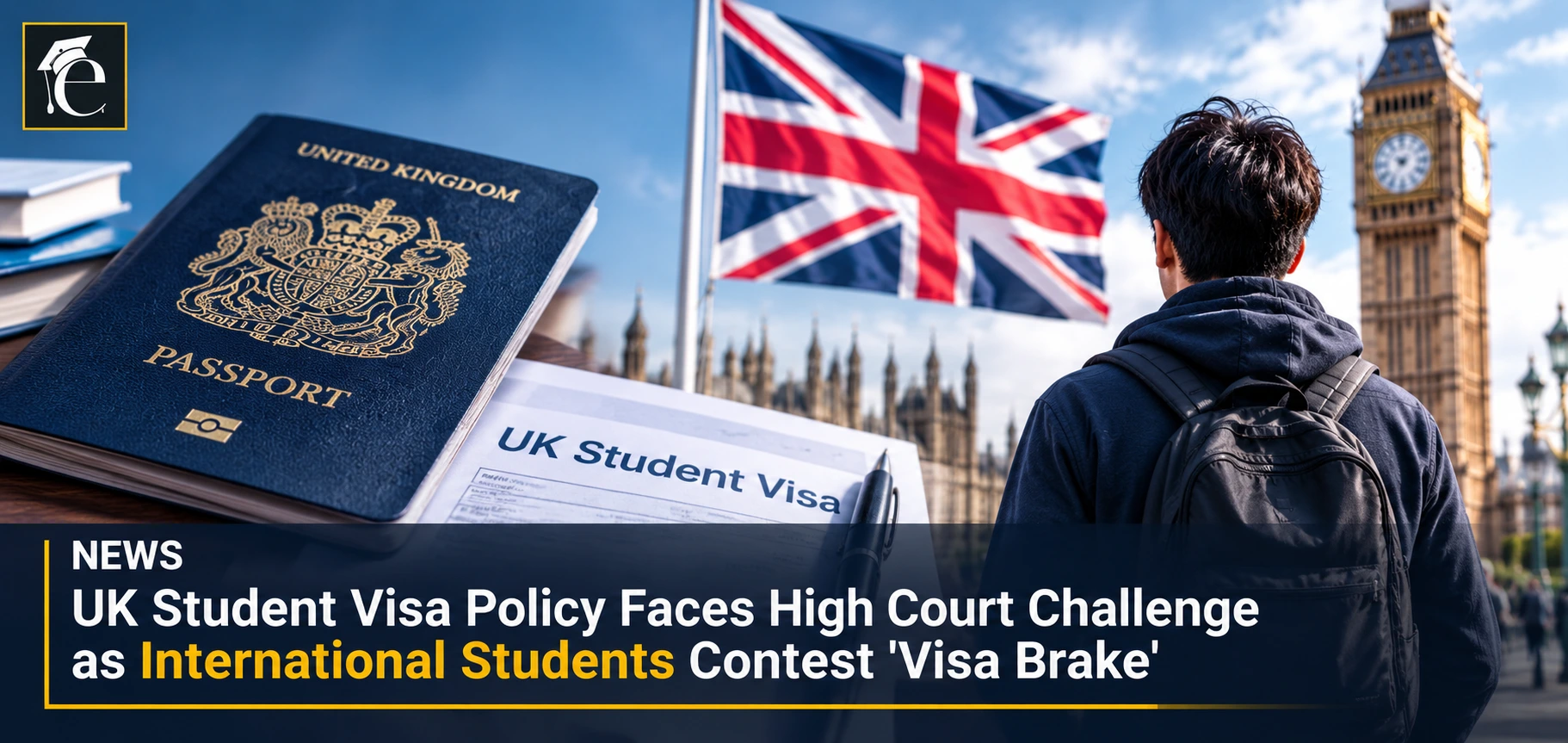
A group of international students has launched a landmark legal challenge against the British government’s controversial UK student visa policy, arguing that recent restrictions unfairly block genuine students from pursuing higher education in the country.
The cases, currently before the High Court, challenge the Home Office’s “visa brake,” introduced earlier this year, which suspended new student visa applications from nationals of Afghanistan, Cameroon, Myanmar, and Sudan. The claimants contend that the policy amounts to a blanket ban based on nationality rather than individual circumstances and should therefore be declared unlawful.
Students Say the Restrictions Are Unfair
The lawsuit has been filed by students who have already won admission to some of the top universities in Britain before the imposition of such rules. Other students had already received scholarship offers or were under consideration for scholarships, one of which is the UK Chevening Scholarship program.
As per the lawyers of the students, the UK student visa policy does not allow universities to issue the Confirmation of Acceptance for Studies (CAS) that is needed for student visas. Due to this policy, it becomes difficult for students to get the visa and therefore universities are withdrawing their admissions.
Government Defends the Visa Brake
Restrictions were placed by the Home Office in March 2026 because there was reportedly widespread misuse of legal migration processes in the country.
Statistics revealed that there was a significant rise in asylum applications made by those who came into the UK legally using visas. It was claimed that the restriction was aimed at minimizing abuse of the immigration process and increasing border protection while the visa classes were under review.
As per the prevailing UK student visa policy, such restrictions have been applied only on citizens of Afghanistan, Sudan, Myanmar, and Cameroon who wish to come to the UK to study.
Lawyers Question the Government’s Evidence
In the High Court hearing, the legal team defending the students’ side pointed out that the government used “arbitrary criteria” in choosing those countries.
The claimants insist that there is no credible evidence to prove that international students coming from those countries have been engaging in abusing the asylum system. Rather, they say that the Department of Homeland Security did not consider each application individually but based the restrictions only on their nationalities.
Legal representatives also contend that the UK student visa policy unlawfully limits ministerial discretion by preventing deserving applicants from having their personal circumstances properly considered before their applications are refused.
Universities Express Growing Concern
This legal fight has gained attention within the higher education system of Britain.
University administrators and education policy analysts have expressed concern about the potential impact of sudden curbs on the international reputation of the UK as a country where global talents come to pursue further education. It is argued that many of the targeted students are well-qualified people who want to pursue post-graduate courses in disciplines like medicine, engineering, artificial intelligence, and public health.
Academics have also pointed out that the situation of students from conflict-prone nations can change dramatically when they arrive at university and, therefore, asylum becomes a justified claim in some cases.
Wider Implications for International Education
Apart from this legal battle, the ruling would have far-reaching effects on Britain’s international education system.
The universities have been increasingly dependent on their international students to help with research and innovation as well as financial stability. The education experts are worried that the ambiguity in the UK student visa policy might discourage highly qualified candidates from studying in British universities because such nationality-specific policies are becoming common.
The legal battle also poses a number of questions regarding the balance between immigration control and keeping UK among the top choices for higher studies in the world.
Court Decision Could Shape Future Immigration Rules
The High Court’s ruling is expected to influence not only the students directly affected but also the future direction of the UK student visa policy.
Should the legal challenge succeed, the government may have no choice but to take into consideration the way in which it judges applications of individuals from the specified countries. If the policy prevails in court, it would enable the Home Office to enact more such nationality-based immigration policies in the future.
There is a lot of interest and anticipation surrounding the legal battle and as the proceedings progress, universities, students, and immigration experts will be watching very carefully, for the case has already turned out to be one of the biggest challenges to the government’s recent immigration reforms.