
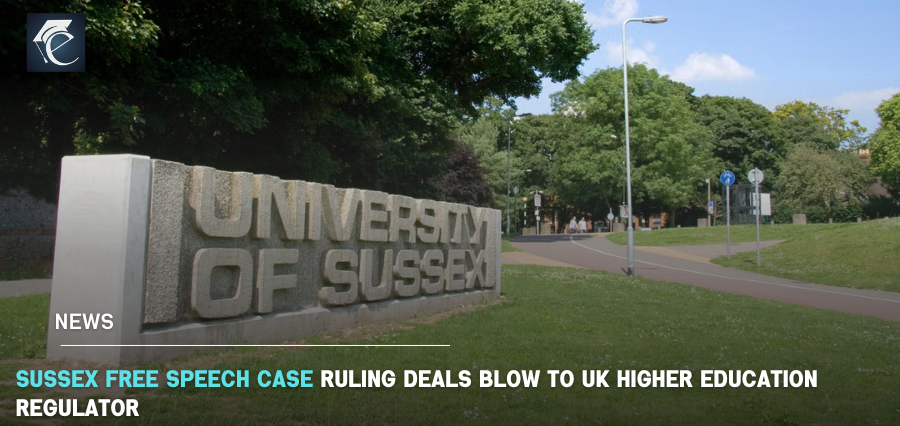
In a significant legal development, the Sussex free speech case ruling has overturned a £585,000 fine imposed on the University of Sussex by England’s higher education regulator, the Office for Students. The High Court decision has raised serious questions about regulatory fairness and the interpretation of academic freedom in UK universities.
The case stemmed from the 2021 resignation of Kathleen Stock, whose views on gender identity sparked protests and national debate. The ruling is now being seen as a major turning point in how free speech issues are handled in higher education.
Criticism of the Regulator’s Methodology from High Court
In the Sussex free speech case, the judgment was delivered by Mrs Justice Lieven, and she stated that the methodology used by the regulator to make decisions was inherently wrong. She claimed that the Office for Students was biased in handling the case, and therefore, the result was pre-decided.
The judge explained that the regulator had a closed mind and did not adequately consider information that could have altered the decision. Therefore, it was an unlawful decision to give the university a huge penalty.
The judge further accused the regulator of failing to implement freedom of expression principles correctly and overstepping its jurisdictional mandate. In addition, the judge was dissatisfied with the failure to consider any changes done by the institution or similar scenarios at other universities.
Background of the Controversy
The decision made in the free speech case at the University of Sussex has been closely connected to the circumstances in which Professor Kathleen Stock left the university in October 2021. Professor Stock expressed the opinion that biological sex was an immutable concept that needed to be acknowledged in legal and governmental decisions. After enduring several days of protest and threats to her safety, Professor Stock resigned from her position after almost two decades at the university.
The Office for Students has conducted a prolonged investigation and has found that the university had breached the rules of free speech, which resulted in a proposal of fines.
University Welcomes Verdict
There has been strong approval from the management of the University of Sussex regarding the free speech case ruling, which has been described as a victory. According to Vice Chancellor Sasha Roseneil, the judgment has upheld the values of the university in respect of academic freedom.
She stated that there is a need for a regulator that works together with universities and not against them. It was also reported that she would be meeting Bridget Phillipson to discuss further consequences of the ruling.
According to her, the University of Sussex had always been characterized by discussions on controversial subjects so that students and academics could develop their perspectives independently.
Credibility of the Regulator Undermined
The free speech case ruling at Sussex has seriously undermined the credibility of the Office for Students. The judgment was quite critical towards Susan Lapworth, implying that the investigation was motivated by the need to demonstrate authority over the whole university sector.
The court indicated that Sussex was used as an example for other universities which calls into question the objectivity of the regulation process.
In response to the decision, interim chief executive Josh Fleming was disappointed but stated that the regulator would analyze the judgment and make decisions accordingly.
Calls for Reform in Higher Education Regulation
The decision by the High Court in the Sussex Free Speech Case has resulted in increased calls for change regarding university regulation in England. The former vice-chancellor, Adam Tickell, stated that the case was a political interference and there is a need for an independent appeal process.
According to Tickell, the matter of the investigation reached him from the Department of Education and not directly from the regulator itself.
Despite recent reforms in the Office for Students potentially improving trust in the regulator, the ruling shows the urgent need for new ways of regulation.
Conclusion
In conclusion, the ruling in the Sussex Free Speech Case is a significant event concerning academic freedom and university regulation in the UK. The rejection of the imposed fine and criticism of the way the case was handled by the regulator serve as a reminder of the significance of fairness and impartiality in higher education.
It is also important to emphasize that free discussion should be encouraged in universities.
Also Read :-Student Loan Interest Cap to Offer Relief for Millions of UK Graduates from September