
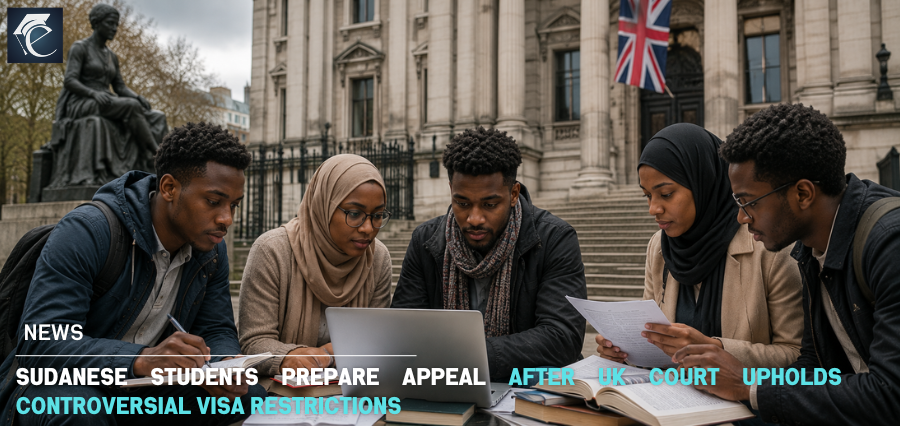
A group of Sudanese students is preparing to appeal after the UK High Court upheld the government’s controversial UK visa brake policy, a measure that has prevented students from several countries from obtaining study visas. The ruling represents a significant setback for dozens of aspiring scholars who had secured admission and scholarships at some of Britain’s most prestigious universities.
The students, represented by advocacy group Sudan Scholars UK, argue that the decision effectively blocks talented individuals from accessing higher education opportunities despite having met academic and financial requirements. Following the court’s judgment, the group announced that it would continue its legal fight through the appeals process.
The case has drawn international attention, reigniting debates about immigration controls, educational access, and the role of international students within the UK’s higher education system.
What Is the UK Visa Brake Policy?
The visa brake policy in the UK was instituted in March 2026 by the Home Office as a temporary policy meant to tackle the rising issue of people making asylum claims after coming into the country through legal migration processes. The policy stopped all study visa applications for nationals of four countries, namely Afghanistan, Cameroon, Myanmar, and Sudan.
According to the British government, the growing trend of students from the four countries applying for asylum in the UK required the implementation of such a policy to safeguard the integrity of the visa programs. However, the fairness and scope of the policy have been challenged by critics who see it as a total ban on the basis of nationality alone.
Students with Elite University Offers Affected
Those affected by the UK visa brake policy include Sudanese students who had obtained admission to reputable universities such as the Universities of Oxford and Cambridge, Imperial College of London, and University College of London (UCL).
As mentioned by Sudan Scholars UK, all the conditions related to academics had been met and the students had been admitted through rigorous processes of admission. The main reason why they are not able to join their classes is the government’s decision and nothing else.
This decision has come as a blow especially for those students who hail from a nation that has been facing turmoil and disruption in education. International education was seen as an opportunity to equip themselves with knowledge and skill set that can help rebuild their nation.
Arguments Presented in Court
The legal challenge focused on whether the UK visa brake policy was lawful and proportionate. The lawyers for the students argued that Sudan was designated as an over-stay country without substantial evidence of abuse of student visas by nationals of Sudan. Additionally, they accused the authorities of failing to evaluate other options or doing individual evaluations.
Among the claimants were professionals such as doctors and pharmacists who had offers for postgraduate studies at Oxford and UCL. Their lawyers argued that this policy was discriminatory because it stopped them from applying for their visas based on their nationality alone.
Government lawyers argued that this policy is a legitimate step towards addressing increased applications for asylum and that the immigration authorities have wide powers in running visa schemes and controls.
In the end, the High Court supported Home Secretary Shabana Mahmood.
Universities and Education Leaders Raise Concerns
The UK visa brake policy has also generated concern among universities and education leaders. Several institutions supported legal challenges or provided evidence highlighting the impact of the restrictions on students and academic communities.
Universities have made claims that international students are key players in research and innovation. Some universities were compelled to revoke or put on hold their offers because the affected students cannot secure the required documents to process visas.
Education experts claim that such actions can harm the reputation of the UK as an ideal destination for higher learning, especially those from areas experiencing wars and political unrest.
What Happens Next?
After the verdict, Sudan Scholars UK stated that it is currently working alongside lawyers to challenge the ruling. The organization wishes to have another look at whether the UK visa brake policy is a proportionate action on the part of the UK government.
The result could bring substantial consequences not only for the Sudanese students but also for the applicants from other nations whose access is restricted. In case of a successful appeal, the students who have already got admitted into universities and scholarships will have chances to visit the country.
A Broader Debate on Immigration and Education
The debate about UK visa brake policy is an example of the increasing conflict between immigration and international education. On one side, there is the need for governments to make their immigration laws stricter. On the other side, universities have come to rely on international students and scholars to keep up with their competitiveness in the world academic environment.
In the case of the Sudanese students, the matter is not only about visas, but also about the ability to access education and opportunities that may help to build the future of their country after many years of conflict.