

Food is one of the few products people place their trust in every day without ever seeing the systems behind it. A loaf of bread, a carton of milk, or a ready meal reaches consumers carrying an invisible promise that countless processes, decisions, and people have worked together to ensure its safety. As the food industry becomes increasingly technology-driven and interconnected, maintaining that trust requires more than compliance. It demands knowledge, continuous learning, operational excellence, and innovation that can be applied in real-world environments.
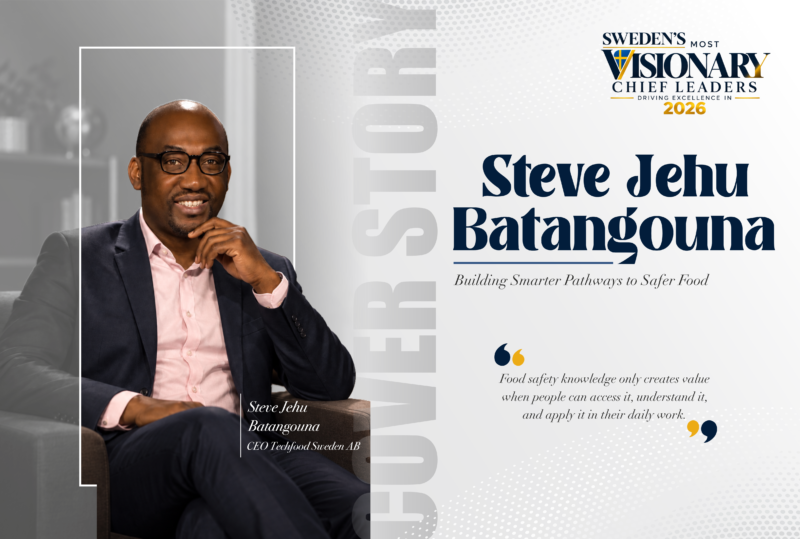
Steve Batangouna, CEO of Techfood Sweden AB, has built his career around that very principle. With experience spanning production, quality management, logistics, purchasing, and supply chain operations, he brings a comprehensive understanding of the challenges facing modern food businesses.
Building a Safer Food Future
For Steve, food safety is not simply a regulatory requirement; it is a foundation for trust, resilience, and long-term success across the entire food value chain. His decision to lead Techfood Sweden AB was driven by a clear understanding that food safety knowledge only creates real value when it is accessible, understandable, and applicable in everyday operations.
Drawing on experience across production, quality, logistics, purchasing, and supply chain management, Steve has developed a holistic view of how every function contributes to food safety and operational excellence. Under his leadership, Techfood Sweden has focused on connecting these disciplines rather than treating food safety as a standalone compliance activity.
His approach places people at the centre of every initiative. By combining professional education, digital tools, operational support, certification guidance, and continuous improvement practices, Steve has steered the company toward practical solutions that address real industry challenges. Whether helping organisations improve traceability, reduce waste, strengthen employee training, or prepare for audits, his vision is rooted in the belief that food safety, digitalisation, efficiency, and sustainability should work together to create lasting value.
Making Food Safety Knowledge Accessible to Everyone
Steve believes that knowledge is one of the most powerful tools in food production, particularly in an industry where human actions directly influence product quality and consumer safety. His commitment to digital learning emerged from recognising that access to food safety education remains uneven across the sector.
While large organisations often possess dedicated teams and extensive resources, smaller businesses frequently face the same regulatory responsibilities with far fewer capabilities. Traditional training methods can also present challenges, particularly for operations that rely on shift-based work schedules.
To address these barriers, Techfood Sweden has embraced digital learning solutions that provide flexible access to structured and practical knowledge. Steve has championed an approach that goes beyond simply placing educational content online. Instead, every learning resource is designed to be clear, relevant, and closely aligned with real workplace responsibilities.
The company’s educational portfolio spans a broad range of topics, including HACCP, food hygiene, BRCGS, FSSC 22000, ISO 22000, legislation, microbiology, logistics, sustainability, production economics, quality management, and digital transformation. By integrating practical routines and digital support systems into these programmes, Techfood Sweden helps organisations strengthen competencies, document learning outcomes, and adapt more effectively to evolving industry standards and expectations.
For Steve, accessibility is ultimately about empowering individuals while simultaneously strengthening organisational capability.
Balancing Food Safety with Business Performance
According to Steve, one of the greatest challenges facing food manufacturers today is managing increasing complexity without losing sight of fundamental principles.
Modern food businesses must navigate changing regulations, certification requirements, retailer expectations, allergen management, traceability demands, cybersecurity concerns, and growing public scrutiny. At the same time, they face mounting pressure related to costs, energy consumption, staffing shortages, raw material availability, and delivery performance.
Steve believes the danger lies in treating these challenges as separate issues managed through disconnected systems. Such an approach can overwhelm employees and transform important controls into administrative exercises rather than effective risk management tools.
His solution centres on simplicity, clarity, and risk-based thinking. He advocates for clear ownership, streamlined processes, and systems that are practical at the point of execution. Information should be collected once and utilised across multiple functions, including quality management, maintenance, traceability, and operational improvement.
Equally important is fostering a workplace culture where employees understand why controls matter and feel encouraged to report deviations early. Steve sees these moments not as failures but as opportunities to learn and improve.
In his view, operational efficiency and food safety are not competing priorities. Organisations that invest in competent teams, preventive maintenance, stable processes, and accurate information are often the ones that achieve both superior safety outcomes and stronger business performance.
Digital Transformation with Purpose
As digitalisation continues to reshape the food industry, Steve remains committed to ensuring that technology serves operational goals rather than becoming an objective in itself.
He believes many organisations make the mistake of approaching digital transformation as a technology purchase rather than an operational improvement strategy. Successful implementation begins with understanding how information flows through a business, identifying critical risks, and recognising areas where inefficiencies occur.
Under Steve’s leadership, Techfood Sweden supports organisations through digital education, practical documentation, standardised routines, and monitoring systems that improve visibility across food production processes.
Rather than advocating large-scale technological change from the outset, he encourages companies to begin with targeted pilot projects in areas such as training management, traceability, temperature monitoring, deviation handling, or audit preparation. Demonstrating measurable value in a focused area often creates the confidence needed for broader digital adoption.
Steve also emphasises the importance of strong data governance, system validation, access control, and contingency planning. For him, digital solutions must be as dependable as the processes they support.
His ultimate goal is not automation for its own sake but enabling employees to make better decisions through clearer information, reduced administrative burdens, and more effective process control.
Where Sustainability and Food Safety Meet
Steve views sustainability as an operational responsibility rather than a standalone initiative. He believes technology has a critical role to play in helping organisations make sustainability measurable, actionable, and economically viable.
Access to accurate data allows businesses to identify where resources are being consumed, where waste is generated, and where improvements can be made. Monitoring systems can help optimise energy and water usage, improve forecasting accuracy, reduce overproduction, minimise spoilage, and strengthen traceability throughout the supply chain.
However, Steve is careful to point out that technology alone cannot create sustainable food systems.
True sustainability requires disciplined processes and a systems-based perspective. Decisions that reduce environmental impact must also protect food safety, maintain product quality, and support long-term operational resilience.
He advocates evaluating safety, quality, productivity, and sustainability together rather than treating them as separate objectives. Leaner operations, responsible sourcing strategies, preventive controls, and more efficient use of resources all contribute to stronger outcomes across the value chain.
Steve also highlights the role of education in creating sustainable workplaces. By equipping employees with strong food safety knowledge, organisations create safer working environments, stronger economic opportunities, and meaningful career development pathways. In his view, sustainability extends beyond environmental considerations to include the wellbeing and growth of the people who make the food industry function every day.
Leading Through Trust, Clarity, and Empowerment
Steve’s extensive experience across production, logistics, and supply chain management has shaped a leadership philosophy centred on people.
One of the most important lessons he has learned is that sustainable performance cannot be imposed from above. The individuals working closest to daily operations are often the first to identify risks, inefficiencies, and opportunities for improvement.
As a result, he sees leadership as the process of creating clear direction while ensuring employees have the knowledge, tools, and confidence to contribute meaningfully. Open communication and psychological safety are essential components of this approach.
Steve also places strong emphasis on connecting strategic goals to everyday actions. Organisational objectives such as improving delivery reliability or reducing quality deviations must be translated into practical responsibilities, measurable indicators, and clear routines.
Regular feedback, visible performance monitoring, and a strong presence within operations help teams understand progress and respond effectively when challenges arise.
At the heart of his leadership philosophy is the belief that motivation grows when people understand the importance of their contributions, feel genuinely involved in decision making, and receive recognition for continuous improvement.
For Steve, trust, accountability, and consistency form the foundation of high performing teams. When leaders align their actions with their values and create an environment where learning is encouraged, organisations become more resilient, adaptable, and capable of maintaining excellence even under pressure.
Through this people-first approach, Steve continues to guide Techfood Sweden AB toward a future where food safety, innovation, digitalisation, and sustainability work together to create lasting value for businesses, employees, and consumers alike.
Creating a Culture Where Learning Never Stops
For Steve, continuous learning is not an optional activity but a fundamental requirement for success in the food industry. He views food safety as a living capability that must evolve alongside changing regulations, technologies, customer expectations, ingredients, and production methods.
As organisations introduce new products, adopt new processes, and move employees into different roles, maintaining competence becomes increasingly important. Steve believes that without a structured learning culture, the gap between documented procedures and actual workplace practices can widen rapidly, creating operational and compliance risks.
His approach to learning emphasises relevance and application. While digital education provides flexible access to foundational knowledge, he believes true competence is developed when employees can apply that knowledge through workshops, coaching, practical exercises, and real workplace scenarios. Competence should be assessed through observation, practical performance, and continuous follow-up rather than attendance records alone.
Steve also advocates integrating learning into daily operations rather than treating it as a separate activity. By regularly reviewing deviations, audit findings, customer feedback, and evolving requirements, organisations create environments where learning becomes a continuous driver of improvement. This approach not only strengthens food safety but also enables employees to embrace technological change with greater confidence and understanding.
According to Steve, organisations that prioritise learning become more adaptable, resilient, and prepared for the challenges of an evolving industry.
The Technologies Shaping the Future of Food Production
Looking ahead, Steve believes the next decade will bring transformative changes driven by the convergence of connected technologies, artificial intelligence, automation, and advanced data systems.
He sees connected sensors and machine vision systems becoming increasingly important in monitoring critical production variables such as temperature, hygiene conditions, packaging integrity, fill levels, labelling accuracy, and process consistency. These technologies provide continuous visibility into operations and support faster decision-making.
Artificial intelligence, meanwhile, offers opportunities to identify patterns, predict equipment failures, improve demand forecasting, and strengthen quality assurance processes. Steve also expects robotics to play a larger role in reducing repetitive tasks while creating safer and more consistent production environments.
Another area he believes will become increasingly influential is digital traceability. As supply chain data becomes more interconnected across suppliers, manufacturers, logistics providers, and customers, organisations will gain greater visibility into product journeys and be able to respond more effectively to quality issues, sourcing decisions, and sustainability objectives.
Despite his enthusiasm for emerging technologies, Steve remains clear that technology alone does not guarantee success. He stresses the importance of data quality, system validation, cybersecurity, transparency, and human oversight, particularly when artificial intelligence influences decisions related to food safety.
For Steve, the most valuable technologies will always be those that support skilled professionals rather than replace critical human judgement.
Eliminating Inefficiencies Through Better Alignment
Having spent years working across production, purchasing, logistics, and supply chain functions, Steve has developed a deep understanding of the inefficiencies that often hinder organisational performance.
One of the most common challenges he encounters is fragmented information. When departments operate in isolation, decisions made within one area can unintentionally create problems elsewhere. A purchasing decision focused solely on cost reduction, for example, may increase production losses or introduce quality challenges. Similarly, production schedule changes can affect sanitation planning, allergen management, warehouse capacity, and delivery performance.
Steve also identifies unclear responsibilities, duplicated administrative processes, weak planning systems, and reactive approaches to maintenance and quality management as recurring obstacles to operational excellence.
His solution begins with understanding the complete value chain. Organisations must map their end-to-end processes, establish shared priorities, and ensure that responsibilities are clearly defined. Standardised ways of working, meaningful performance indicators, and strong root cause analysis practices help replace repetitive firefighting with sustainable improvement.
He also highlights the importance of preventive maintenance, effective supplier collaboration, improved forecasting, and inventory visibility in reducing waste, shortages, excess stock, and costly disruptions.
While digital tools can support these improvements, Steve emphasises that technology should never be used to automate poorly designed processes. The first step should always be simplifying workflows, clarifying responsibilities, and engaging the people closest to the work. Sustainable progress, he believes, is often achieved through consistent incremental improvements rather than large-scale transformations that overwhelm employees.
Keeping Innovation Practical and Purpose Driven
Operating at the intersection of technology and food safety requires a careful balance between innovation and practicality. For Steve, successful innovation begins with understanding real operational challenges rather than pursuing technology for its own sake.
His philosophy centres on solving practical problems. Food manufacturers need tools that help them manage risk, improve efficiency, strengthen compliance, and make better decisions. Achieving this requires a deep understanding of the operational environment, workforce capabilities, digital maturity, and resource constraints within each organisation.
At Techfood Sweden, Steve has focused on translating complex standards and technical requirements into accessible learning programmes, operational routines, and digital workflows that can be implemented effectively in day-to-day operations.
He favours modular solutions that allow organisations to adopt new technologies gradually, adapting implementation to their specific needs and levels of experience. User feedback, pilot projects, demonstrations, and testing play an important role in ensuring that innovations deliver genuine value before broader deployment.
Steve also recognises the importance of long-term usability. Systems must remain accessible, maintainable, and functional even during incidents or unexpected disruptions.
For him, practical innovation is measured by outcomes. If a solution reduces errors, saves time, improves competence, increases visibility, or strengthens control over a critical risk, it delivers value. If it creates additional complexity without clear operational benefits, it requires reconsideration.
This commitment to practicality ensures that innovation remains aligned with the realities faced by food manufacturers and industry professionals.
Leading Across Cultures Through Understanding and Trust
Steve’s bilingual and multicultural background has had a considerable impact on his leadership style and relationship-building skills.
Having worked in various countries, he has learned the value of listening rather than jumping to conclusions. He understands that people can have very different perceptions of how communication, hierarchy, decision-making, negotiations, and time management should work. The key to success is to be flexible and respect all the differences.
In addition, his bilingual experience has helped him to understand the difference between translating something and actually understanding it. Technical terms, regulations, and management principles may have to be conveyed differently based on the professional and cultural environment.
That is why Steve puts special importance to effective communication and confirmation of mutual understanding, especially while talking about quality, compliance, and food safety issues.
International collaboration has also reinforced his belief that diversity enhances problem-solving. Teams composed of individuals with different experiences and viewpoints often identify opportunities and solutions that more homogeneous groups may overlook.
At the same time, Steve believes strong business relationships are built on universal principles. Reliability, transparency, mutual respect, and delivering on commitments remain essential regardless of cultural differences.
His leadership style combines adaptability with consistency, ensuring that clients and partners feel valued while maintaining clear expectations regarding standards, responsibilities, and risk management.
A Long-Term Vision for the Future of Food Safety
Steve’s aspirations for Techfood Sweden AB go much further than simply offering training and consultancy services. He wants to build a company that will act as a reliable platform for developing practical competencies and implementing digital transformation in the food value chain.
In the long run, his plan is to assist companies of any size in becoming more efficient, safer and sustainable through a combination of learning, management, and production in a digital world. By linking theory with practice and results, he is going to fill the gap between the two.
Moreover, he sees chances of broadening collaboration in the way that will make it possible to reach a greater number of people with their knowledge about food safety around the world.
In his advice to innovative entrepreneurs, Steve tells them to pay attention to real problems rather than trendy technologies. It all starts with understanding the processes, involving people, setting goals, and only then adopting new technologies.
He is for building a solid base in food safety, competence building, and data quality before engaging in any further innovation endeavors. Learning from achievements and failures should be key to any progress being made.
Most importantly, Steve considers innovation to be grounded in human purpose. The most worthwhile innovations are those that help to keep the consumer safe, employees well, good businesses responsible, and wasteful resource usage minimized.
To Steve, vision helps set a direction for actions, yet real results can only come through rigorous execution, ongoing learning, and effective cooperation. Such an approach still guides him as an entrepreneur and as a leader, as well as the company he runs, Techfood Sweden AB.
“Food safety knowledge only creates value when people can access it, understand it, and apply it in their daily work.”
“When food safety, efficiency, digitalisation, and sustainability work together, compliance becomes a platform for trust and long-term competitiveness.”
“The most competitive organisations do not treat safety as a requirement; they make it part of operational excellence.”