True belonging is more than simply fitting in. It is the feeling of being known, valued, and welcomed for who you are without needing to shrink or stretch yourself to meet expectations. In a school setting, belonging becomes the soil in which confidence grows. When students feel safe to speak, question, experiment, and even fail, learning takes root with far greater strength. Friendships form with ease, curiosity flourishes, and young people begin to trust their own voice. A sense of belonging allows learners to bring their whole selves into the classroom and this transforms school from a place they attend into a place they feel connected to.
The American International School of Cape Town (AISCT) offers this sense of connection with intention and warmth. Its community is shaped by students from many cultures who are welcomed through small classes, attentive teachers, and relationships built on respect.
The AISCT Town fosters community and inclusivity by placing international education at the heart of its mission. With students representing more than fifty countries, the school builds belonging through small classes, a low teacher-to-student ratio, and a culture that encourages every learner to show up as his or her authentic self. Counselors, learning support staff, and internationally experienced teachers guide students as they settle in and navigate a multicultural environment. Strong student and parent groups, dedicated buddy systems for newcomers, and numerous events focused on learning and celebration help bring the diverse community together.
The school adopted the U.S. curriculum to support expatriate families, especially those arriving from the United States. Although the student body now reflects over fifty nationalities, the U.S. curriculum remains a strong fit because of its balanced, holistic, rigorous, and standards-based framework. Advanced Placement (AP) courses offer a powerful advantage, preparing students for university-level work and easing their transition into higher education no matter where they study. Since most students pursue tertiary studies outside South Africa, this curriculum broadens their global opportunities.
With over 60 classes available in high school, the school ensures that students receive thoughtful guidance when selecting their courses. School counselors deliver comprehensive presentations explaining graduation requirements, course sequences, subject options, and key decision-making factors. Students in grades 9 and 10 follow a more structured program aligned with core requirements, while those in grades 11 and 12 gain the flexibility to pursue their personal interests and academic aspirations. University counselors also support students in aligning their choices with future study and career plans. Through this guidance, learners are encouraged to explore their interests confidently and choose course combinations that challenge and inspire them.
At the AISCT, curiosity and student agency are intentionally woven into daily classroom experiences. Teachers create learning environments where students make choices, explore ideas, and take ownership of their thinking and learning.
One way this appears is through choice-based tasks. Students
select from a menu of learning goals that align with the standards being
taught. They may analyze an image, pose a question,make a prediction, or
connect new content to previous lessons. This immediately communicates that
their thinking matters and that learning can begin from different entry points.
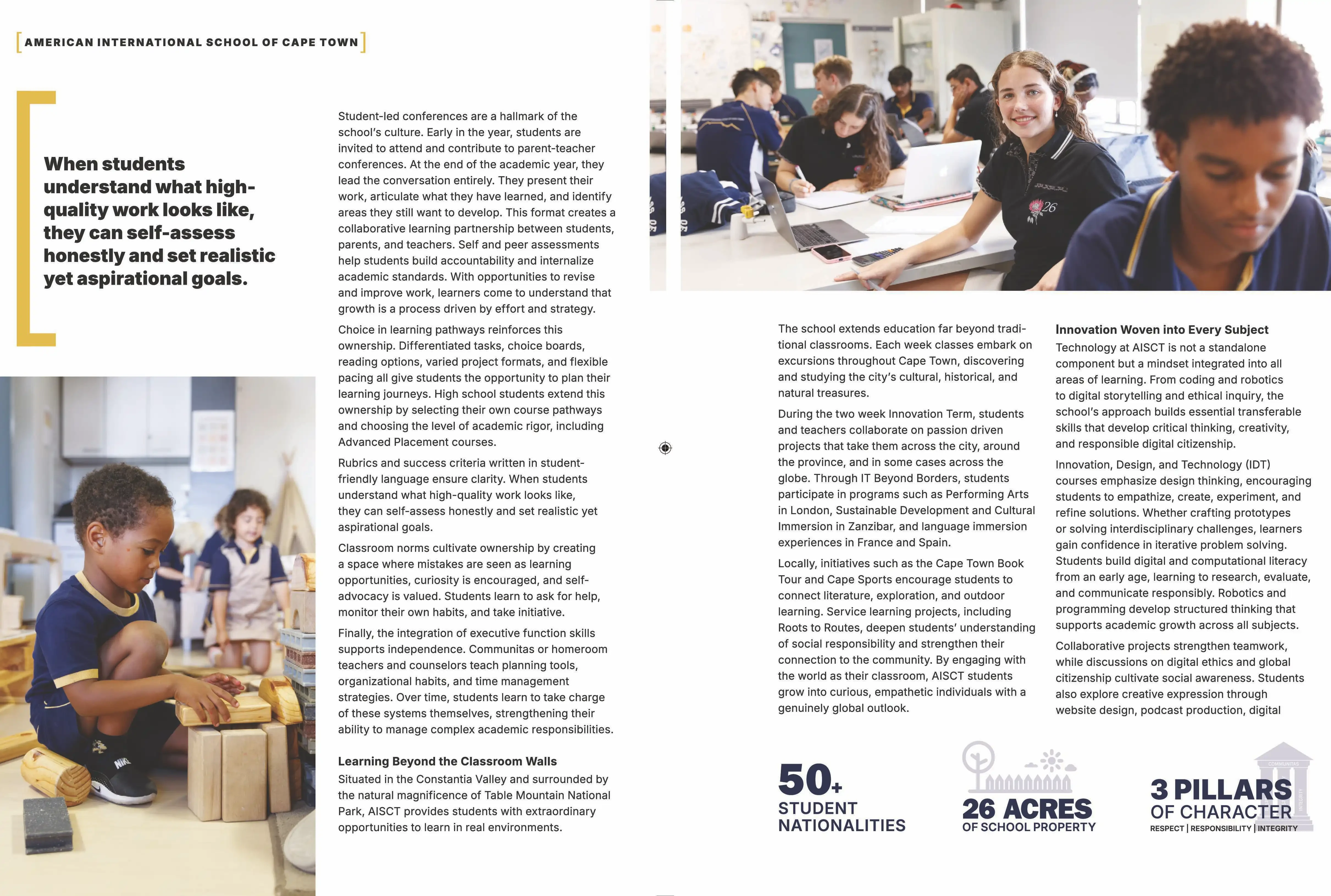
Inquiry stations also play a significant role. Classrooms in the Lower School are arranged with small challenges, mini experiments, or short texts. Students decide which station to visit first, pace their own progress, and record discoveries as they go. This blends structure with autonomy and builds confidence in independent learning.
Project-based assessments deepen this agency further. Instead of relying only on traditional end-of-unit exams, teachers assign projects that encourage students to design solutions, create prototypes, or produce original products. Students choose the format that suits their strengths and interests, whether an infographic, podcast, model, or script
.
Classroom discussions are another opportunity for shared leadership. Upper School classrooms, Socratic circles, Harkness discussions, and student-led literature circles invite learners to prepare their own questions, facilitate participation, and synthesize key ideas. The teacher becomes a guide, allowing students to shape the direction of the conversation.
Reflection is a daily routine as well. Students complete short prompts such as what surprised me or where I want to stretch next. Regular check-ins with Communitas or homeroom teachers help them monitor progress and set actionable goals. Differentiated pathways also support self-awareness. Students choose tasks at varying levels of complexity, selecting options that match their readiness and ambition.
Finally, teachers respond to student curiosity in real time. When a topic sparks interest, they find ways to connect it to real-world examples, ensuring learning feels relevant and student-driven. These moments reinforce that student curiosity is not a detour but a driving force in the curriculum.
Teachers at the school ensure that learning feels authentic and deeply connected to prior knowledge by designing experiences that are meaningful, relevant, and grounded in what students already know.
Each unit or lesson often begins with activities that activate prior knowledge, such as KWL charts, concept maps, notice and wonder activities, anticipatory questions, or visual prompts. These strategies reveal what students already understand and help teachers tailor lessons to the appropriate level of challenge.
Lessons are also anchored in real-world contexts. Teachers link content to current events, community issues, or practical tasks drawn from professional environments. These connections elevate motivation and help students see the lasting value of what they are learning.
Culturally and contextually relevant examples ensure that students see themselves reflected in the curriculum. Texts, case studies, and applied problems draw from students' lived experiences and local environments, strengthening comprehension and personal relevance.
Teachers also follow a concrete-to-abstract progression, beginning with hands-on experiences, models, or simulations before introducing complex terminology or theories. This mirrors natural learning processes and ensures that new concepts have a solid foundation.
Students are prompted to make explicit connections through questions such as how does this relate to or where have you seen this before. Sharing insights with partners or small groups cultivates collective understanding.
Understanding is checked regularly through exit tickets, mini conferences, short quizzes, or whiteboard checks. These touch points help teachers identify misconceptions or uneven understanding and adjust instruction accordingly.
Authentic tasks such as performance assessments and problem-based learning mirror real-world work, inviting students to apply skills in ways that feel purposeful. When student voice and choice are integrated into these tasks, learners naturally draw on their backgrounds and interests.
Cross-curricular collaboration further strengthens connections. Teachers plan together to link concepts across subjects, helping students recognize how knowledge fits together rather than existing in isolated academic silos.
Reflection routines are central to this approach. Students
use journals, exit tickets, and personal progress trackers to examine their
learning strategies and challenges. Questions such as what strategy helped me
today build metacognition and self-awareness.
Students at the school are encouraged to take meaningful responsibility for their learning through routines, structures, and a classroom culture that treats them as active partners in their own growth.
Student-led conferences are a hallmark of the school’s culture. Early in the year, students are invited to attend and contribute to parent-teacher conferences. At the end of the academic year, they leadthe conversation entirely. They present their work, articulate what they have learned, and identify areas they still want to develop. This format creates a collaborative learning partnership between students, parents, and teachers. Self and peer assessments help students build accountability and internalize academic standards. With opportunities to revise and improve work, learners come to understand that growth is a process driven by effort and strategy.
Choice in learning pathways reinforces this ownership. Differentiated tasks, choice boards, reading options, varied project formats, and flexible pacing all give students the opportunity to plan their learning journeys. High school students extend this ownership by selecting their own course pathways and choosing the level of academic rigor, including Advanced Placement courses.
Rubrics and success criteria written in student-friendly language ensure clarity. When students understand what high-quality work looks like, they can self-assess honestly and set realistic yet aspirational goals.
Classroom norms cultivate ownership by creating a space
where mistakes are seen as learning opportunities, curiosity is encouraged, and
self-advocacy is valued. Students learn to ask for help, monitor their own
habits, and take initiative.
Finally, the integration of executive function skills supports independence. Communitas or homeroom teachers and counselors teach planning tools, organizational habits, and time management strategies. Over time, students learn to take charge of these systems themselves, strengthening their ability to manage complex academic responsibilities.
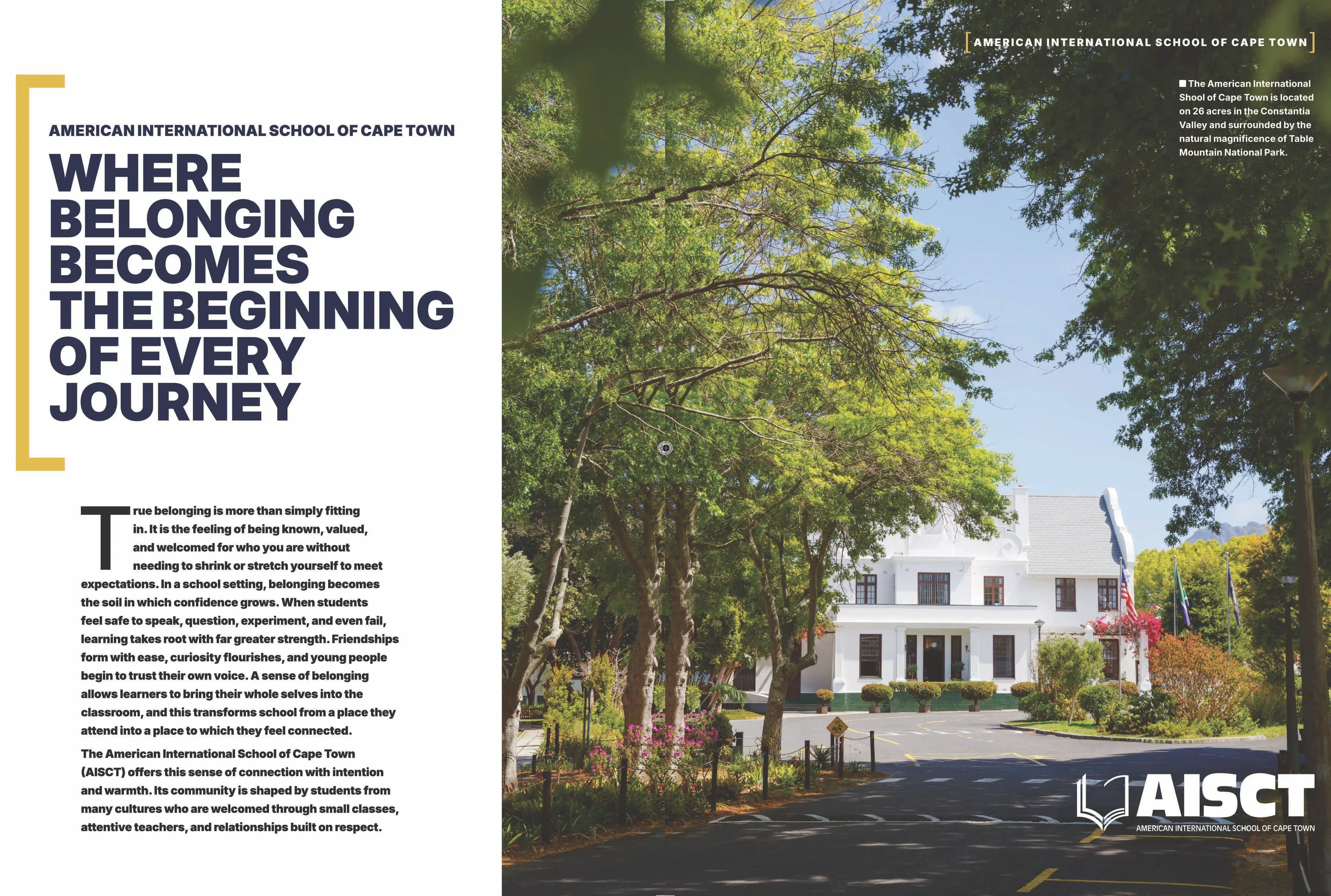
Situated in the Constantia Valley and surrounded by the natural magnificence of Table Mountain National Park, AISCT provides students with extraordinary opportunities to learn in real environments. The school extends education far beyond traditional classrooms. Each week classes embark on excursions throughout Cape Town, discovering and studying the city’s cultural, historical, and natural treasures.
During the two week Innovation Term, students and teachers collaborate on passion driven projects that take them across the city, around the province, and in some cases across the globe. Through IT Beyond Borders, students participate in programs such as Performing Arts in London, Sustainable Development and Cultural Immersion in Zanzibar, and language immersion experiences in France and Spain.
Locally, initiatives such as the Cape Town Book Tour and Cape Sports encourage students to connect literature, exploration, and outdoor learning. Service learning projects, including Roots to Routes, deepen students’ understanding of social responsibility and strengthen their connection to the community. By engaging with the world as their classroom, AISCT students grow into curious, empathetic individuals with a genuinely global outlook.

Innovation Woven into Every Subject
Technology at AISCT is not a standalone component but a mindset integrated into all areas of learning. From coding and robotics to digital storytelling and ethical inquiry, the school’s approach builds essential transferable skills that develop critical thinking, creativity, and responsible digital citizenship.
Innovation and Design Technology courses emphasize design thinking, encouraging students to empathize, create, experiment, and refine solutions. Whether crafting prototypes or solving interdisciplinary challenges, learners gain confidence in iterative problem solving.
Students build digital and computational literacy from an early age, learning to research, evaluate, and communicate responsibly. Robotics and programming develop structured thinking that supports academic growth across all subjects.
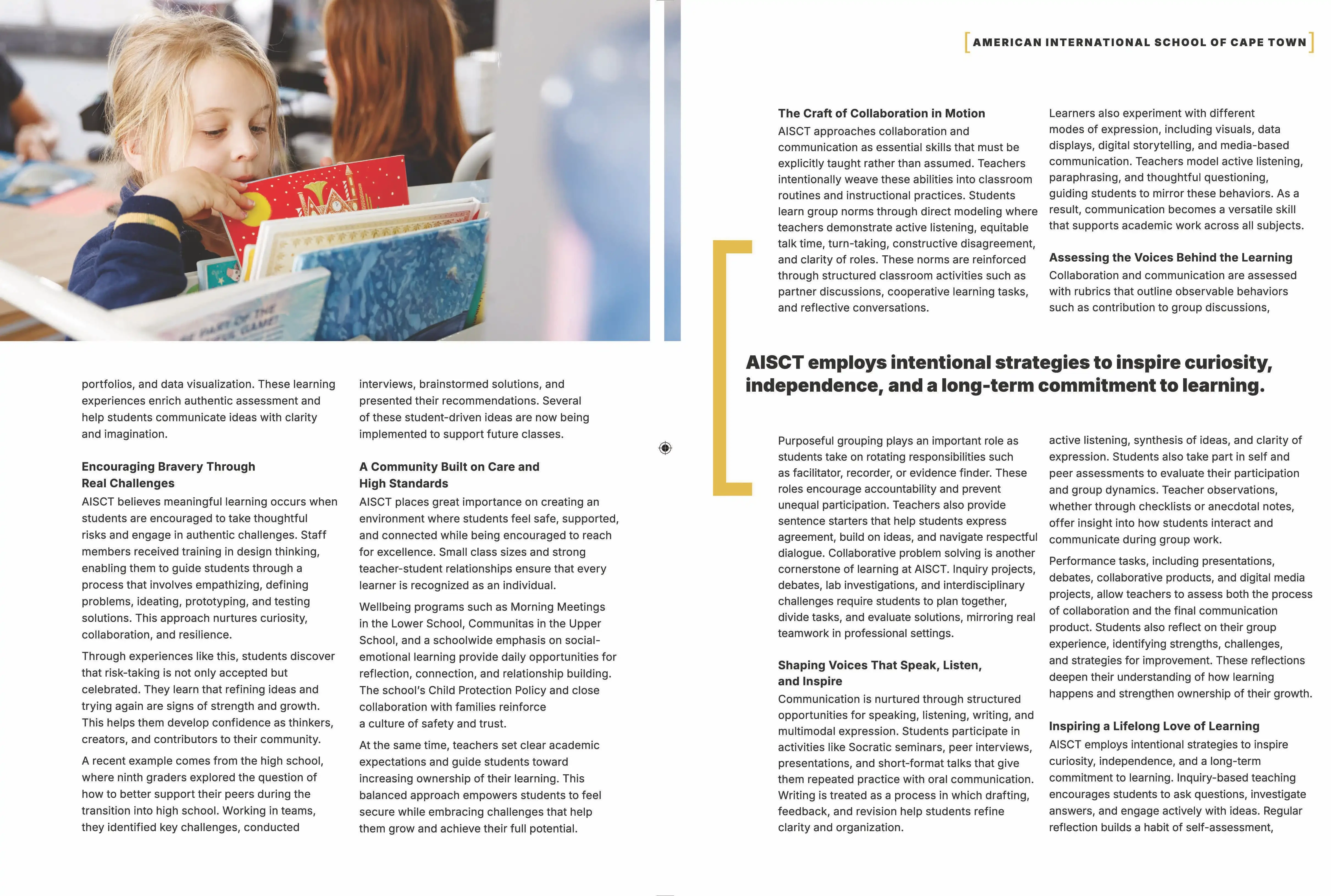
Collaborative projects strengthen teamwork, while discussions on digital ethics and global citizenship cultivate social awareness. Students also explore creative expression through website design, podcast production, digital portfolios, and data visualization. These learning experiences enrich authentic assessment and help students communicate ideas with clarity and imagination.
AISCT believes meaningful learning occurs when students are encouraged to take thoughtful risks and engage in authentic challenges. Staff members received training in design thinking, enabling them to guide students through a process that involves empathizing, defining problems, ideating, prototyping, and testing solutions. This approach nurtures curiosity, collaboration, and resilience.
Through experiences like this, students discover that risk-taking is not only accepted but celebrated. They learn that refining ideas and trying again are signs of strength and growth. This helps them develop confidence as thinkers, creators, and contributors to their community.
A recent example comes from the high school, where ninth graders explored the question of how to better support their peers during the transition into high school. Working in teams, they identified key challenges, conducted interviews, brainstormed solutions, and presented their recommendations. Several of these student-driven ideas are now being implemented to support future classes.
AISCT places great importance on creating an environment where students feel safe, supported, and connected while being encouraged to reach for excellence. Small class sizes and strong teacher-student relationships ensure that every learner is recognized as an individual.
Wellbeing programs such as Morning Meetings in the Lower School, Communitas in the Upper School, and a schoolwide emphasis on social-emotional learning provide daily opportunities for reflection, connection, and relationship building. The school’s Child Protection Policy and close collaboration with families reinforce a culture of safety and trust.
At the same time, teachers set clear academic expectations and guide students toward increasing ownership of their learning. This balanced approach empowers students to feel secure while embracing challenges that help them grow and achieve their full potential.
The Craft of Collaboration in Motion
AISCT approaches collaboration and communication as essential skills that must be explicitly taught rather than assumed. Teachers intentionally weave these abilities into classroom routines and instructional practices. Students learn group norms through direct modeling where teachers demonstrate active listening, equitable talk time, turn-taking, constructive disagreement, and clarity of roles. These norms are reinforced through structured classroom activities such as partner discussions, cooperative learning tasks, and reflective conversations.
Purposeful grouping plays an important role as students take on rotating responsibilities such as facilitator, recorder, or evidence finder. These roles encourage accountability and prevent unequal participation. Teachers also provide sentence starters that help students express agreement, build on ideas, and navigate respectful dialogue. Collaborative problem solving is another cornerstone of learning at AISCT. Inquiry projects, debates, lab investigations, and interdisciplinary challenges require students to plan together, divide tasks, and evaluate solutions, mirroring real teamwork in professional settings.
Communication is nurtured through structured opportunities for speaking, listening, writing, and multimodal expression. Students participate in activities like Socratic seminars, peer interviews, presentations, and short-format talks that give them repeated practice with oral communication. Writing is treated as a process in which drafting, feedback, and revision help students refine clarity and organization.
Learners also experiment with different modes of expression, including visuals, data displays, digital storytelling, and media-based communication. Teachers model active listening, paraphrasing, and thoughtful questioning, guiding students to mirror these behaviors. As a result, communication becomes a versatile skill that supports academic work across all subjects.
Collaboration and communication are assessed with rubrics that outline observable behaviors such as contribution to group discussions, active listening, synthesis of ideas, and clarity of expression. Students also take part in self and peer assessments to evaluate their participation and group dynamics. Teacher observations, whether through checklists or anecdotal notes, offer insight into how students interact and communicate during group work.
Performance tasks, including presentations, debates, collaborative products, and digital media projects, allow teachers to assess both the process of collaboration and the final communication product. Students also reflect on their group experience, identifying strengths, challenges, and strategies for improvement. These reflections deepen their understanding of how learning happens and strengthen ownership of their growth.
AISCT employs intentional strategies to inspire curiosity, independence, and a long-term commitment to learning. Inquiry-based teaching encourages students to ask questions, investigate answers, and engage actively with ideas. Regular reflection builds a habit of self-assessment, helping students understand their strengths and growth areas. Real-world learning experiences such as service learning and community engagement connect academic work to authentic needs, giving students a clear sense of purpose.
Student agency is central to lifelong learning at AISCT. The school’s impact projects allow seniors to pursue meaningful initiatives driven by personal passions. Many students take on work related to sustainability, social justice, education, and community wellbeing. These projects teach initiative, moral purpose, and sustained commitment, all of which are essential for lifelong learners.
Evidence of lifelong learning is strongly reflected in the school’s graduates. The Class of 2025 received numerous global university offers and significant scholarship awards, demonstrating academic readiness as well as the confidence to navigate complex application processes. Alumni continue to pursue ambitious and values-driven endeavors, many inspired by their experiences at AISCT.
Graduates study in countries across North America, Europe, South Africa, and beyond, illustrating the global mindset cultivated at the school. Their resilience and determination are also evident in the way they approach university life, extracurricular involvement, and community impact. Many return to AISCT to share their journeys, offering insight into how the school’s culture of curiosity, respect, and responsibility shaped their paths.
While several alumni have been accepted to prestigious institutions such as Harvard, Princeton, and MIT, AISCT views success through a broader lens. The school prioritizes the meaningful contributions graduates make in their communities and the ways they lead with integrity and purpose. Some even return as parents, continuing the cycle of curiosity and global citizenship for future generations of students.
Also Read :- Education Excellence Magazine for more information