
Every school carries a story
that extends far beyond classrooms and corridors. It lives in the conversations
between teachers and parents, the announcements that shape school life, the
events that bring communities together, and the trust families place in an
institution responsible for their children’s growth. As expectations around
transparency and accessibility continue to rise, schools are being asked to
communicate more clearly, more frequently, and more effectively than ever
before. Yet many institutions still rely on fragmented digital tools that were
never designed with education in mind. Websites become difficult to maintain,
communication is scattered across multiple channels, and educators often find
themselves spending precious time managing systems instead of focusing on
students. The challenge is no longer simply about having a digital presence. It
is about building communication systems that truly support school communities.
Responding to this need, iClassSchool Solutions has established itself as a transformative force in
education technology. Founded by Frank O’Grady and Rory McNichol,
the platform was created with a simple yet powerful objective: to give schools
technology that works as naturally and efficiently as the environments they
serve.
Today,
the organization’s most significant focus is the introduction of iClass
District into the United States market, a development that reflects the
platform’s evolution from supporting individual schools to empowering entire
education systems. Introduced in partnership with school districts in
Cincinnati and Nevada, the platform is designed to support district-level
digital transformation across the United States. Built specifically for the
operational realities of school districts, iClass District creates a unified
digital ecosystem that strengthens communication with parents, enhances school
visibility, and supports student enrolment.
The
creation of the iClass platform was driven by a simple but powerful objective.
The organization set out to build a content management system where almost any
task could be completed in under sixty seconds.
The
founders observed that many widely used website platforms had gradually become
complicated and difficult for non technical users to manage. Systems such as
WordPress, Weebly, and other generic content management platforms were
originally designed to simplify website creation. Over time, however, they
evolved into complex ecosystems requiring technical expertise to manage
effectively.
Schools
faced a unique challenge in this environment. The individuals responsible for
managing school websites and communication channels are typically teachers or
administrators rather than trained web developers. Yet these professionals were
expected to operate increasingly sophisticated digital platforms.
At
the same time, the organization recognized an often overlooked reality about
educational institutions. Schools operate in many ways like businesses. They
must attract families, communicate effectively with their communities, and
build trust with parents and students.
This
insight became central to the development of the platform. Instead of focusing
on classroom learning tools, the organization concentrated on two core
outcomes.
The
first objective was helping schools and districts drive enrolment while
strengthening their operational performance. The second objective focused on
enabling clear, efficient, and consistent communication between schools and
parents.
Every
feature developed by the organization aligns with these two priorities. The
platform integrates Google Analytics so schools can understand their digital
performance and how families discover them online. Automated search engine
optimization ensures that schools can be easily found by prospective parents
without requiring specialized marketing expertise. Integration with Google
marketing tools further enhances the visibility of schools in search results.
By
strengthening the digital infrastructure that connects schools with their
communities, the platform helps institutions present themselves more
effectively and manage communication with greater clarity.
One
of the defining features of the platform is that it was built specifically for
the education sector. Traditional content management systems are typically
designed for commercial businesses. Schools, however, operate in ways that
differ significantly from corporate organizations.
Educational
institutions have rotating content cycles, frequent updates related to events
and policies, and multiple staff members contributing to website content. They
also operate within strict compliance frameworks and must ensure that
information remains accurate and accessible.
Rather
than asking schools to adapt to generic platforms, the organization built a
system that mirrors the structure and needs of educational institutions.
Content categories reflect common school requirements such as policies,
admissions information, news updates, classroom pages, and school events.
Automation
is deeply embedded throughout the platform. The system automatically manages
elements such as search engine optimization architecture, image tagging,
metadata generation, accessibility formatting, and search-friendly content
structures.
In this way, the platform moves beyond being a simple website tool. Instead, it functions as a digital infrastructure tailored to the operational realities of schools.

Parental communication represents one of the most important areas in which the platform has had an impact. The iClass mobile application centralizes communication between schools and families into a single secure environment.
Historically, communication between schools and parents was largely one-directional. Schools distributed information through newsletters, printed notices, or emails and hoped that families would receive the message.
Modern parents expect faster and more transparent communication. They want updates in real time and prefer simple digital tools that allow them to interact with schools easily.
?Through the mobile application, parents can receive announcements, submit absence notes, complete digital forms, respond to surveys, and access school updates instantly. Because all communication takes place within one trusted channel, parents do not need to monitor multiple platforms or search through email threads to find important information.
Schools using the platform consistently report higher levels of engagement compared with traditional communication channels such as email or SMS messaging. By streamlining communication, the system reduces administrative pressure on staff while building stronger relationships between schools and families.
Although education systems vary across countries, many of the operational needs of schools remain similar. Communication, compliance, and community engagement are universal challenges faced by institutions around the world.
To address these variations, the organization designed its platform as a flexible framework rather than a fixed product. This structure allows the system to adapt to different regulatory environments, local terminology, governance structures, and enrolment processes.
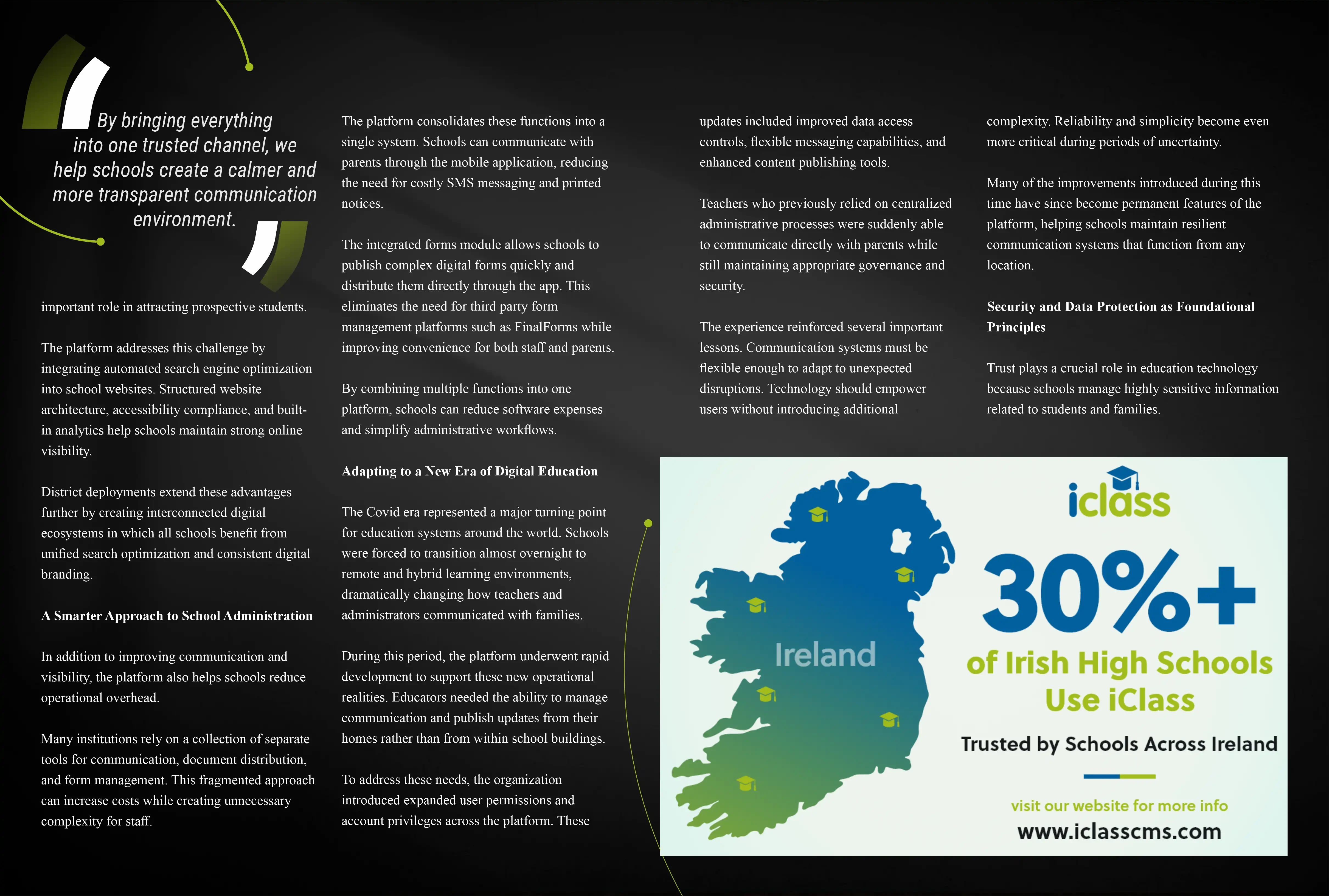
The platform has already achieved widespread adoption in Ireland (over 30% of Irish high schools already use iClass) and is now expanding across the United Kingdom and the United States.
Ireland, where the platform was originally developed, has only a very small fee-paying school sector. As a result, the team designed iClass to be highly affordable and accessible from the outset. This approach shaped the platform’s pricing model and overall philosophy. As iClass expands into the US market, affordability remains one of its key competitive advantages. The platform aims to offer its services at less than 50 percent of the cost of many established providers, positioning itself as a cost-effective alternative for schools seeking modern digital learning solutions.
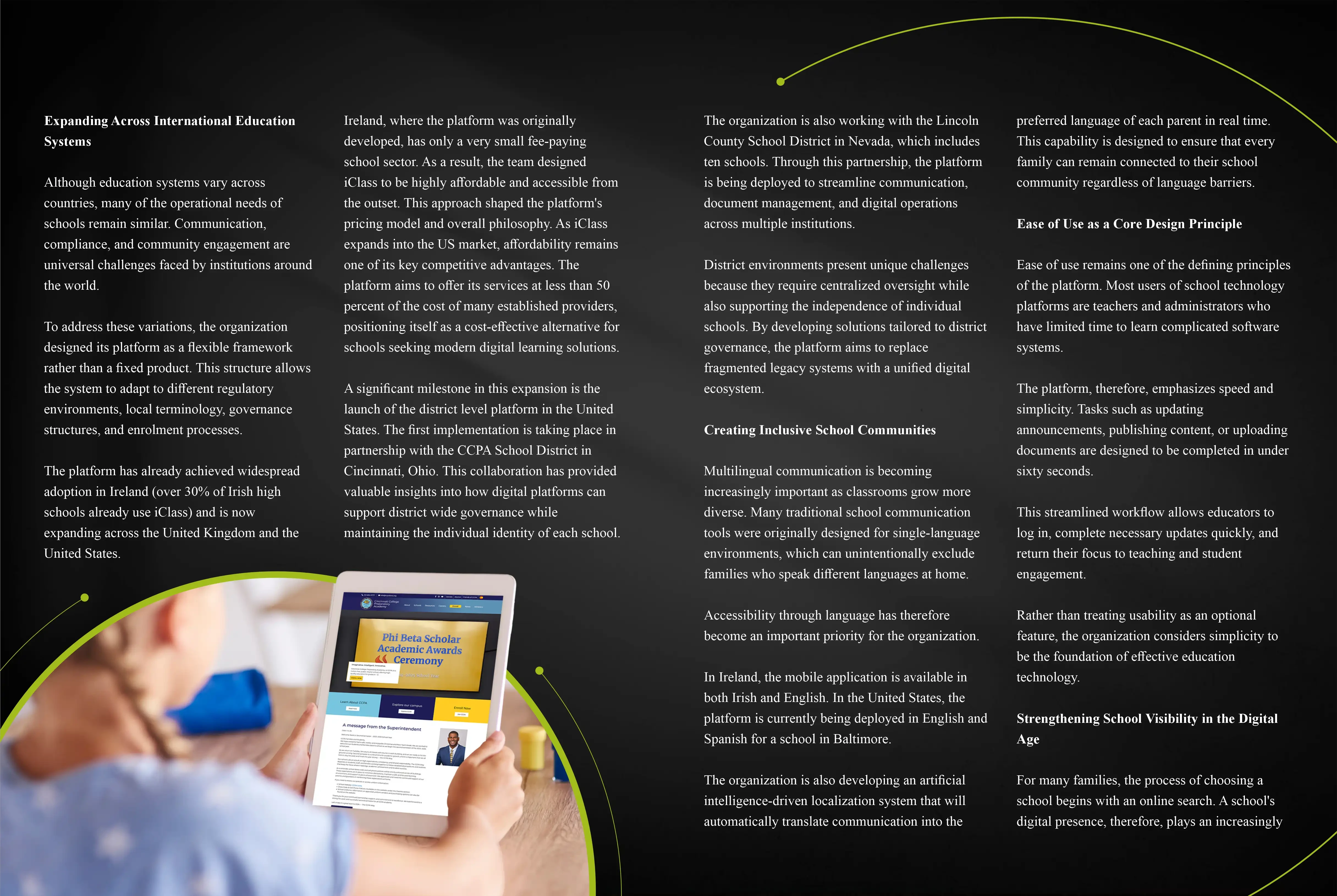
A significant milestone in this expansion is the launch of the district level platform in the United States. The first implementation is taking place in partnership with the CCPA School District in Cincinnati, Ohio. This collaboration has provided valuable insights into how digital platforms can support district wide governance while maintaining the individual identity of each school.
The organization is also working with the Lincoln County School District in Nevada, which includes ten schools. Through this partnership, the platform is being deployed to streamline communication, document management, and digital operations across multiple institutions.
District environments present unique challenges because they require centralized oversight while also supporting the independence of individual schools. By developing solutions tailored to district governance, the platform aims to replace fragmented legacy systems with a unified digital ecosystem.
Multilingual communication is becoming increasingly important as classrooms grow more diverse. Many traditional school communication tools were originally designed for single-language environments, which can unintentionally exclude families who speak different languages at home.
Accessibility through language has therefore become an important priority for the organization.
In Ireland, the mobile application is available in both Irish and English. In the United States, the platform is currently being deployed in English and Spanish for a school in Baltimore.
The organization is also developing an artificial intelligence-driven localization system that will automatically translate communication into the preferred language of each parent in real time. This capability is designed to ensure that every family can remain connected to their school community regardless of language barriers.
Ease of use remains one of the defining principles of the platform. Most users of school technology platforms are teachers and administrators who have limited time to learn complicated software systems.
The platform, therefore, emphasizes speed and simplicity. Tasks such as updating announcements, publishing content, or uploading documents are designed to be completed in under sixty seconds.
This streamlined workflow allows educators to log in, complete necessary updates quickly, and return their focus to teaching and student engagement.
Rather than treating usability as an optional feature, the organization considers simplicity to be the foundation of effective education technology.
For many families, the process of choosing a school begins with an online search. A school’s digital presence, therefore, plays an increasingly important role in attracting prospective students.
The platform addresses this challenge by integrating automated search engine optimization into school websites. Structured website architecture, accessibility compliance, and built-in analytics help schools maintain strong online visibility.
District deployments extend these advantages further by creating interconnected digital ecosystems in which all schools benefit from unified search optimization and consistent digital branding.
In addition to improving communication and visibility, the platform also helps schools reduce operational overhead.
Many institutions rely on a collection of separate tools for communication, document distribution, and form management. This fragmented approach can increase costs while creating unnecessary complexity for staff.
The platform consolidates these functions into a single system. Schools can communicate with parents through the mobile application, reducing the need for costly SMS messaging and printed notices.
The integrated forms module allows schools to publish complex digital forms quickly and distribute them directly through the app. This eliminates the need for third party form management platforms such as FinalForms while improving convenience for both staff and parents.
By combining multiple functions into one platform, schools can reduce software expenses and simplify administrative workflows.
The Covid era represented a major turning point for education systems around the world. Schools were forced to transition almost overnight to remote and hybrid learning environments, dramatically changing how teachers and administrators communicated with families.
During this period, the platform underwent rapid development to support these new operational realities. Educators needed the ability to manage communication and publish updates from their homes rather than from within school buildings.
To address these needs, the organization introduced expanded user permissions and account privileges across the platform. These updates included improved data access controls, flexible messaging capabilities, and enhanced content publishing tools.
Teachers who previously relied on centralized administrative processes were suddenly able to communicate directly with parents while still maintaining appropriate governance and security.
The experience reinforced several important lessons. Communication systems must be flexible enough to adapt to unexpected disruptions. Technology should empower users without introducing additional complexity. Reliability and simplicity become even more critical during periods of uncertainty.
Many of the improvements introduced during this time have since become permanent features of the platform, helping schools maintain resilient communication systems that function from any location.
Trust plays a crucial role in education technology because schools manage highly sensitive information related to students and families.
The platform operates under strict data protection standards aligned with GDPR requirements in the United Kingdom and Ireland. As the organization expands in the United States, it also aligns its systems with federal, state, and district level privacy regulations.
For example, the platform complies with Ohio Senate Bill 29, which establishes standards for student data privacy and responsible use of educational technology.
A key element of the system architecture is the separation of public facing website content from secure communication environments. Sensitive information related to students and parents is never stored within publicly accessible website structures.
All communication is encrypted, and access to information is governed through carefully structured role-based permissions. Teachers, school staff, administrators, and district leaders each receive access privileges tailored to their responsibilities.
By consolidating communication, document management, and publishing tools within a single secure environment, the platform also reduces risks associated with using multiple third-party systems.
Security is therefore not treated as an optional feature but as a foundational principle embedded throughout the platform’s design.
Looking ahead, the organization is expanding its use of artificial intelligence to further simplify administrative tasks for schools.
In February, the platform launched what is believed to be the first multilingual chatbot on a United States school district website. The chatbot enables parents to ask questions and receive information in the language of their choice, making school resources more accessible to diverse communities.
This innovation represents the beginning of a broader strategy focused on practical artificial intelligence applications within education infrastructure.
Upcoming developments include AI assisted content publishing tools, intelligent insights that help schools improve communication strategies, and automated localization systems that translate information seamlessly for parents.
The long term vision is to create an intelligent digital infrastructure that quietly removes administrative friction from school operations. By simplifying technology and automating routine processes, the platform allows educators to devote more of their time to teaching, community engagement, and supporting student success.
Also Read :- Education Excellence Magazine For more information