Higher
education systems are rarely transformed through rhetoric alone. Real change
emerges through patient institution-building, rigorous policy work, and leaders
who understand both the academic core and the operational realities of complex
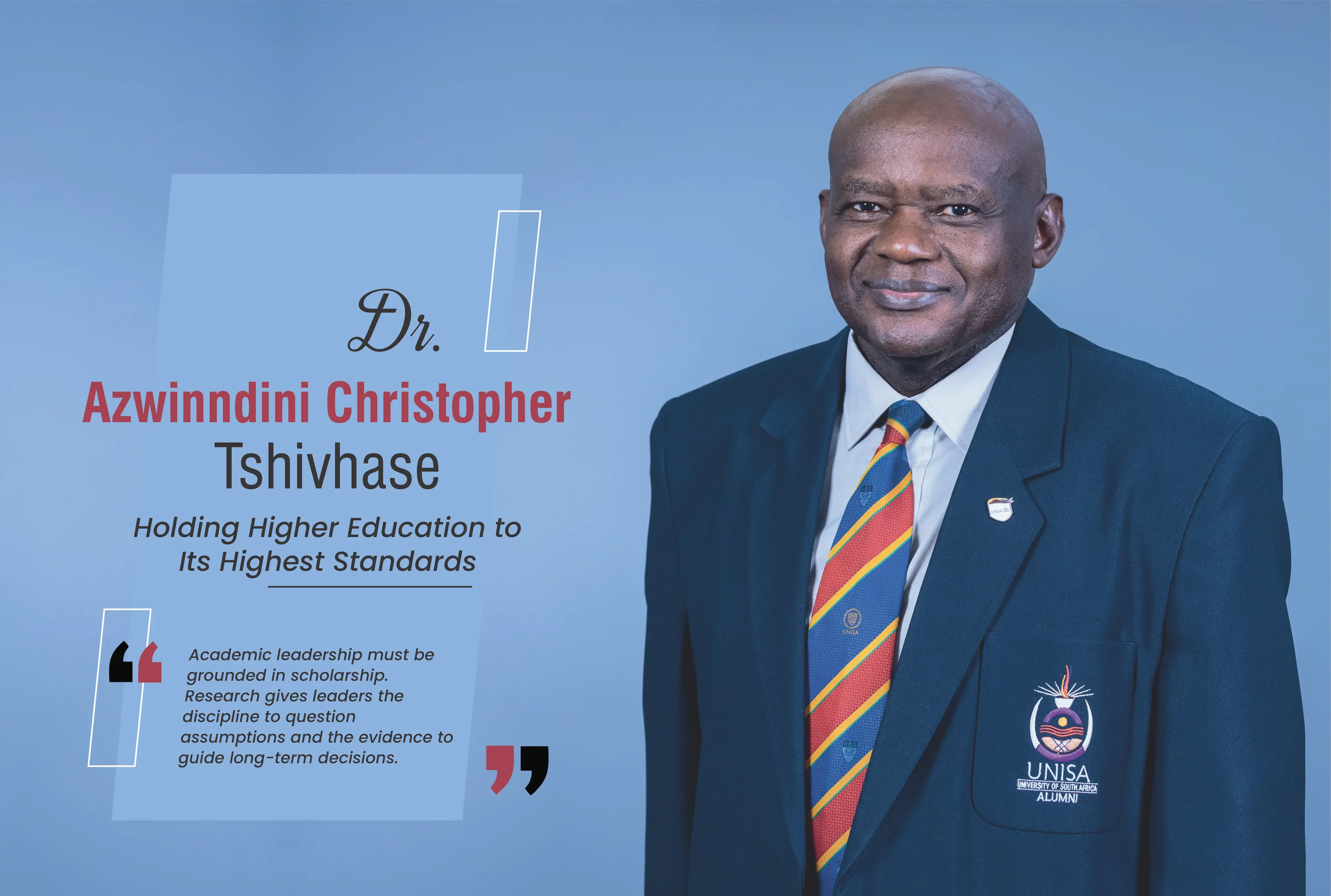
organisations. Across South Africa’s higher education and training realm, few figures embody this depth of engagement as consistently as Dr Azwinndini Christopher Tshivhase. With a career spanning teaching, curriculum development, quality assurance, executive leadership, and national standards oversight, his work reflects a sustained commitment to strengthening education as a public good.
Dr
Tshivhase’s professional journey is rooted in a rare combination of classroom
experience, academic scholarship, and senior executive responsibility. Over
several decades, he has played a central role in shaping curriculum policy,
advancing open and distance learning, strengthening governance frameworks, and
leading institutions through periods of transition and reform. His career offers
a lens into how education leadership, when grounded in scholarship and
practice, can influence systems at scale.
Dr
Tshivhase’s career began where educational impact is most immediate: the
classroom. Trained initially as a teacher of English and Biology, he worked in
secondary schools in both Venda and Pretoria, teaching learners across diverse
social and educational contexts. These formative years provided him with
first-hand exposure to the realities of South Africa’s schooling system,
including issues of access, equity, language, and learner support.
His
teaching experience extended beyond mainstream education. At Filadelfia
Secondary School, he taught learners with special educational needs, including
students who were physically disabled, blind or partially sighted, deaf, and
hard of hearing. This period deeply shaped his understanding of inclusive
education, learner diversity, and the importance of adaptive teaching and
assessment practices. It also reinforced a belief that educational systems must
be designed to accommodate difference rather than marginalise it.
These early roles laid the ethical and professional foundation for a career that would later influence national policy, curriculum frameworks, and institutional governance.
.jpg)
Alongside his teaching career, Dr Tshivhase pursued advanced academic study, building a strong scholarly base in education management, multiculturalism, and higher education policy. His academic journey culminated in a PhD focused on the development and implementation of institutional policy in an open and distance learning institution, using the University of South Africa as a case study.
This research marked a turning point in his career. It positioned him not only as a practitioner, but as a scholar of institutional systems, policy alignment, and governance in large, complex universities. His doctoral work continues to inform his approach to academic planning, curriculum design, and quality assurance, particularly within open and distance education contexts.
Throughout his career, Dr Tshivhase has remained engaged in academic research and publication, contributing to accredited journals, edited volumes, and conference proceedings on topics including blended learning, staff development, learning organisations, and policy issues in distance education.
Dr Tshivhase’s transition into higher education leadership began at the Vaal University of Technology, where he served as Senior Lecturer in Languages, Communication, and Educational Studies. In this role, he lectured across faculties, designed curricula for diverse disciplines, and coordinated education management programmes at the postgraduate level.
This period sharpened his ability to work across disciplinary boundaries and to align teaching, assessment, and curriculum design with institutional and national priorities. His contributions were formally recognised through awards for research output and academic development.
His move to the University of South Africa marked the beginning of a long and influential association with one of the continent’s largest open and distance learning institutions. As Education Consultant and later Director within curriculum and learning development directorates, he became deeply involved in institutional transformation, staff development, and policy implementation across multiple colleges.
At Unisa, Dr Tshivhase’s responsibilities extended far beyond curriculum design. He played a central role in aligning qualifications with national frameworks, implementing quality assurance mechanisms, and supporting academics in developing learning materials that responded to diverse student needs.
He worked extensively with national policy instruments and regulatory bodies, ensuring institutional compliance with frameworks such as SAQA, HEQF, CHE, and DHET requirements. His work required not only technical expertise but also diplomacy, leadership, and the ability to translate policy into practice across large academic units.
As Director of the Directorate for Curriculum and Learning Development, he provided strategic leadership during a critical period of institutional change. His key performance areas included the transformation of core academic business, service excellence, sustainability, stakeholder engagement, and people-centred leadership. These responsibilities positioned him at the heart of institutional decision-making and long-term planning.
Dr Tshivhase’s influence extended beyond individual institutions when he joined the Council on Higher Education as Senior Manager in the Directorate for National Standards and Reviews. In this role, he contributed to national standards development, institutional reviews, and quality assurance processes affecting universities across South Africa.
This system-level perspective deepened his understanding of how policy, governance, and academic quality intersect across the sector. It also reinforced the importance of consistency, accountability, and evidence-based decision-making in protecting the credibility of higher education.
His subsequent consulting work with the Thabo Mbeki African Leadership Institute further demonstrated his ability to operate at the intersection of academic vision and institutional strategy, advising on curriculum redesign, programme qualification mixes, and leadership development.
Dr Tshivhase’s career includes several senior executive roles that demanded both strategic oversight and operational accountability. As Director of Academic Planning and Quality Assurance at the University of Zululand, he led initiatives focused on internal auditing, programme review, policy development, and regulatory reporting.
His appointment as Director of Curriculum Development and E-Learning at the South African Judicial Education Institute marked another expansion of his leadership scope. In this role, he oversaw judicial curriculum development, introduced blended learning approaches, and ensured that educational programmes remained aligned with legislative and policy changes affecting the judiciary.
Perhaps one of his most visible leadership roles was as Principal and Chief Executive Officer of the Limpopo Community Education and Training College. Here, he was responsible for student access, academic success, financial management, governance, and human capital development across community learning centres. This role highlighted his commitment to education beyond traditional universities, emphasising lifelong learning, community development, and inclusive access.
Dr Tshivhase’s work has not been confined to South Africa. He has led and participated in training initiatives across Africa, working with universities and educational institutions in Nigeria, Botswana, Namibia, Kenya, Zimbabwe, Ghana, and Sudan. These engagements focused on curriculum design, learning material development, and open and distance education methodologies. He also contributed massively to Unisa’s mandate through the New Partnership for African Development (NEPAD).
Through these international projects, he contributed to capacity-building and knowledge exchange, reinforcing the role of African higher education institutions in shaping locally relevant, globally informed learning systems. As part of Unisa’s global extension, he has represented the institution at various conferences and forums. Thus, he has traveled to the UK, the Netherlands, Belgium, Germany, and France to learn and establish partnerships and participation in a fellowship programme. He also stayed at Fontys University in the Netherlands, undertaking a fellowship programme on education leadership and management. He also visited Open UK in Milton Keynes to understudy their academic strategic planning and operationalisation. Unisa also provided him with the opportunity to go to Athabasca University in Canada to learn more about online learning and teaching, including assessments.
His conference participation and publication record further demonstrate a sustained commitment to scholarly engagement and sector-wide dialogue. He went to Mohammed Bin University in the United Arab Emirates Republic to strengthen the partnership of Unisa and the delivery of the quality programme in open and distance learning.
Across roles and institutions, a consistent thread in Dr Tshivhase’s work is a people-centred approach to leadership. Whether developing staff, mentoring academics, or managing large teams, he has prioritised capacity-building, professional development, and ethical governance.
His leadership philosophy recognises that sustainable institutional performance depends on empowered people, clear systems, and shared purpose. This perspective is evident in his focus on staff development, quality culture, and participatory approaches to curriculum and policy design.
Dr Tshivhase currently serves as Executive Director for Academic Planning at the University of South Africa, while also holding the position of Acting Vice-Principal for Teaching, Learning, Community Engagement, and Student Support. These roles place him at the centre of strategic decision-making related to academic alignment, programme articulation, quality assurance, teaching and learning, and student success.
In these capacities, he continues to shape institutional direction, balancing regulatory compliance with innovation, and academic excellence with social responsibility.
Dr Azwinndini Christopher Tshivhase’s career reflects a rare continuity of purpose across multiple levels of the education system. From classroom teaching to national policy, from curriculum design to executive leadership, his work has consistently focused on building institutions that are inclusive, credible, and resilient.
Rather than pursuing visibility, his impact is embedded in systems, frameworks, and people. It is visible in curricula that work, policies that endure, and institutions better equipped to serve their students and society.
In an era where higher education faces increasing complexity, his career stands as an example of leadership grounded in scholarship, practice, and an unwavering commitment to educational integrity.
Also Read :- Education Excellence Magazine for more information