Learning is understood not as the accumulation of information, but as a
deeply human journey of restoration and becoming. It is a process that shapes
character as much as intellect, inviting curiosity, reflection, and
responsibility to grow together. True learning strengthens what already exists
within the learner, cultivating resilience, balance, and purpose.
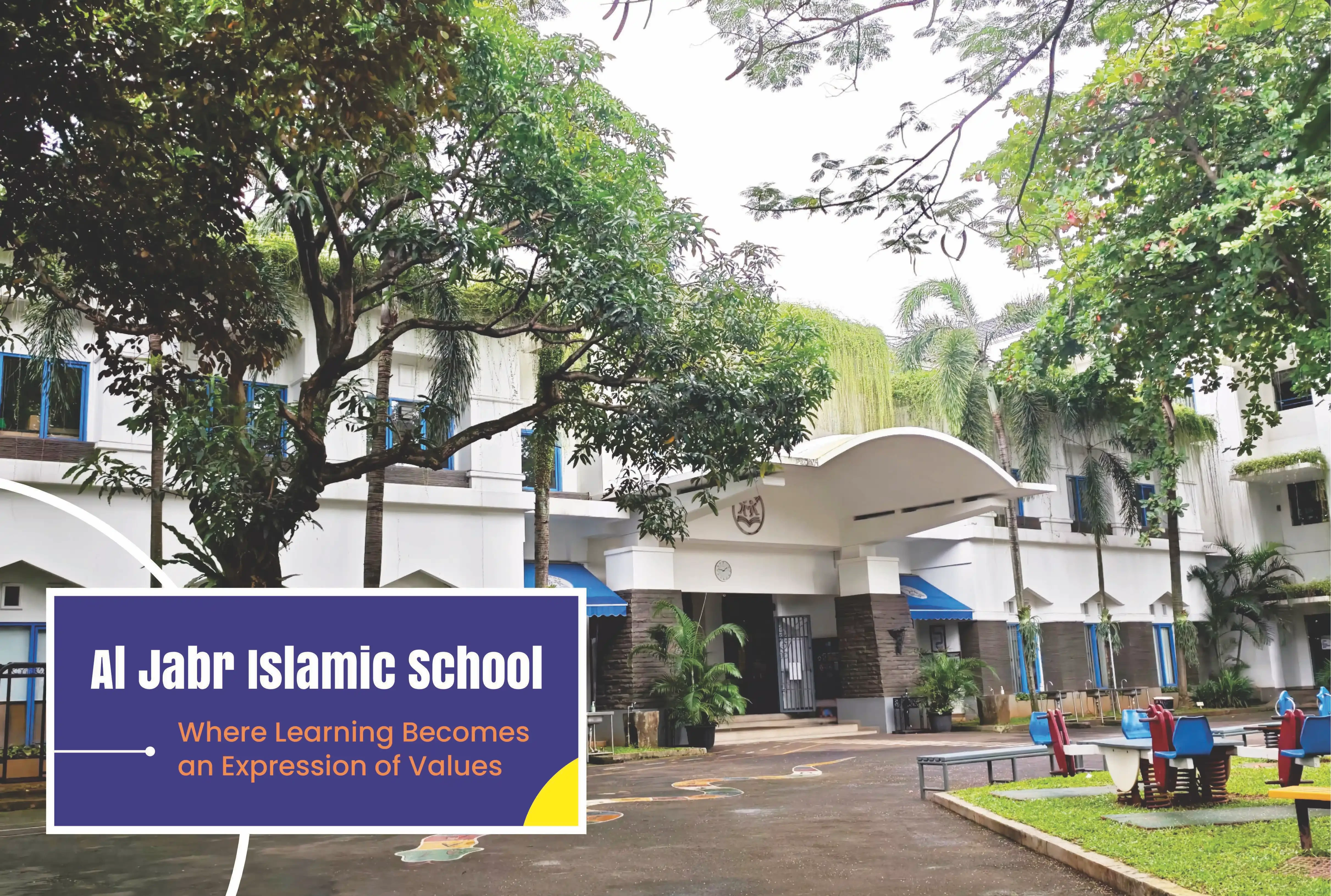
Al Jabr Islamic School embodies this philosophy through an educational model
that seamlessly weaves faith, academic rigor, and service into everyday
learning. Rooted in Islamic values and strengthened by international standards,
the school offers a rare and thoughtful integration of the National Curriculum,
the International Baccalaureate framework, and a strong community-centered
ethos.
The name Al Jabr carries profound meaning that shapes the school’s
identity and educational philosophy. Rooted in Islamic tradition, Al Jabr is
derived from one of the Asmaul Husna, Al Jabb?r, which signifies The Restorer,
The Sustainer, and The One who brings strength and balance. The meaning
embodies resilience, courage, greatness, dignity, and istiqomah or
steadfastness. This concept is further reflected in its connection to Algebra,
a discipline that emphasizes relationships, balance, and problem-solving.
This parallel philosophy forms the foundation of Al Jabr Islamic
School’s identity and guides its educational purpose. Education is viewed as a
transformative journey that restores potential, strengthens character, and
nurtures the whole child. Learning is understood as a continuous process of
growth, reflection, and improvement.
The school believes that every student possesses unique potential that
deserves to be developed with care and dignity. Students are nurtured to
strengthen their personal profiles, develop learning skills, organize
themselves, and adapt to challenges. These abilities are essential for
navigating an increasingly complex world.
Aligned with international best practices, the school aims to develop
learners who are lifelong learners, critical and creative thinkers,
compassionate global citizens, and individuals of integrity and purpose. This
is achieved within a supportive environment grounded in strong Islamic values,
where challenges are embraced as opportunities for development.
Al Jabr Islamic School’s roots in community service have deeply
influenced its values and long-term educational vision. Education is viewed not
as an individual pursuit but as a collective journey rooted in purpose,
service, and contribution. Students are encouraged to reflect on what they have
learned, how they can apply their knowledge meaningfully, and how they can
contribute to their communities.
These principles were first cultivated through the establishment of the
Al Jabr Mosque. The mosque was envisioned as more than a place of worship. It
became a center for nurturing sincerity, humility, care for others, and shared
responsibility. These values were later embedded deeply into the school’s
culture and learning environment.
As lifelong learners, students come to understand that true education
leads to meaningful action, that knowledge carries responsibility, and that
service is not an additional activity but an expression of faith and purpose.
Action and service-learning activities are integrated into the Unit of Inquiry
from Early Years to Grade Twelve. Students identify community needs, design
relevant initiatives, raise funds, take meaningful action, and reflect on their
experiences.
These service activities extend beyond the immediate neighborhood, reaching communities across the city and province. Through this approach, students grow within a community that models respect for faith and moral values, empowerment of others, collaboration, and responsibility toward society and the environment. This philosophy aligns deeply with the Islamic concept of Amal Jariyah, continuous good deeds whose impact extends beyond one’s lifetime.
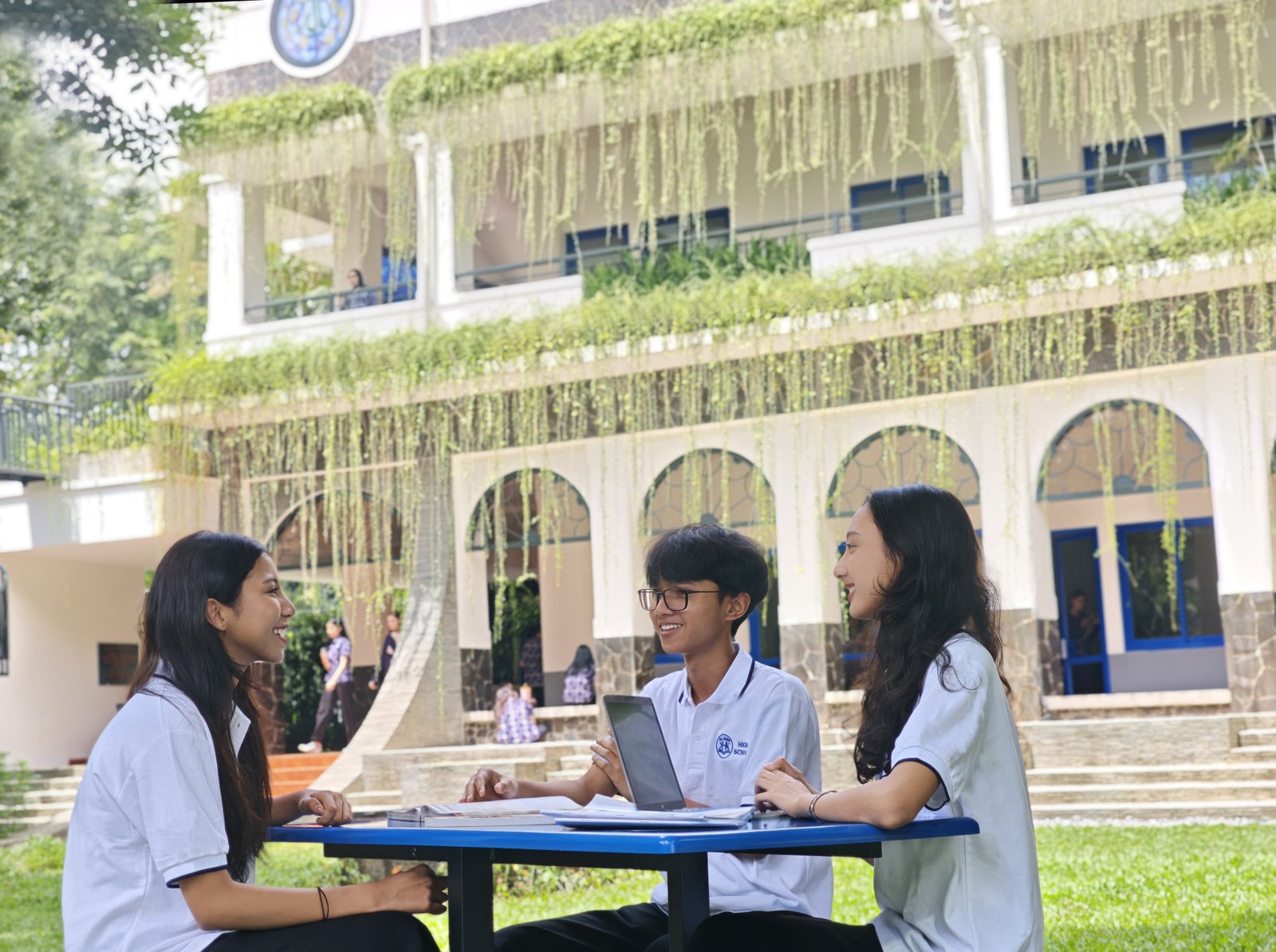
Since its early days, education for all has been a guiding principle of Al Jabr Islamic School. As a non-profit institution, the school was established to enable families from diverse socioeconomic backgrounds to access an international standard education. Tuition fees are intentionally set to remain among the most affordable compared to other IB schools.
Each class includes orphaned students who receive full scholarships, ensuring that financial circumstances do not limit access to quality education. The support provided is designed to empower students rather than function as an act of charity.
Inclusivity is further sustained through investment in local educators. All teachers are locally recruited and continuously developed through structured professional learning programs, both internal and external. This includes participation in IB regional workshops and IB Global Conferences.
This approach ensures teaching practices meet international standards while remaining deeply connected to local culture and community needs.
The school actively shares knowledge and best teaching and learning practices with other local schools and communities, reinforcing the belief that education is a collective responsibility. Knowledge and service are seen as vehicles for creating lasting benefit.
The learning environment is intentionally designed to recognize and embrace student diversity. Multiple teaching and learning approaches are used, allowing students to express understanding through projects, performances, and portfolios. Differentiation and scaffolding are embedded in classrooms to support students according to readiness, learning needs, and personal contexts while maintaining high expectations for all.
The establishment of an orphanage alongside the school represents a unique integration of education and social responsibility. The inclusion of orphaned students in classrooms nurtures authentic empathy and meaningful service learning. Values such as compassion, social awareness, and inclusion are not merely taught but lived daily.
Students grow up witnessing inclusion in action and learning alongside peers from diverse backgrounds. They come to understand that education is a shared right rather than a privilege. This lived experience fosters humility, gratitude, and a deep sense of responsibility toward others.
This approach aligns with the IB philosophy and strengthens students’ development as caring, reflective, and principled learners. Empathy becomes a natural outcome of shared experiences rather than an abstract concept.
Al Jabr Islamic School began as a playgroup and kindergarten before growing into a full Kindergarten to Grade Twelve institution. This journey included key milestones and meaningful challenges, particularly in maintaining coherence across multiple educational frameworks, ensuring teacher readiness, and sustaining a balanced integration of faith, national identity, and global perspectives.
The school initially adopted a Montessori approach for early childhood education, establishing a strong foundation for independence, inquiry, and holistic development. As parental demand increased, the school expanded organically to include elementary, junior high, and senior high levels. This growth reflected the community’s trust in the school’s philosophy and long-term vision.
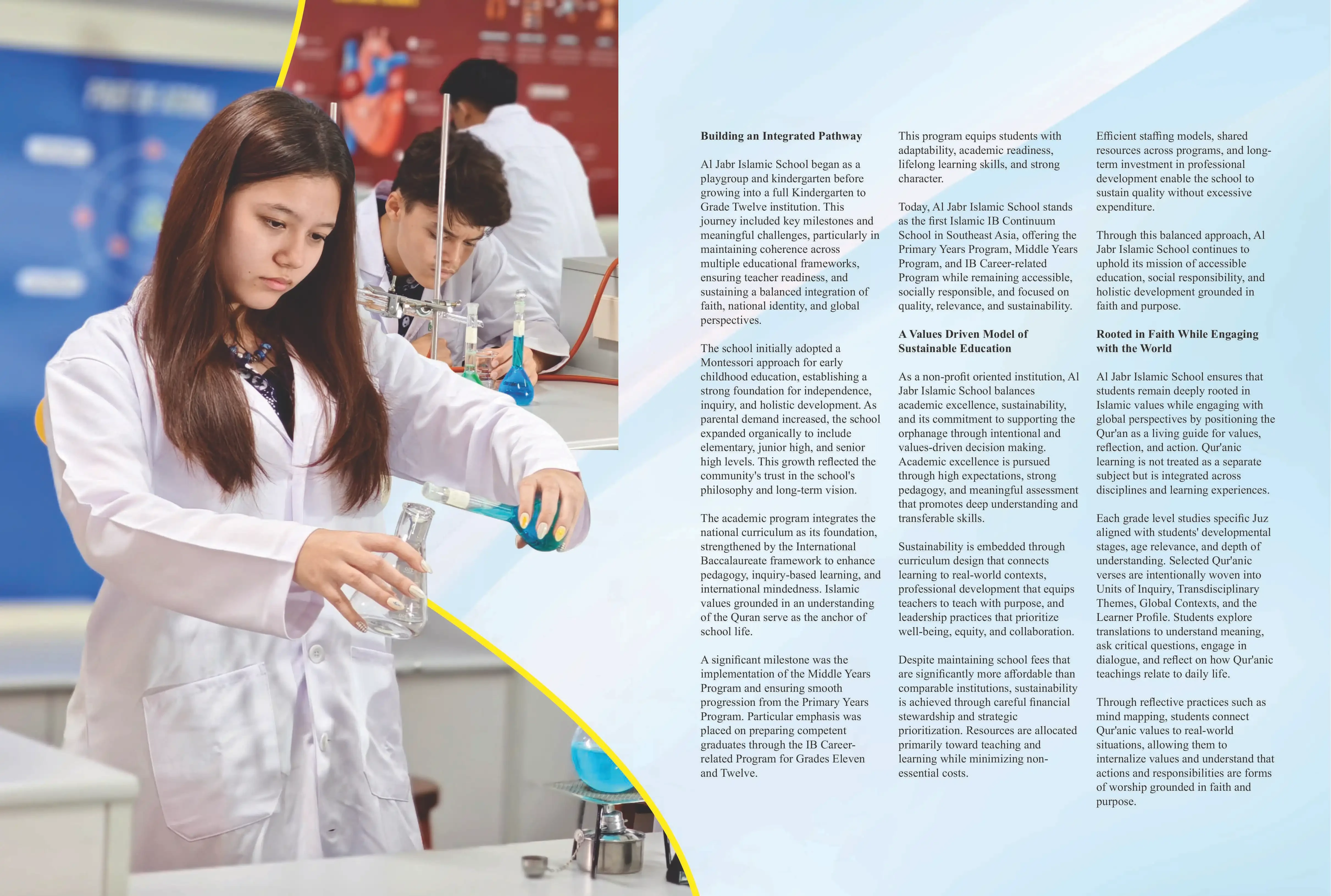
The academic program integrates the national curriculum as its foundation, strengthened by the International Baccalaureate framework to enhance pedagogy, inquiry-based learning, and international mindedness. Islamic values grounded in an understanding of the Quran serve as the anchor of school life.
A significant milestone was the implementation of the Middle Years Program and ensuring smooth progression from the Primary Years Program. Particular emphasis was placed on preparing competent graduates through the IB Career-related Program for Grades Eleven and Twelve. This program equips students with adaptability, academic readiness, lifelong learning skills, and strong character.
Today, Al Jabr Islamic School stands as the first Islamic IB Continuum School in Southeast Asia, offering the Primary Years Program, Middle Years Program, and IB Career-related Program while remaining accessible, socially responsible, and focused on quality, relevance, and sustainability.
As a non-profit oriented institution, Al Jabr Islamic School balances academic excellence, sustainability, and its commitment to supporting the orphanage through intentional and values-driven decision making. Academic excellence is pursued through high expectations, strong pedagogy, and meaningful assessment that promotes deep understanding and transferable skills.
Sustainability is embedded through curriculum design that connects learning to real-world contexts, professional development that equips teachers to teach with purpose, and leadership practices that prioritize well-being, equity, and collaboration.
Despite maintaining school fees that are significantly more affordable than comparable institutions, sustainability is achieved through careful financial stewardship and strategic prioritization. Resources are allocated primarily toward teaching and learning while minimizing non-essential costs. Efficient staffing models, shared resources across programs, and long-term investment in professional development enable the school to sustain quality without excessive expenditure.
Through this balanced approach, Al Jabr Islamic School continues to uphold its mission of accessible education, social responsibility, and holistic development grounded in faith and purpose.
Al Jabr Islamic School ensures that students remain deeply rooted in Islamic values while engaging with global perspectives by positioning the Qur’an as a living guide for values, reflection, and action. Qur’anic learning is not treated as a separate subject but is integrated across disciplines and learning experiences.
Each grade level studies specific Juz aligned with students’ developmental stages, age relevance, and depth of understanding. Selected Qur’anic verses are intentionally woven into Units of Inquiry, Transdisciplinary Themes, Global Contexts, and the Learner Profile. Students explore translations to understand meaning, ask critical questions, engage in dialogue, and reflect on how Qur’anic teachings relate to daily life.
Through reflective practices such as mind mapping, students connect Qur’anic values to real-world situations, allowing them to internalize values and understand that actions and responsibilities are forms of worship grounded in faith and purpose.
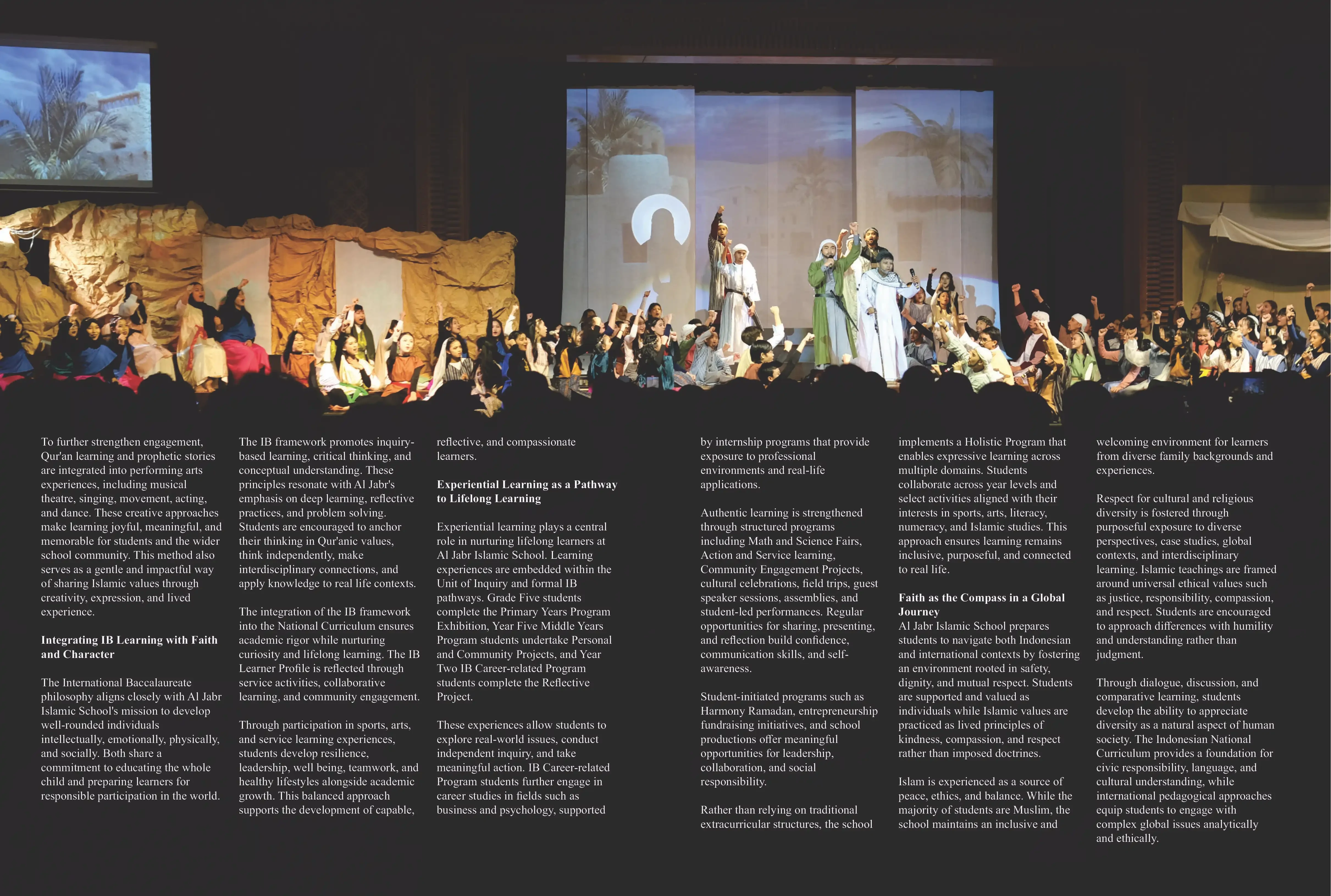
To further strengthen engagement, Qur’an learning and prophetic stories are integrated into performing arts experiences, including musical theatre, singing, movement, acting, and dance. These creative approaches make learning joyful, meaningful, and memorable for students and the wider school community. This method also serves as a gentle and impactful way of sharing Islamic values through creativity, expression, and lived experience
The International Baccalaureate philosophy aligns closely with Al Jabr Islamic School’s mission to develop well-rounded individuals intellectually, emotionally, physically, and socially. Both share a commitment to educating the whole child and preparing learners for responsible participation in the world.
The IB framework promotes inquiry-based learning, critical thinking, and conceptual understanding. These principles resonate with Al Jabr’s emphasis on deep learning, reflective practices, and problem solving. Students are encouraged to anchor their thinking in Qur’anic values, think independently, make interdisciplinary connections, and apply knowledge to real life contexts.
The integration of the IB framework into the National Curriculum ensures academic rigor while nurturing curiosity and lifelong learning. The IB Learner Profile is reflected through service activities, collaborative learning, and community engagement.
Through participation in sports, arts, and service learning experiences, students develop resilience, leadership, well being, teamwork, and healthy lifestyles alongside academic growth. This balanced approach supports the development of capable, reflective, and compassionate learners.
Experiential learning plays a central role in nurturing lifelong learners at Al Jabr Islamic School. Learning experiences are embedded within the Unit of Inquiry and formal IB pathways. Grade Five students complete the Primary Years Program Exhibition, Year Five Middle Years Program students undertake Personal and Community Projects, and Year Two IB Career-related Program students complete the Reflective Project.
These experiences allow students to explore real-world issues, conduct independent inquiry, and take meaningful action. IB Career-related Program students further engage in career studies in fields such as business and psychology, supported by internship programs that provide exposure to professional environments and real-life applications.
Authentic learning is strengthened through structured programs including Math and Science Fairs, Action and Service learning, Community Engagement Projects, cultural celebrations, field trips, guest speaker sessions, assemblies, and student-led performances. Regular opportunities for sharing, presenting, and reflection build confidence, communication skills, and self-awareness.
Student-initiated programs such as Harmony Ramadan, entrepreneurship fundraising initiatives, and school productions offer meaningful opportunities for leadership, collaboration, and social responsibility.
Rather than relying on traditional extracurricular structures, the school implements a Holistic Program that enables expressive learning across multiple domains. Students collaborate across year levels and select activities aligned with their interests in sports, arts, literacy, numeracy, and Islamic studies. This approach ensures learning remains inclusive, purposeful, and connected to real life.
Al Jabr Islamic School prepares students to navigate both Indonesian and international contexts by fostering an environment rooted in safety, dignity, and mutual respect. Students are supported and valued as individuals while Islamic values are practiced as lived principles of kindness, compassion, and respect rather than imposed doctrines.
Islam is experienced as a source of peace, ethics, and balance. While the majority of students are Muslim, the school maintains an inclusive and welcoming environment for learners from diverse family backgrounds and experiences.
Respect for cultural and religious diversity is fostered through purposeful exposure to diverse perspectives, case studies, global contexts, and interdisciplinary learning. Islamic teachings are framed around universal ethical values such as justice, responsibility, compassion, and respect. Students are encouraged to approach differences with humility and understanding rather than judgment.
Through dialogue, discussion, and comparative learning, students develop the ability to appreciate diversity as a natural aspect of human society. The Indonesian National Curriculum provides a foundation for civic responsibility, language, and cultural understanding, while international pedagogical approaches equip students to engage with complex global issues analytically and ethically.
Teachers, parents, and the wider community play a vital role in sustaining Al Jabr Islamic School’s mission and creating a supportive learning environment. This collaborative ecosystem ensures that the school remains values-driven and student-centered.
Teachers apply purposeful pedagogy and reflective practice, using appropriate strategies and formative assessment to guide learning. Regular professional development sessions focus on understanding student needs, interests, and learning barriers to maximize individual potential and support holistic growth.
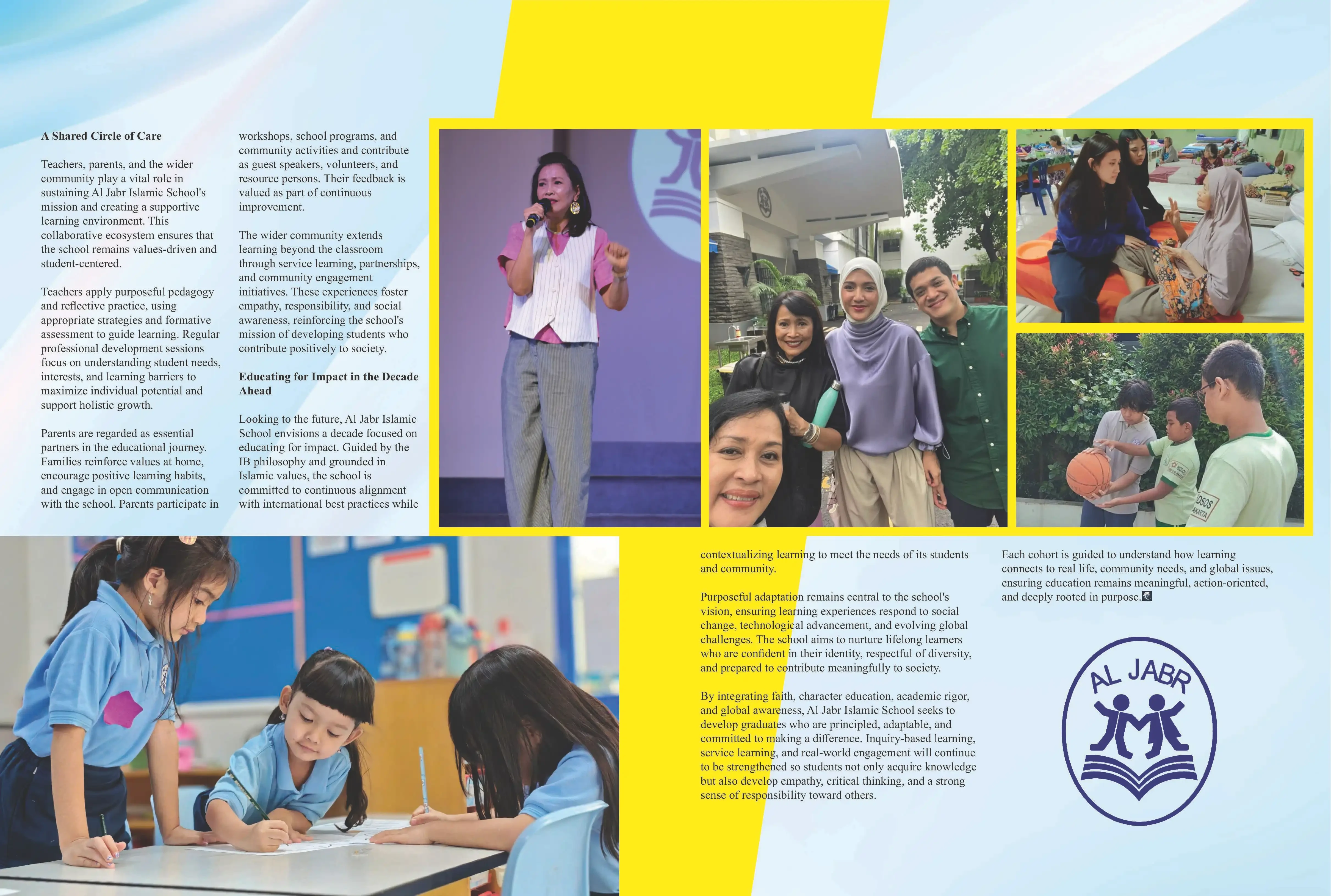
Parents are regarded as essential partners in the educational journey. Families reinforce values at home, encourage positive learning habits, and engage in open communication with the school. Parents participate in workshops, school programs, and community activities and contribute as guest speakers, volunteers, and resource persons. Their feedback is valued as part of continuous improvement.
The wider community extends learning beyond the classroom through service learning, partnerships, and community engagement initiatives. These experiences foster empathy, responsibility, and social awareness, reinforcing the school’s mission of developing students who contribute positively to society.
Looking to the future, Al Jabr Islamic School envisions a decade focused on educating for impact. Guided by the IB philosophy and grounded in Islamic values, the school is committed to continuous alignment with international best practices while contextualizing learning to meet the needs of its students and community.
Purposeful adaptation remains central to the school’s vision, ensuring learning experiences respond to social change, technological advancement, and evolving global challenges. The school aims to nurture lifelong learners who are confident in their identity, respectful of diversity, and prepared to contribute meaningfully to society.
By integrating faith, character education, academic rigor, and global awareness, Al Jabr Islamic School seeks to develop graduates who are principled, adaptable, and committed to making a difference. Inquiry-based learning, service learning, and real-world engagement will continue to be strengthened so students not only acquire knowledge but also develop empathy, critical thinking, and a strong sense of responsibility toward others.
Each cohort is guided to understand how learning connects to real life, community needs, and global issues, ensuring education remains meaningful, action-oriented, and deeply rooted in purpose.
Also Read :- Education Excellence Magazine For more information