

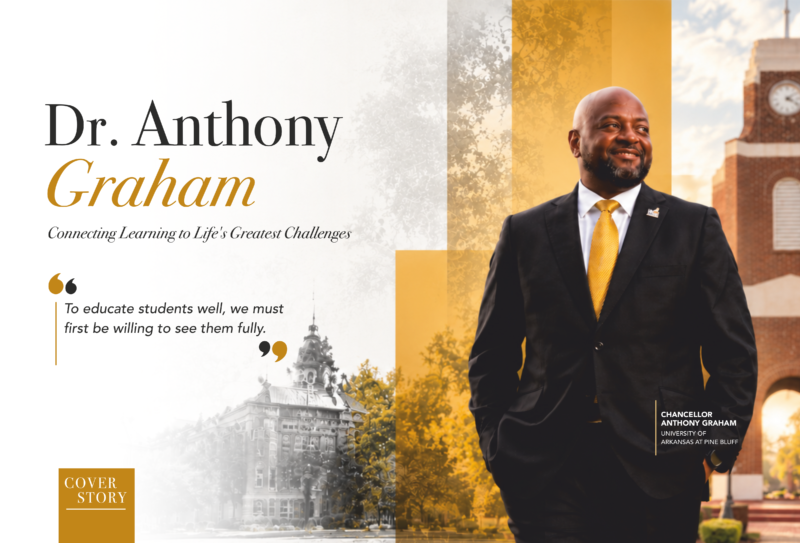
To educate students well, we must first be willing to see them fully
A student’s future is often shaped by moments that seem ordinary at the time. A teacher who refuses to lower expectations. A mentor who notices potential others overlook. An opportunity that arrives at just the right moment. Years later, those moments become turning points, opening doors that once felt out of reach and changing the direction of a life.
Dr. Anthony Graham has spent his career creating more of those moments. From the classroom to the chancellor’s office, his work has been guided by a belief that talent exists everywhere, but opportunity does not always arrive equally. As Chancellor of the University of Arkansas at Pine Bluff, he is focused on expanding what is possible for students, strengthening the institution’s impact on the communities it serves, and ensuring that education remains a pathway to growth, mobility, and meaningful change.
Reflecting on his years as a high school English teacher, Dr. Graham says, “The classroom also taught me that educators are powerful creators of climate.” That understanding continues to shape his approach to leadership today.
A Classroom Mindset That Never Left
Dr. Graham’s leadership philosophy is rooted in his early years as a high school English teacher, where he learned that education is fundamentally built on relationships. He believes students thrive when they feel seen, valued, and supported by educators who genuinely care about their growth and success. Drawing inspiration from Maya Angelou’s belief that people remember how they are made to feel, he has carried this perspective throughout his career.
At the same time, Dr. Graham emphasizes that care and support should never come at the expense of high expectations. In his view, the role of an educator is not only to encourage students but also to challenge them to discover capabilities they may not yet see in themselves. “We demonstrate our belief in students by maintaining high expectations while providing the support and opportunities they need to meet them,” he explains.
His classroom experiences also shaped his understanding of the educator’s responsibility in creating a positive learning environment. Influenced by Haim Ginott’s concept of the educator as the decisive element, Dr. Graham believes leaders have the power to inspire, encourage, and elevate those around them. Although his role has evolved from teacher to chancellor, he still views himself as an educator. The size of the classroom may have changed, but his purpose remains the same: creating conditions that allow people to learn, grow, recognize their potential, and use their talents to make a meaningful difference in the lives of others.
A Mission Aligned with Purpose
Dr. Graham was drawn to the University of Arkansas at Pine Bluff because of its rich history, powerful mission, strategic location, and tremendous potential. Its status as one of the nation’s 1890 land-grant institutions held particular significance for him, reflecting a mission that closely aligns with his own values and professional experiences.
His eighteen years at North Carolina Agricultural and Technical State University deeply shaped his understanding of the land-grant philosophy. During his progression from staff member and adjunct professor to dean, he witnessed firsthand how teaching, research, Extension, and community engagement can work together to improve lives and strengthen communities.
For Dr. Graham, leading UAPB represented far more than a career advancement. It was an opportunity to guide an institution whose purpose closely mirrors his commitment to transformative servant leadership. Situated in the Arkansas Delta, UAPB possesses a unique capacity to develop talent, generate knowledge, and address critical regional challenges. His vision is to build upon the university’s legacy while positioning it as a nationally recognized and preeminent 1890 land grant institution.
Putting Students at the Center of Every Decision
Upon assuming the chancellorship, Dr. Graham’s first priority was listening. Through conversations with students, faculty, staff, alumni, and community partners, he discovered a deep appreciation for UAPB alongside a collective desire to see the institution reach even greater heights.
These discussions reinforced one central principle: student success must remain at the heart of every institutional decision. Dr. Graham is deeply focused on the student experience, both inside and outside the classroom. He often begins meetings with a question inspired by higher education leader Paul LeBlanc: Are the decisions being made truly benefiting students?
This commitment guides a broader framework built around Direction, Alignment, and Commitment. Student success provides the direction, while institutional resources, policies, programs, and systems are aligned to support clearly defined outcomes. Shared commitment among stakeholders ensures effective execution of these goals.
Through this approach, Dr. Graham is advancing priorities that include academic excellence, research and innovation, institutional effectiveness, accountability, reputation building, and strategic partnerships. Ultimately, he seeks to cultivate a culture of ownership where every member of the university community contributes to advancing the institution’s mission and achieving measurable outcomes.
From Academic Silos to Collective Solutions
Dr. Graham believes that the most pressing challenges facing society cannot be addressed within the boundaries of a single discipline. Issues such as food security, artificial intelligence, environmental sustainability, rural health, and economic development require collaboration across multiple fields of expertise.
This belief has led him to champion a transdisciplinary approach to education and research. Rather than organizing learning solely around traditional academic disciplines, he advocates focusing on real world problems that universities are uniquely positioned to solve.
One example of this philosophy is Aquavision, an initiative led by UAPB’s Aquaculture and Fisheries Center of Excellence. The project combines aquaculture, computer vision, and machine learning technologies to identify microscopic indicators of disease in shrimp populations. Students from aquaculture, biology, and computer science work together on research with global significance.
Dr. Graham envisions a future where students possess both deep disciplinary knowledge and the ability to apply that knowledge across fields. Beyond technical expertise, he believes graduates must develop communication skills, critical thinking, creativity, technological fluency, ethical judgment, and adaptability. Success in the modern workforce requires the ability to integrate knowledge, navigate unfamiliar challenges, and create innovative solutions.
Creating Environments Where Every Student Can Flourish
Dr. Graham’s research on the educational experiences of Black male students and culturally responsive teaching has reinforced a fundamental belief: effective education begins with seeing students fully. He recognizes that students bring their identities, cultures, experiences, histories, and aspirations into every learning environment, and he views these characteristics as strengths rather than obstacles.
For Dr. Graham, culturally responsive education is not about lowering standards. Instead, it demands rigorous expectations and meaningful engagement. It requires educators to understand their students deeply enough to connect challenging academic content to their lived experiences while expanding their perspectives and opportunities.
Inspired by Haim Ginott’s observation that people grow when they are treated according to their potential rather than their current circumstances, Dr. Graham sees culturally responsive teaching as an act of belief in what students can become.
This philosophy challenges universities to examine how their environments support students from different backgrounds and life experiences. He rejects the idea of a one size fits all model and instead advocates for institutions that foster belonging, maintain high expectations, and cultivate authentic relationships.
Ultimately, Dr. Graham believes universities have a responsibility not to force students into a predefined mold, but to recognize who they are, nurture their strengths, and help them realize their fullest potential.
Creating the Conditions for Lasting Change
Dr. Graham believes that successful resource development begins with a clearly defined purpose. Rather than pursuing funding first and determining objectives later, he advocates establishing a compelling vision that identifies the problem to be solved, the communities that will benefit, and the outcomes that define success. Guided by the philosophy that where there is clear vision, there will be provision, he views resource development as an extension of institutional mission rather than a standalone objective.
Throughout his career, Dr. Graham has learned that transformational challenges cannot be solved by individual institutions working alone. Effective partnerships emerge when universities, communities, industry leaders, government agencies, and philanthropic organizations align their unique strengths around a shared purpose. Universities contribute expertise and innovation, communities provide lived experience, industry offers workforce and market insights, while public and philanthropic partners bring resources and influence.
He also emphasizes that sustainable transformation occurs when strategy leads and resources follow. In his view, meaningful partnerships are built at the intersection of institutional mission, public need, organizational capacity, and partner priorities. When stakeholders believe in a vision and trust an institution’s ability to execute it, external support becomes more than funding; it becomes a catalyst for long term impact and lasting change.
Building a Culture of Student Success
At UAPB, Dr. Graham has championed a broad and intentional definition of student success. While degree completion remains a critical goal, he believes success also encompasses the intellectual, personal, and professional growth students experience through academic, co-curricular, and experiential learning opportunities.
This philosophy shapes the university’s approach to retention, engagement, and graduation outcomes. UAPB has strengthened proactive advising systems, leveraged data to identify challenges earlier, and reviewed institutional policies to ensure they support rather than hinder student progress. The university is also creating clearer pathways that help students complete their degrees in four years or less, reducing both financial and academic obstacles.
Dr. Graham views the entire campus as a learning environment. Investments in facilities such as the Student Engagement Center and the Track and Soccer Complex, along with ongoing campus improvements, are designed to foster belonging, wellness, engagement, and growth. At the same time, UAPB is preparing students for a rapidly evolving technological landscape through initiatives like the Center for Artificial Intelligence and Data Analytics, which integrates emerging technologies and data science across academic disciplines.
Experiential learning remains a central component of this strategy. Through internships, cooperative education, undergraduate research, leadership opportunities, and community engagement experiences, students gain practical skills and real world exposure. Dr. Graham firmly believes that student success is a shared responsibility, requiring every member of the university community to understand how their work contributes to student development and achievement.
Reimagining Higher Education for a New Era
As higher education faces demographic shifts, technological advancements, and changing student expectations, Dr. Graham sees a significant opportunity for institutions to rethink how they operate and deliver value.
Drawing on systems thinking, he often reflects on the principle that every system is perfectly designed to produce the results it currently achieves. If universities are no longer generating outcomes that fully meet the needs of students, employers, and communities, he believes the solution is not simply working harder within existing structures. Instead, institutions must be willing to examine and redesign those structures.
Dr. Graham views artificial intelligence, workforce transformation, and evolving expectations around educational value as forces that are reshaping the higher education landscape. These changes require universities to prepare graduates who are adaptable, effective communicators, and capable of solving unfamiliar problems.
For him, reinvention is not optional but an essential responsibility. While preserving the fundamental mission of higher education, institutions must distinguish between enduring principles and outdated practices. Dr. Graham believes the coming decade will reward universities willing to move beyond diagnosing challenges and toward implementing meaningful, innovative solutions.
Expanding Access and Creating Pathways to Mobility
Dr. Graham often emphasizes that access without success represents an incomplete promise. For institutions such as UAPB, which were established to provide educational opportunities to historically underserved communities, opening doors is only the beginning of a much larger responsibility.
He believes universities must support students throughout their entire journey, from recruitment and enrollment to graduation and career preparation. This requires examining institutional processes that may unintentionally create barriers, particularly for first generation students and families who may be unfamiliar with higher education systems.
Recognizing that students arrive with diverse experiences, responsibilities, and needs, Dr. Graham advocates for support systems that reflect those differences. He believes institutions must be flexible and responsive in helping students navigate their educational pathways.
Equally important is connecting educational access to economic and social mobility. Through internships, undergraduate research, career development initiatives, mentorship, and professional networking opportunities, students can translate academic achievement into meaningful opportunities after graduation. In Dr. Graham’s view, access creates opportunity, but student success determines how far that opportunity can reach.
Leading With Optimism and Purpose
According to Dr. Graham, an optimist is someone who believes that present conditions are not necessary determinants for future results. Dr. Graham sees optimism not as ignoring problems and being blind to realities but as a conviction that positive outcomes can be achieved by taking purposeful actions.
It is the cornerstone of Dr. Graham’s philosophy of transformational servant leadership. In times of uncertainty, a leader should be visible, open to communication, a careful listener, and a provider of vision to people.
Transformational philosophy is based on both ideas of servant leadership and the power of vision-driven change. Whereas servant leadership presupposes care and empowerment of people, transformational leadership implies inspiration, innovation, and tough decisions in certain cases.
The core of Dr. Graham’s philosophy is a strong conviction about educational power. Dr. Graham sees education as one of the most lasting symbols of optimism in society. Every educational opportunity for students means a belief in their ability to bring positive changes in the future. Education provides not only knowledge but also inspires aspirations and transforms opportunities.
Chancellor Anthony Graham | University of Arkansas at Pine Bluff
“Students need to know that you see them, believe in their capacity, and are genuinely invested in their success.”
“We demonstrate our belief in students by maintaining high expectations while providing the support and opportunities they need to meet them.”
“Student success must remain at the center of our institutional strategy.”