- April 16, 2026

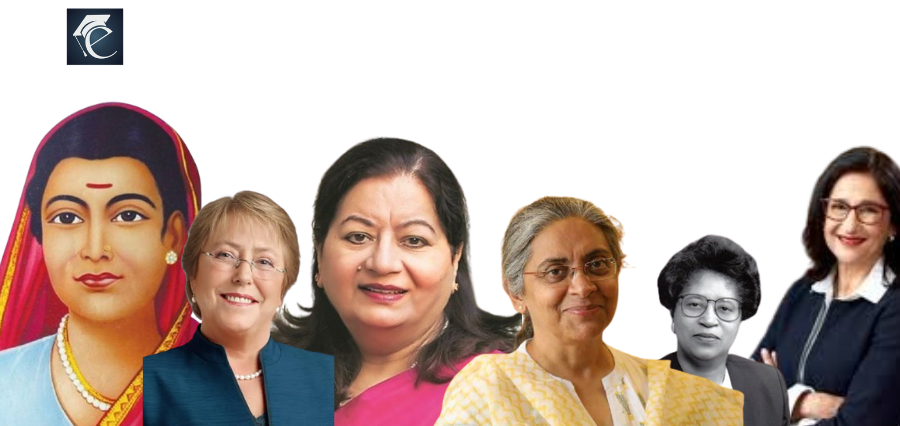
Education is one of the most powerful tools for personal and societal
growth, and the rise of women in education has significantly reshaped
institutions, policies, and leadership structures across the world. From
pioneering classroom teachers to university vice chancellors and global
education reformers, women have moved beyond traditional roles to occupy
positions of major influence within the academic ecosystem. The story of women
in education is not only about access to schooling but also about authority,
innovation, research, and institutional transformation. As we explore this
subject, we will also give list of sucessfull women who achieve very big
position with help of edcation within the education sector itself,
demonstrating how knowledge and academic commitment have propelled them to
remarkable heights.
The journey of women in education reflects determination, intellectual
excellence, and resilience. Historically, women were first allowed into
education systems primarily as learners at primary levels and later as
teachers. Over time, their participation expanded into research,
administration, curriculum development, and policy design.
Women initially entered the profession as schoolteachers, especially in
primary education. Teaching was considered an extension of caregiving roles.
However, as higher education became more accessible, women began earning
advanced degrees and entering universities as lecturers and researchers. This
marked the beginning of a powerful transformation.
Today, women serve as professors, deans, chancellors, researchers, and
policy advisors. Their leadership shapes institutional strategies, promotes
inclusive curriculum models, and strengthens research culture. Women in
education now influence global academic standards and quality benchmarks.
To understand the full impact of women in education, it is essential to
examine real examples. Below, we give list of sucessfull women who achieve very
big position with help of edcation and dedicated their professional lives to
advancing education systems.
One of the pioneers of the education of girls in India was Savitribai
Phule. Being the first woman teacher in the country, she founded schools with
girls and together with them, when there was great opposition towards female
education. Her personal education helped her to break the strict social
conventions and support equality. She established the premise of inclusive
education and has continued to be a shining example of valour and change in the
history of academia.
Dr. Najma Akhtar was the
Vice Chancellor of Jamia Millia Islamia, which is one of the best central
universities in India. She has academic qualifications in the field of
education and administration and was able to climb the ladder to the top in the
academic world to become the head of a nationally acclaimed institution.
Through her illustrious career, women in education can attain the highest
leadership in universities through excellence in education and management
skills.
Dame Minouche Shafik has
been a leading figure in academic leadership in various capacities, such as
President of Columbia University and Director of the London School of
Economics. Her learning background in economics helped her to transition to
international policy institutions to become a leader of the leading
universities. She is a representation of the worldwide spread of women in
education and their capability to impact both the academic and the economic
policy arena.
Dr. Shirley Ann Jackson
is the first African American woman to achieve a doctorate at Massachusetts
Institute of Technology. She was to become President of Rensselaer Polytechnic
Institute later on. Her education policy in higher education made research funding
stronger, increased access to STEM, and enhanced institutional quality. Her
experience can serve as a good example of how a successful academic performance
can lead to a leadership revolution.
The Chief Executive
Officer of Pratham Education Foundation is Dr. Rukmini Banerji, who has been
instrumental in enhancing basic literacy and numeracy in India. Having academic
training in development studies, she headed major-scale tests and grassroots programs
that shaped national policy in education. The example of her work indicates
that women in education can influence large education reform movements.
Despite her popularity in
the political sphere, Michelle Bachelet has never ceased promoting the policies
of education reforms and social inclusion. Her education in medicine was used
to influence her critical thinking when it came to governance and policymaking.
The overall effects of education in preparing women to assume influential
positions are traced in her career.
The expansion of women in education into leadership roles has
transformed how institutions function and evolve.
The focus of women
leaders in universities is usually on transparency, student involvement,
research growth, and community involvement. Their policies in governance often
incorporate social inclusion and fair access.
Women teachers have
established new progressive modes of pedagogies that emphasize on critical
thinking, experiential learning, and inclusive content. Female scholars have
spearheaded many reforms in the field of gender studies, child psychology, and
inclusive education.
Women with academic expertise are increasingly shaping national and
international education policies. Their research and advocacy influence funding
models, literacy programs, and digital learning initiatives.
Despite progress, barriers remain. Women are still underrepresented in
certain STEM leadership roles. The gender gap in research funding and top-tier
academic appointments continues in many regions. Societal expectations
sometimes limit career advancement opportunities, particularly in conservative
environments.
Balancing administrative leadership, research expectations, and personal
responsibilities can also present unique pressures. Addressing these issues
requires mentorship networks, equitable promotion systems, and strong
institutional commitment to gender parity.
When women in education are empowered, the benefits go way beyond the
campuses. Women leaders who have received an education shape the quality of the
curriculum, research advancement, and social policies. They make
non-discriminatory environments for future generations of students. They guide
the young scholars and create intellectual ecosystems that enhance critical
thinking and innovation.
The education of women leads to increased literacy, better institutions
and sustainable development of the country. Leadership in education that has
been influenced by different views creates more balanced and socially
responsible systems.
Women are being offered more opportunities by the future of education
through digital platforms, online degrees, and global scholarship programs,
which are expanding opportunities. There is an increase in the number of women
taking doctoral degrees and venturing into academic research. Universities are
establishing diversity programs to encourage inclusive leadership practices.
Technology is also providing women teachers with new possibilities to
impact global learners with the help of online teaching, open research
relations, and global scholarly cooperation. With more women taking up
leadership positions in the governance of higher education institutions,
institutional cultures are slowly changing to become more equitable.
One of the most important changes in the contemporary history of
academics is the emergence of Women in Education. Since the early feminist
activists, such as Savitribai Phule, up to the modern university heads and
policy makers, women have transformed the education system by scholarship,
administration, and movement. We observe a pattern as we give list of
sucessfull women who achieve very big position with help of edcation. Women can
overcome the limitations that have characterized them since time immemorial
through education, and earn their place in institutions, policies, and even
generations.
Women in education are not only educators. They are reformers,
strategists, researchers, and institutional architects. Their continued
advancement strengthens academic systems worldwide and ensures that education
remains a tool for equality, innovation, and societal progress.
Also Read :- Education Excellence Magazine for more information