

13th July 2026
Schools across the United Kingdom are struggling to protect pupils and staff as extreme summer temperatures expose the limitations of buildings that were not designed for prolonged heat.
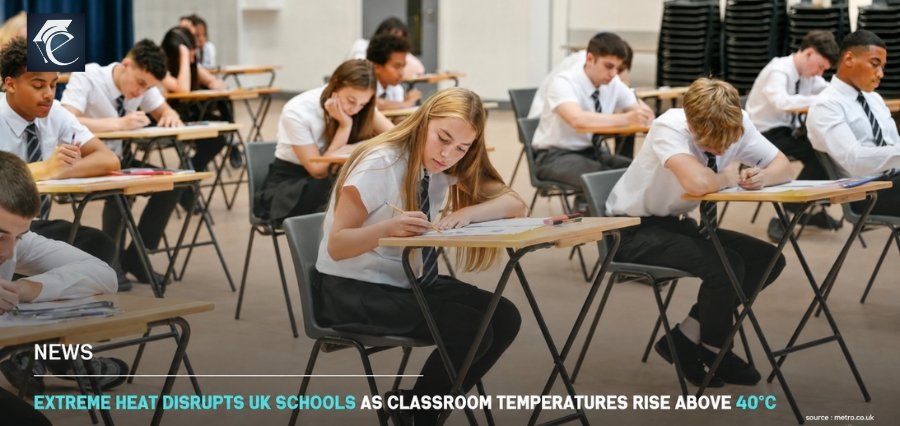
During the recent UK school heatwave, temperatures in some classrooms reportedly climbed above 40°C, leaving pupils and teachers experiencing headaches, nausea, exhaustion, and other symptoms associated with heat exposure. Some students and staff reportedly fainted, while teachers said maintaining concentration and normal classroom activities became increasingly difficult.
With many schools lacking air conditioning and adequate ventilation, staff have relied on temporary measures to keep children comfortable. Teachers described using wet paper towels to cool younger pupils, providing trays of water for students to place their feet in, and moving classes into shaded areas wherever possible.
The conditions have raised growing concerns about whether the country’s education infrastructure is adequately prepared for increasingly frequent periods of extreme heat.
Ageing School Buildings Intensify the Heat
The effects of the UK school heatwave have been worsened by the design and condition of many educational buildings. Older schools often have limited insulation, insufficient shade, large glass surfaces, and windows that do not provide effective ventilation.
Playgrounds made up of artificial turf, concrete, and tarmac are capable of absorbing and retaining heat, thus causing increased temperature levels around school buildings as well as depriving children of the chance of cooling down outside.
Many of the classrooms do not even feature air conditioning systems. Some of the teachers were known to spend their own money on acquiring fans and curtains in order to cool their classroom environment.
Climate change advisors for the UK government earlier in the year highlighted how much of the UK’s infrastructure was built with conditions that no longer existed in mind. They called for air conditioning to be installed in all schools within the next 25 years.
Teachers Turn to Emergency Cooling Measures
As temperatures continued to rise, educators were required to prioritize pupil safety over regular lessons. In some schools, children sat or rested on classroom floors with water bottles while lights were switched off to reduce additional heat.
The UK school heatwave significantly affected students’ ability to concentrate, participate, and retain information. Teachers reported that attention levels declined rapidly during the hottest periods, while tiredness and physical discomfort made normal learning increasingly difficult.
There were some schools that altered the uniform code, scaled down on physical activities, altered schedules, or restricted the use of hot classrooms. However, it has been claimed by the teachers that the temporary solutions are not a substitute for any permanent improvements to the infrastructural facilities at schools.
The Department for Education stated that the schools must be kept open in order to use the existing mechanisms to cope with extreme heat. These would include keeping the pupils hydrated, changing uniforms if needed, and not indulging in rigorous physical activity.
Parents Raise Concerns About Children’s Safety
There have been more and more concerns raised by parents about how extremely high temperatures might affect the health of children.
According to a survey conducted among 1,000 parents in the UK, more than 50% of them said their children missed a day at school during the heat wave of June. 40% of them mentioned that their children came back home exhausted after becoming overheated, whereas 46% of them stated that it is too hot to go outside.
Almost 2/3 of parents believe that summer in the country became unsafe for kids.
The findings suggest that the UK school heatwave is no longer being viewed solely as a temporary weather disruption. For many families, it has become part of a broader discussion about climate resilience, public infrastructure, and the ability of schools to provide safe learning environments during extreme conditions.
Calls Grow for Long-Term Climate Adaptation
An integrated national plan has been recommended by education and climate activists instead of leaving each institution to address the problem of high temperatures on its own.
These plans include insulation of buildings, use of ventilation and cooling systems, external shading, tree planting, reduction in the number of heat-storing areas, and redesigning school buildings for better air circulation.
The UK school heatwave is an example where infrastructure meant to store heat in winter may need drastic changes due to the increasing frequency of hot weather in summer.
Climate experts have also highlighted the importance of not only adapting to the changing climate but taking measures to cut down greenhouse gas emissions responsible for global warming. The western European region had its hottest June in 2026, while the UK was facing its third major heatwave of the year in July.
Extreme Weather Creates a New Challenge for Education
The increasing incidence of severe weather poses many problems for schools, which go far beyond the initial effects on the health of those involved. Extreme heat may have adverse implications for attendance, attentiveness, academic results, wellbeing of teachers, and continued education in general.
The most recent UK school heatwave has demonstrated the substantial gaps in the capability of schools to react to changes in the weather patterns. Some schools are equipped with state-of-the-art ventilation and air conditioning systems; others rely upon improvised solutions by teachers and staff.
Without any investments into their infrastructure in the long term, schools will be repeatedly interrupted during summer months, especially considering the forecast of increased periods of extremely high temperatures.
Therefore, the most recent UK school heatwave has emphasized the need to consider education facilities as one of the priorities in the climate adaptation plan of the country. Under current climatic conditions, it may become crucial to create classrooms where kids will be able to learn in safety.